验证数据展示
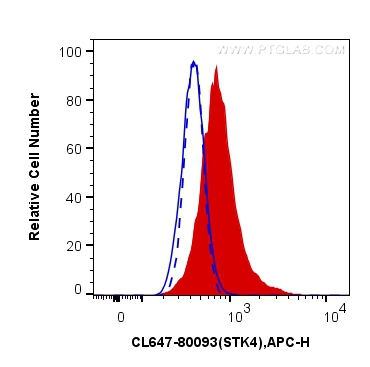
经过测试的应用
| Positive FC (Intra) detected in | Calyculin A treated HeLa cells |
推荐稀释比
| 应用 | 推荐稀释比 |
|---|---|
| Flow Cytometry (FC) (INTRA) | FC (INTRA) : 0.25 ug per 10^6 cells in a 100 µl suspension |
| It is recommended that this reagent should be titrated in each testing system to obtain optimal results. | |
| Sample-dependent, Check data in validation data gallery. | |
产品信息
CL647-80093 targets Phospho-MST1 (Thr183)/MST2 (Thr180) in FC (Intra) applications and shows reactivity with human samples.
| 经测试应用 | FC (Intra) Application Description |
| 经测试反应性 | human |
| 免疫原 |
Peptide 种属同源性预测 |
| 宿主/亚型 | Rabbit / IgG |
| 抗体类别 | Recombinant |
| 产品类型 | Antibody |
| 全称 | serine/threonine kinase 4 |
| 别名 | MST1 (Thr183)/MST2 (Thr180), p MST1 (Thr183)/MST2 (Thr180), Phospho MST1 (Thr183), Phospho MST1 (Thr183)/MST2 (Thr180), Phospho MST2 (Thr180) |
| 计算分子量 | 56 kDa |
| 观测分子量 | 59 kDa |
| GenBank蛋白编号 | BC005231 |
| 基因名称 | MST1 |
| Gene ID (NCBI) | 6789 |
| RRID | AB_2920328 |
| 偶联类型 | CoraLite® Plus 647 Fluorescent Dye |
| 最大激发/发射波长 | 654 nm / 674 nm |
| 激发激光 | Red Laser (633 nm) |
| 形式 | Liquid |
| 纯化方式 | Protein A purification |
| UNIPROT ID | Q13043 |
| 储存缓冲液 | PBS with 50% glycerol, 0.05% Proclin300, 0.5% BSA, pH 7.3. |
| 储存条件 | Store at -20°C. Avoid exposure to light. Stable for one year after shipment. Aliquoting is unnecessary for -20oC storage. |
背景介绍
Mammalian STE20-like serine-threonine kinase MST1, encoded by the STK4 gene, is a multifunctional protein. MST1 and its closest paralogs MST2 (encoded by the STK3 gene), MST3, and MST4 are members of the Class II Germinal Center Family of Protein Kinases . STK3/4 and LATS1/2 (large tumor suppressor 1 and 2) are core kinase components of the Hippo tumor suppressor pathway in mammalians . In the conventional Hippo pathway, the STK3/4 and LATS1/2 signaling cascade phosphorylates and inactivates the transcriptional coactivator YAP1 (yes associated protein 1) and its close paralog WWTR1]. YAP1 and WWTR1 do not have DNA binding domains and they exert their biological outputs, such as cell proliferation and survival, by interacting with the TEAD1-4 transcription factors. Lines of evidence have indicated that dysregulation or loss of STK4/Hippo signaling is linked to developmental disorders and carcinogenesis with poor prognosis. STK4 is a stress-induced kinase and it can be activated in response to cell-death inducers. Autophosphorylation of STK4 at Thr183 (Thr180 in STK3) in the activation loop is a key activation mechanism for STK4/3 because phosphorylation of Thr183/180 causes the cleavage of STK4 by caspases under apoptotic conditions. The caspase-cleavage results in a more active STK4 protein (STK4-N, an amino-terminally truncated STK4), which localizes into the nucleus and induces apoptosis through histone modifications and chromatin condensations.