FlexAble Oligo-Ready Antibody Labeling Kits
FlexAble Oligo-Ready 抗体标记试剂盒是Proteintech研发的一种新型抗体标记试剂盒,采用独有的FlexLinker®抗体标记技术专利,通过两步操作快速轻松制备寡核苷酸偶联抗体(Oligo-Antibody)。
-

每个抗体可标记1条或2条寡核苷酸
-
支持同种属多重标记
-
每个试剂盒可标记100 µg抗体
-
回收率达到60–80 %
-
单次反应可标记0.5 ug抗体
-
兼容多种缓冲液体系
工作流程:
1. 制备Oligo-FlexLinkers:
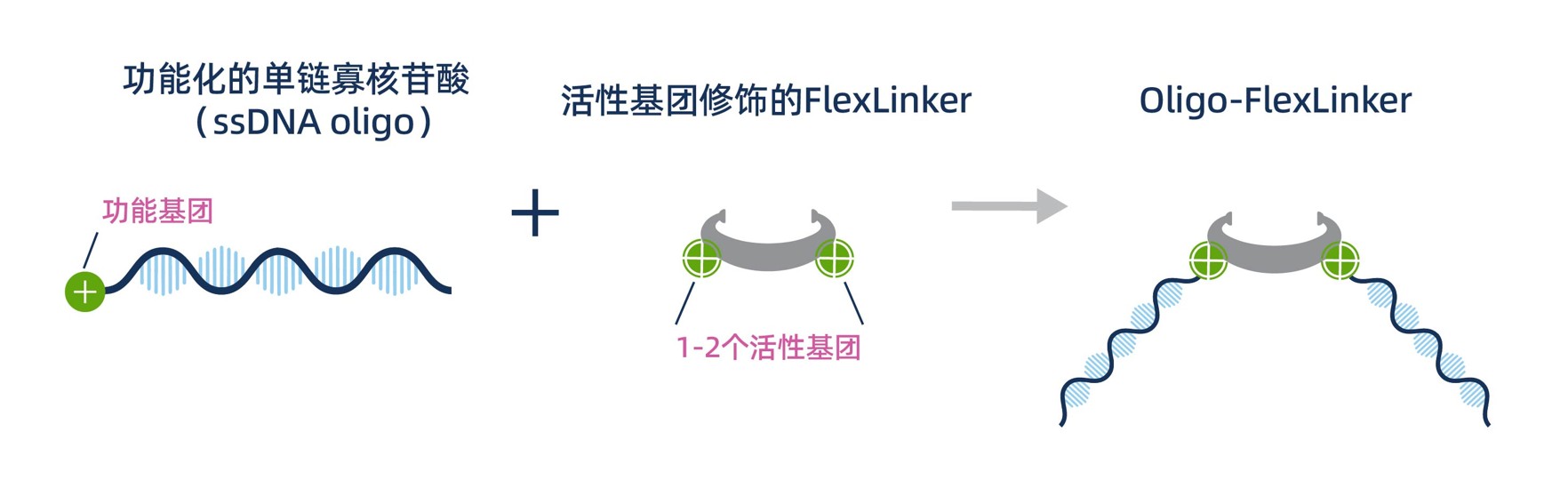
功能化(如, DBCO)的单链DNA寡核苷酸(ssDNA oligo)与带有活性基团(如, Azide)的FlexLinker,可发生Azide-DBCO的点击化学偶联反应,生成Oligo-FlexLinkers。 (该方案还包含一个清除步骤,用于去除多余的oligo)
- 1个试剂盒提供的FlexLinker足以用于将多达3种不同的oligo偶联到Linker 上(可扩展范围:3×33 µg至1×100 µg)。
- 此方案已包含了clean-up的步骤,用于去除反应体系中多余oligo。
- Oligo-FlexLinker的稳定性良好,可在–20℃下保存长达6个月。
2. 抗体标记(仅需15分钟)
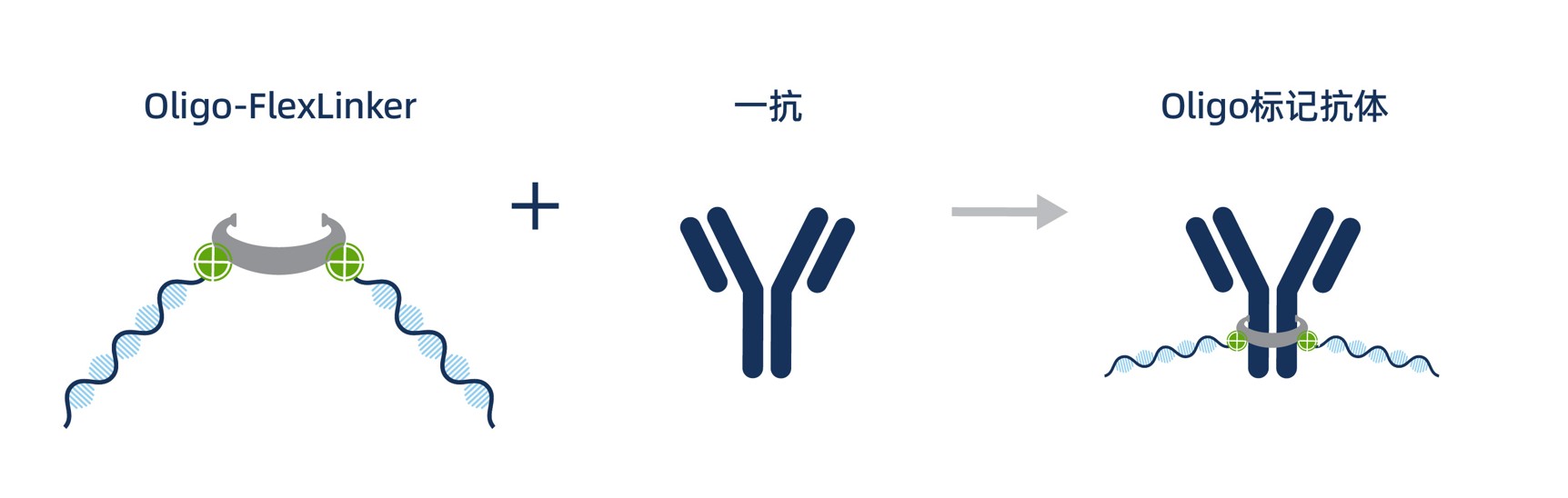
使用生成的Oligo-FlexLinkers对一抗进行标记,整个过程只需15分钟,操作简单,动手时间短。
- 1个试剂盒可制备足够的 Oligo-FlexLinker去标记100 µg一抗(或标记200种不同的一抗)。
- 每次反应最低可标记0.5µg一抗。
Ⅰ. FlexLinker具有种属和IgG亚型双重特异性,它可对一抗进行种属特异性、高亲和力的标记。
Ⅱ. 建议您在最终使用前再将Oligo-FlexLinker标记到一抗上,以确保Oligo-FlexLinker的活性和最佳性能。
产品目录
| 标记抗体类型 | DBCO-Azide基团数量 | 货号 | 规格 |
|---|---|---|---|
| Rabbit IgG | 1x DBCO-Ready | KFA150 | 100ug |
| 2x DBCO-Ready | KFA151 | 100ug | |
| Mouse IgG1 | 1x DBCO-Ready | KFA152 | 100ug |
| 2×DBCO-Ready | KFA153 | 100ug | |
| Mouse IgG2a | 1x DBCO-Ready | KFA154 | 100ug |
| 2x DBCO-Ready | KFA155 | 100ug | |
| Mouse IgG2b | 1x DBCO-Ready | KFA156 | 100ug |
| 2x DBCO-Ready | KFA157 | 100ug | |
| Human IgG | 1x DBCO-Ready | KFA158 | 100ug |
| 2×DBCO-Ready | KFA159 | 100ug | |
| Rat Kappa Light Chain | 1x DBCO-Ready | KFA160 | 100ug |
| 2×DBCO-Ready | KFA161 | 100ug |
提示:点击查看 用于 FlexLinker 偶联所需的其他试剂。
Oligo-Ready FlexLinkers与Oligo的偶联
微量标记
用多少标记多少。传统标记试剂盒通常要求一次性使用100 µg抗体,即使一些典型的免疫荧光(或其他)实验往往只需几微克抗体。而使用本试剂盒,您拥有充分地灵活性:先制备好FlexLinker,挑选想标记的抗体,并且一次反应最低可标记0.5 µg抗体。
多重检测
FlexAble技术支持同种属一抗的标记,让多重检测更便捷。
自建条码库
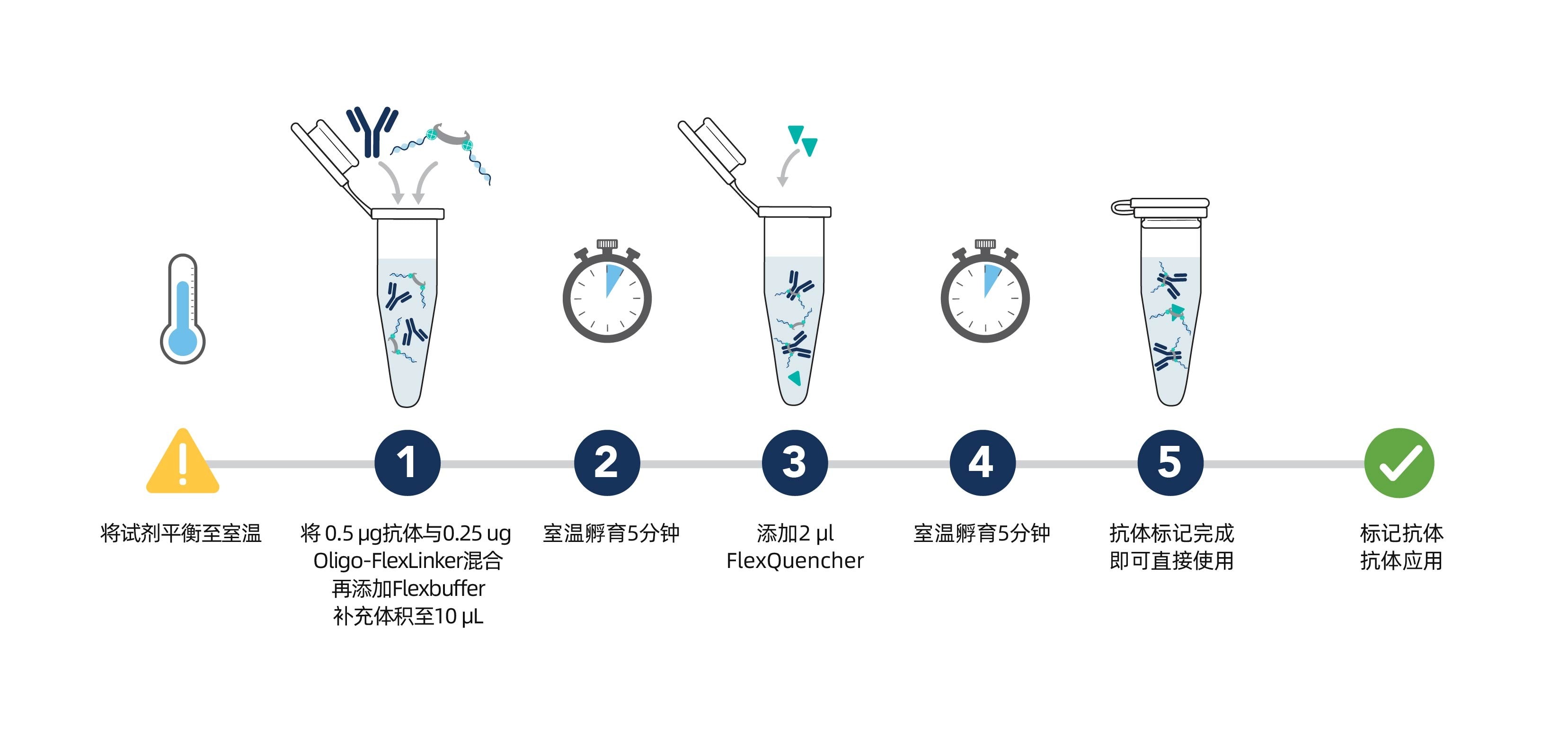
一个FlexAble Oligo-Ready抗体标记试剂盒至多可制备3种带不同寡核苷酸(oligo)的 Oligo-FlexLinker,助您快速搭建专属条码库。所得Oligo-FlexLinker 稳定性佳,可在−20℃长期保存;后续用这些条码标记抗体仅需15分钟。
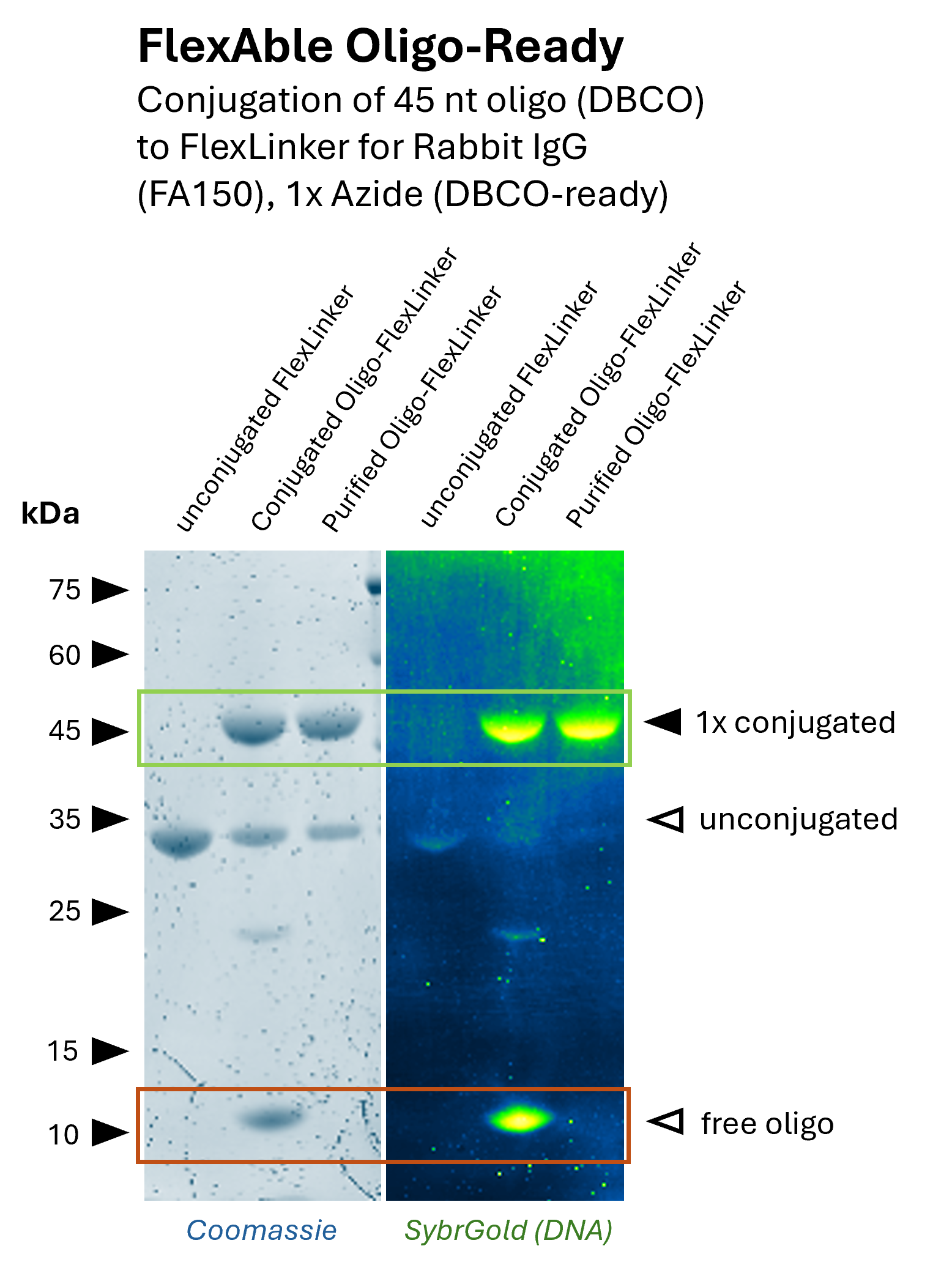
Oligo-Ready FlexLinker for rabbit IgG carrying 1 azide groups (FA150) was conjugated with a 45 nt long DBCO functionalized oligonucleotide to generate an Oligo-FlexLinker. Lane 1 shows unconjugated FlexLinker. Lane 2 shows successfully conjugated FlexLinker, the SybrSafe stain shows both conjugated Linker and excess oligo in this fraction. Lane 3 shows the purified Oligo-FlexLinker after removal of excess DNA. Absence of free oligo indicates a clean Oligo-FlexLinker that is ready for antibody labeling.
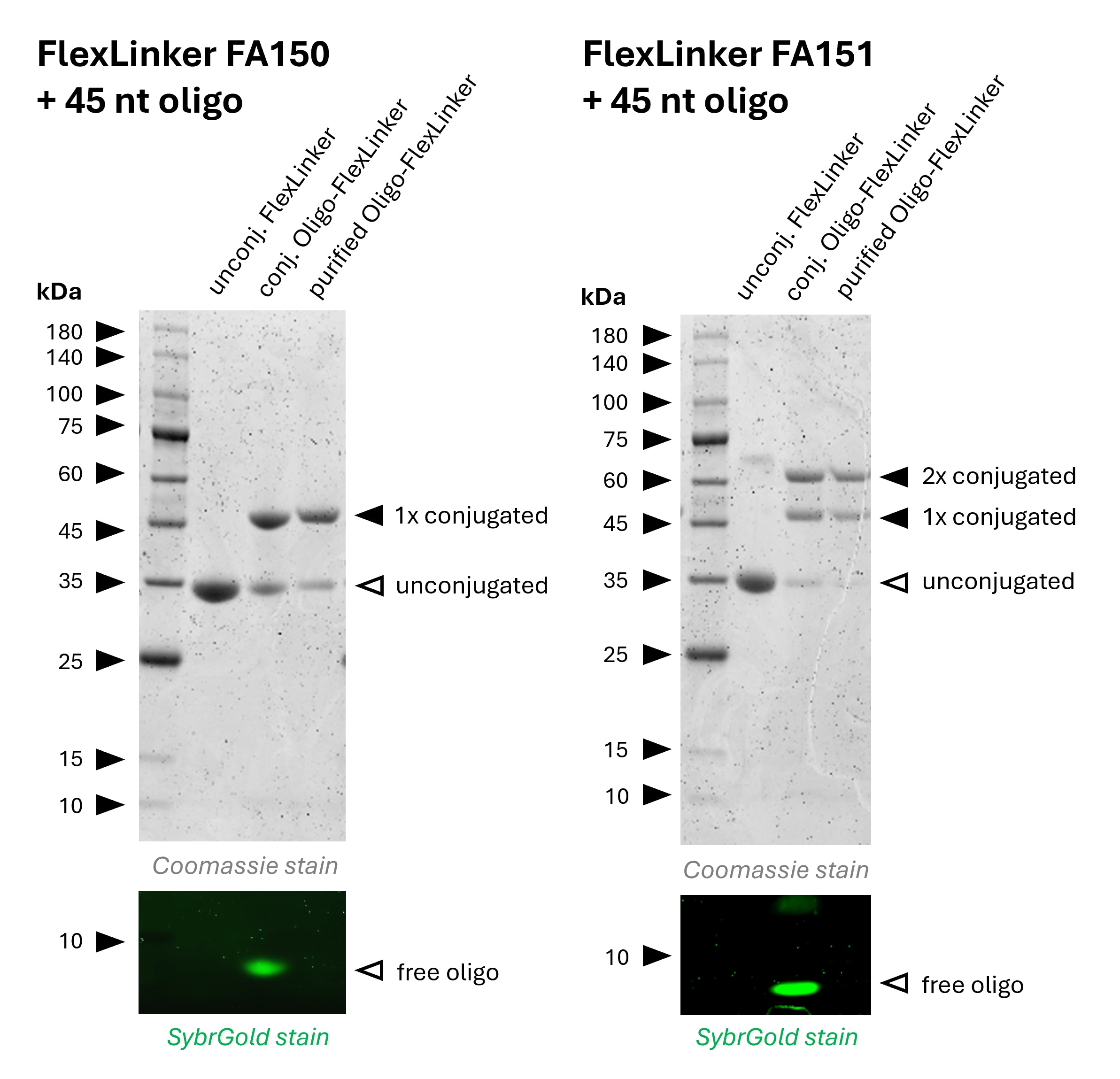
Oligo-Ready FlexLinkers for rabbit IgG carrying 1 or 2 azide groups (FA150 & FA151 respectively) were conjugated with a 45 nt long DBCO functionalized oligonucleotide to generate Oligo-FlexLinkers. Lane 1 shows unconjugated FlexLinker. Lane 2 shows successfully conjugated FlexLinker, the SybrGold stain shows excess oligo in this fraction. Lane 3 shows the purified Oligo-FlexLinker after removal of excess DNA. Absence of free oligo indicates a clean Oligo-FlexLinker that is ready for antibody labeling.
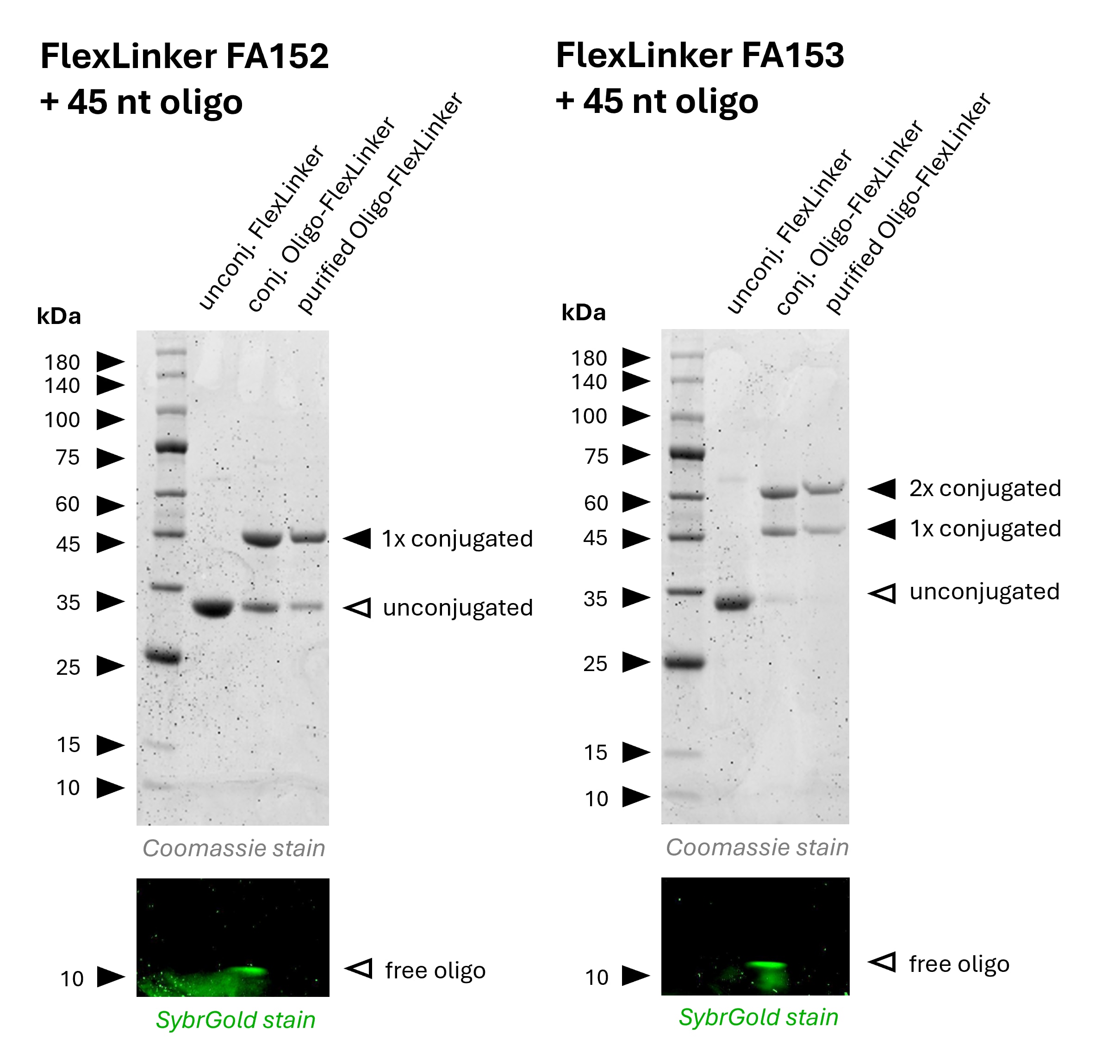
Oligo-Ready FlexLinkers for mouse IgG1 carrying 1 or 2 azide groups (FA152 & FA153 respectively) were conjugated with a 45 nt long DBCO functionalized oligonucleotide to generate Oligo-FlexLinkers. Lane 1 shows unconjugated FlexLinker. Lane 2 shows successfully conjugated FlexLinker, the SybrGold stain shows excess oligo in this fraction. Lane 3 shows the purified Oligo-FlexLinker after removal of excess DNA. Absence of free oligo indicates a clean Oligo-FlexLinker that is ready for antibody labeling.
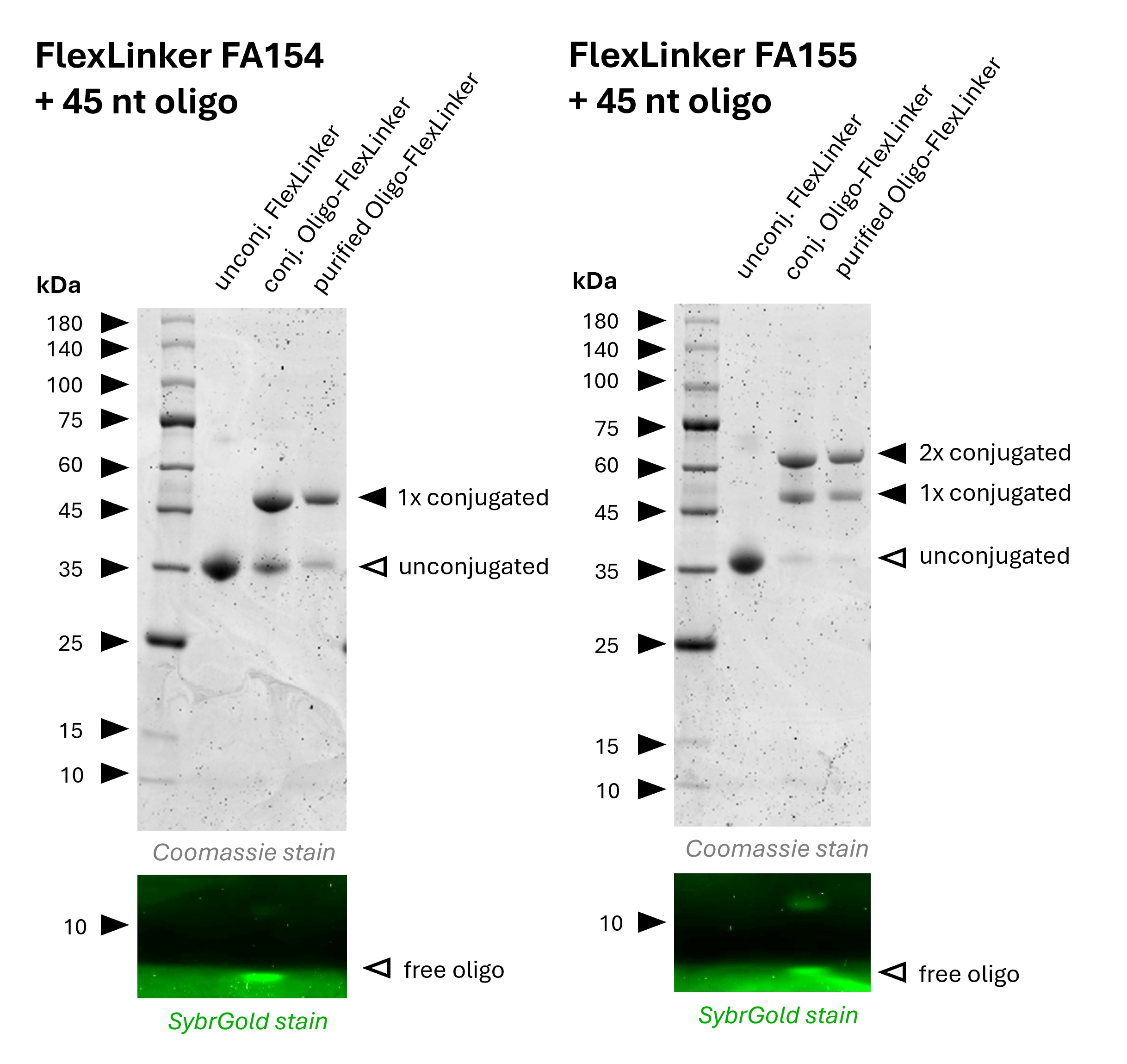
Oligo-Ready FlexLinkers for mouse IgG2a carrying 1 or 2 azide groups (FA154 & FA155 respectively) were conjugated with a 45 nt long DBCO functionalized oligonucleotide to generate Oligo-FlexLinkers. Lane 1 shows unconjugated FlexLinker. Lane 2 shows successfully conjugated FlexLinker, the SybrGold stain shows excess oligo in this fraction. Lane 3 shows the purified Oligo-FlexLinker after removal of excess DNA. Absence of free oligo indicates a clean Oligo-FlexLinker that is ready for antibody labeling.
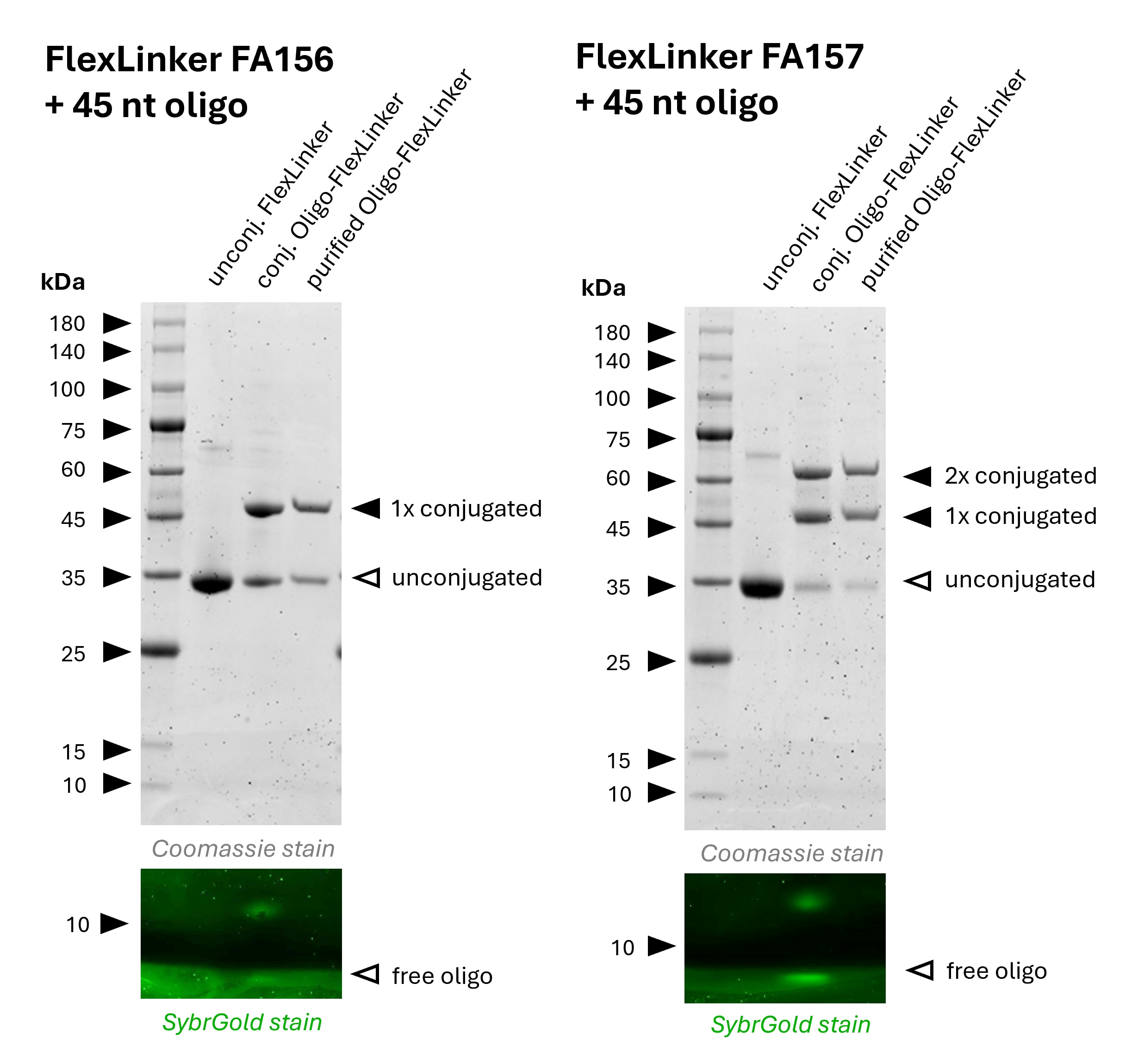
Oligo-Ready FlexLinkers for mouse IgG2b carrying 1 or 2 azide groups (FA156 & FA157 respectively) were conjugated with a 45 nt long DBCO functionalized oligonucleotide to generate Oligo-FlexLinkers. Lane 1 shows unconjugated FlexLinker. Lane 2 shows successfully conjugated FlexLinker, the SybrGold stain shows excess oligo in this fraction. Lane 3 shows the purified Oligo-FlexLinker after removal of excess DNA. Absence of free oligo indicates a clean Oligo-FlexLinker that is ready for antibody labeling.
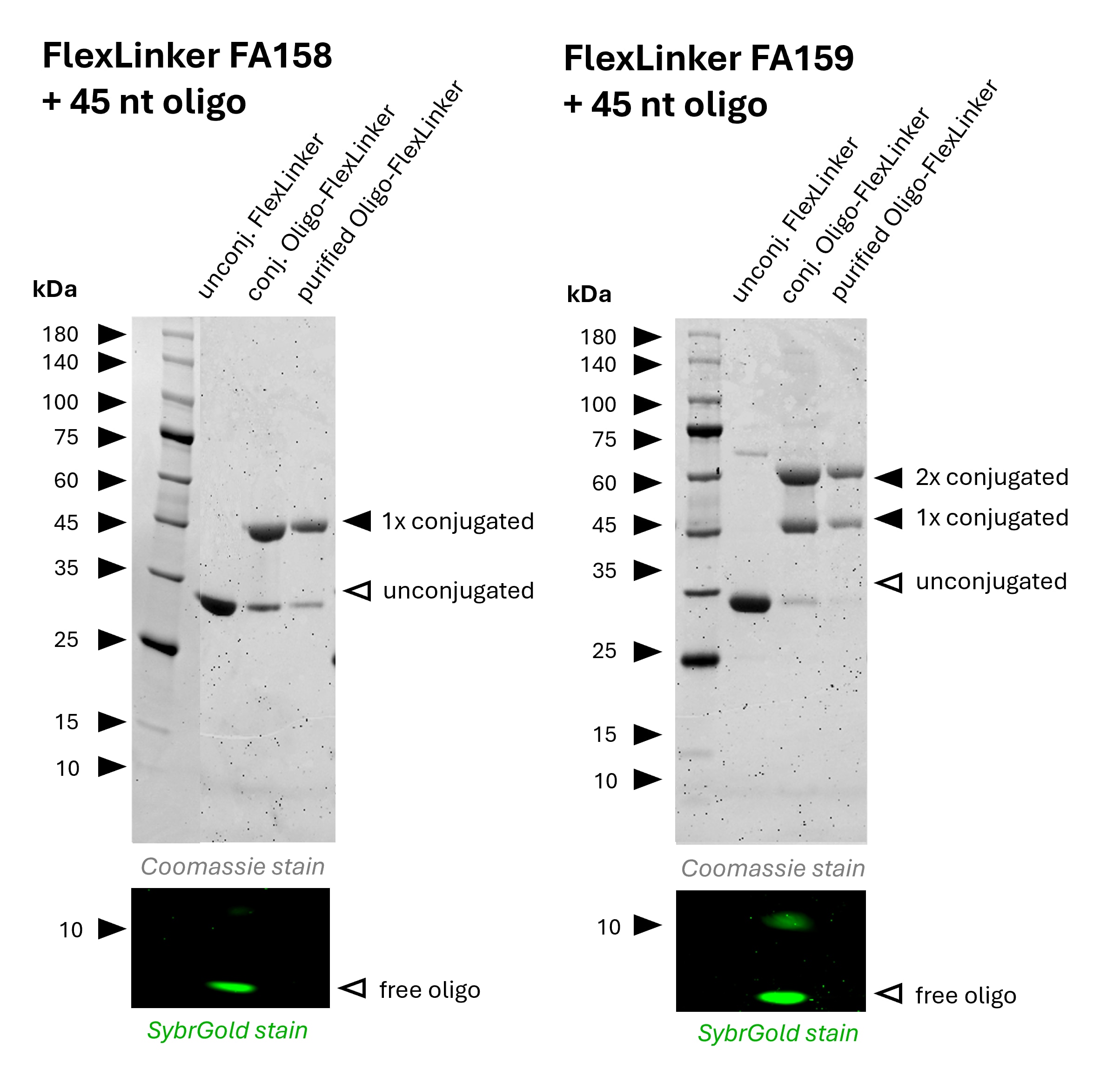
Oligo-Ready FlexLinkers for human IgG carrying 1 or 2 azide groups (FA158 & FA159 respectively) were conjugated with a 45 nt long DBCO functionalized oligonucleotide to generate Oligo-FlexLinkers. Lane 1 shows unconjugated FlexLinker. Lane 2 shows successfully conjugated FlexLinker, the SybrGold stain shows excess oligo in this fraction. Lane 3 shows the purified Oligo-FlexLinker after removal of excess DNA. Absence of free oligo indicates a clean Oligo-FlexLinker that is ready for antibody labeling.
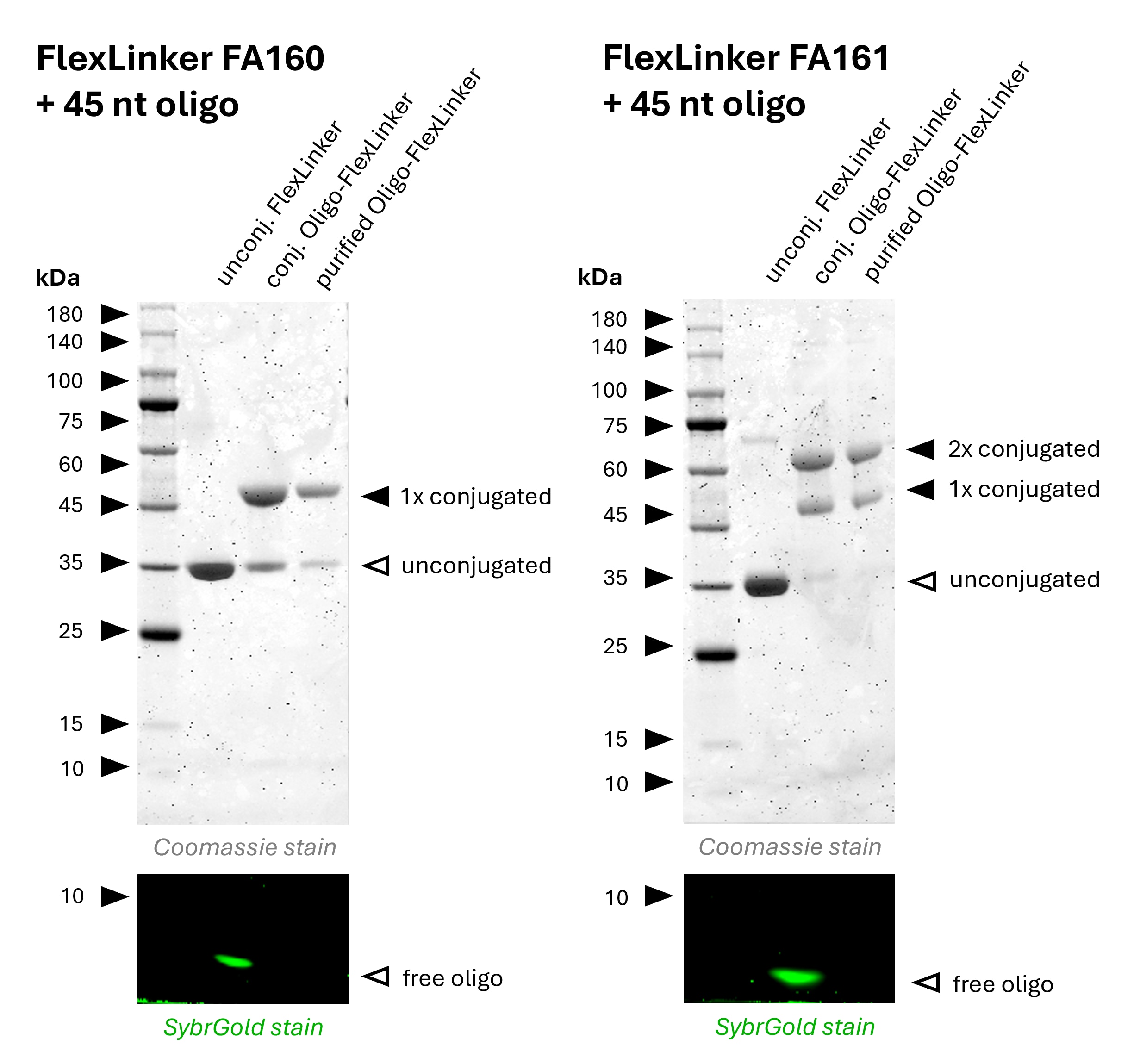
Oligo-Ready FlexLinkers for rat kappa light chain carrying 1 or 2 azide groups (FA160 & FA161 respectively) were conjugated with a 45 nt long DBCO functionalized oligonucleotide to generate Oligo-FlexLinkers. Lane 1 shows unconjugated FlexLinker. Lane 2 shows successfully conjugated FlexLinker, the SybrGold stain shows excess oligo in this fraction. Lane 3 shows the purified Oligo-FlexLinker after removal of excess DNA. Absence of free oligo indicates a clean Oligo-FlexLinker that is ready for antibody labeling.
使用Oligo-FlexLinker在15分钟内完成抗体标记
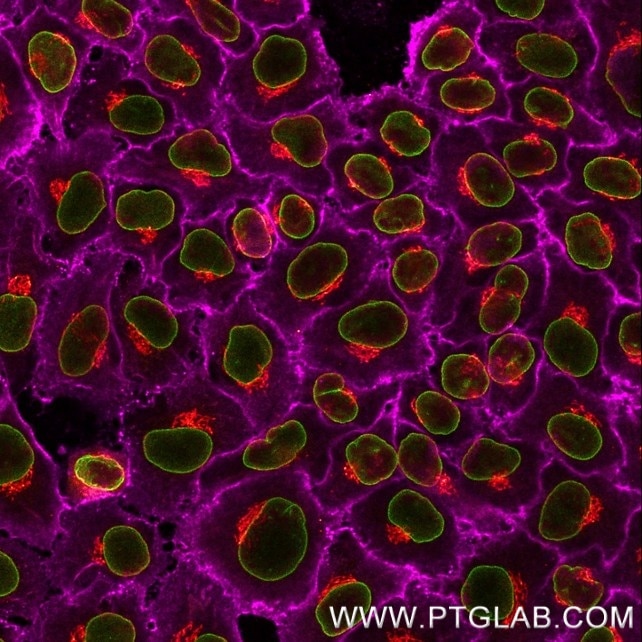
Immunostaining of HeLa cells with three rabbit antibodies - anti-CD147 (11989-1-AP, 1:200, magenta), anti-Lamin B1 (12987-1-AP, 1:200, green), and anti-GM130 (11308-1-AP, 1:200, red) - each labeled with a different 15-nt DNA oligonucleotide separately using KFA150 and KFA151 Kits. Detection was performed by hybridization with imaging DNA strands, carrying ATTO643/488/565 respectively.
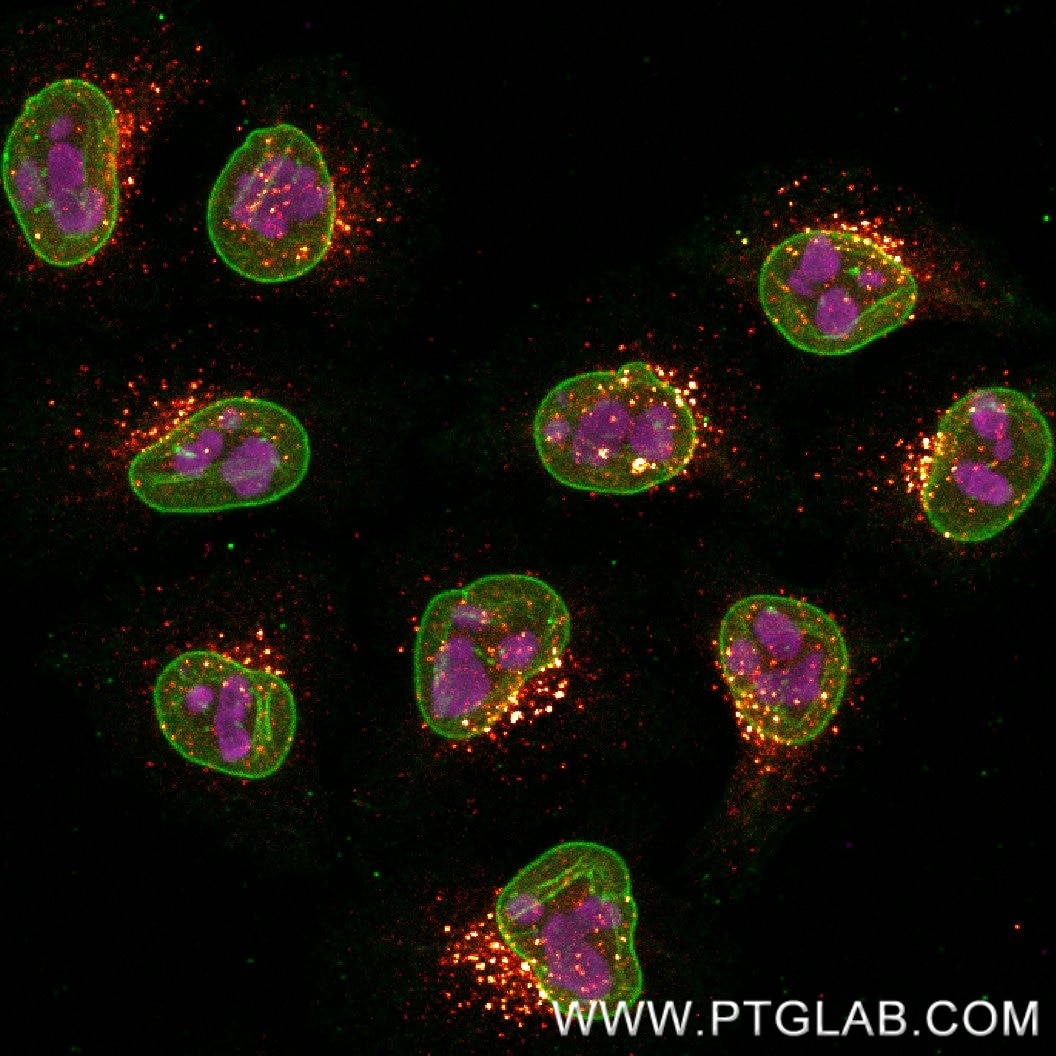
Immunostaining of HeLa cells with three mouse IgG1 antibodies - anti-B23 (60096-1-Ig, 1:500, magenta), anti-Lamin B1 (66095-1-Ig, 1:200, green), and anti-EEA1 (68065-1-Ig, 1:200, orange hot) - each labeled with a different 15-nt DNA oligonucleotide separately using KFA152 and KFA153 Kits. Detection was performed by hybridization with imaging DNA strands, carrying ATTO643/565/488 respectively. Confocal z-stack animation is shown.
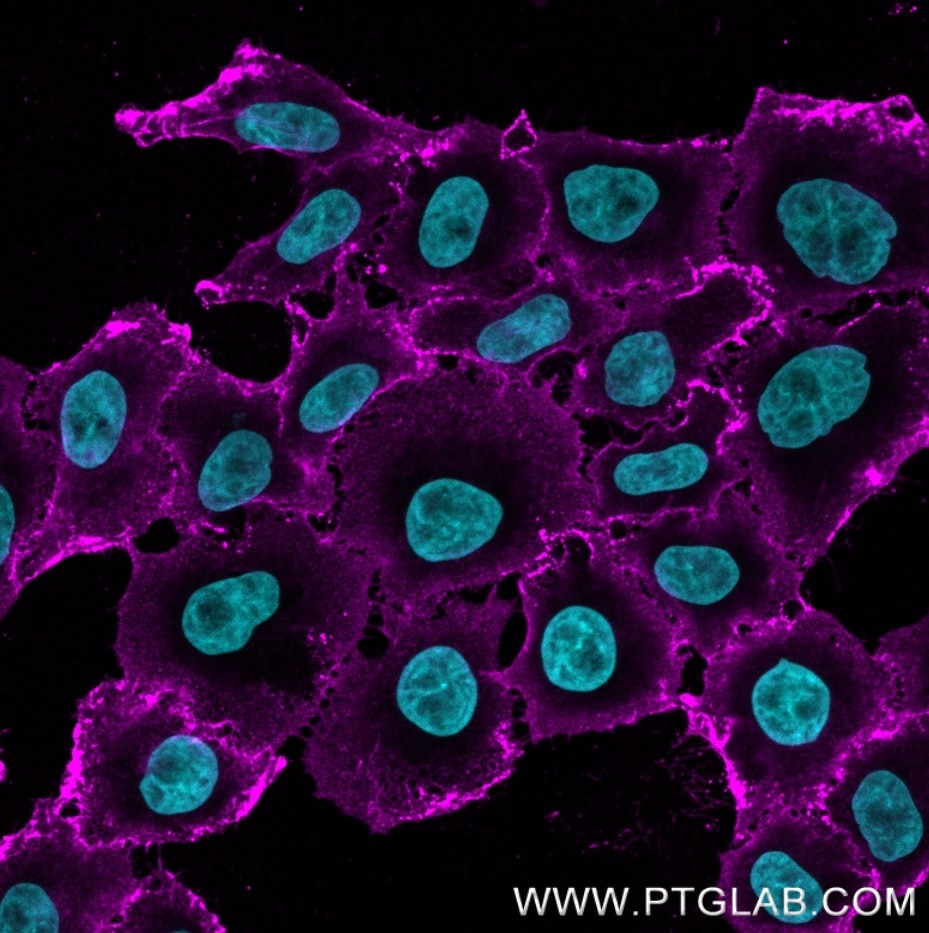
Immunostaining of HeLa cells with rabbit anti-CD147 antibody (11989-1-AP, 1:200, magenta), which was labeled with a 15-nt DNA oligonucleotide using the KFA150 Kit. Detection was performed by hybridization with an imaging DNA strand carrying ATTO643. Nuclei are stained with DAPI (cyan).
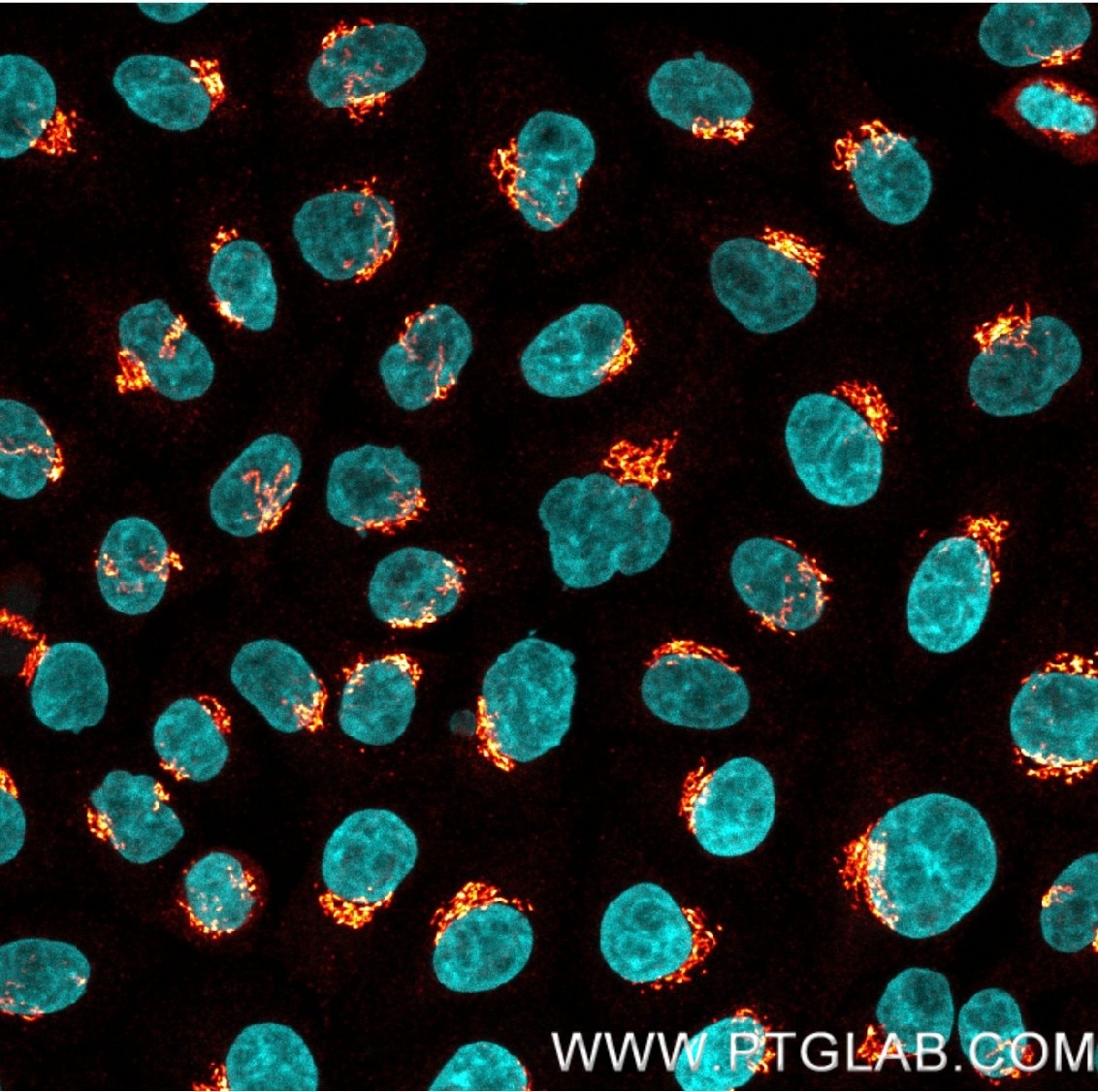
Immunostaining of HeLa cells with rabbit anti-GM130 antibody (11308-1-AP, 1:200, hot orange), which was labeled with a 15-nt DNA oligonucleotide using the KFA151 Kit. Detection was performed by hybridization with an imaging DNA strand carrying ATTO643. Nuclei are stained with DAPI (cyan).
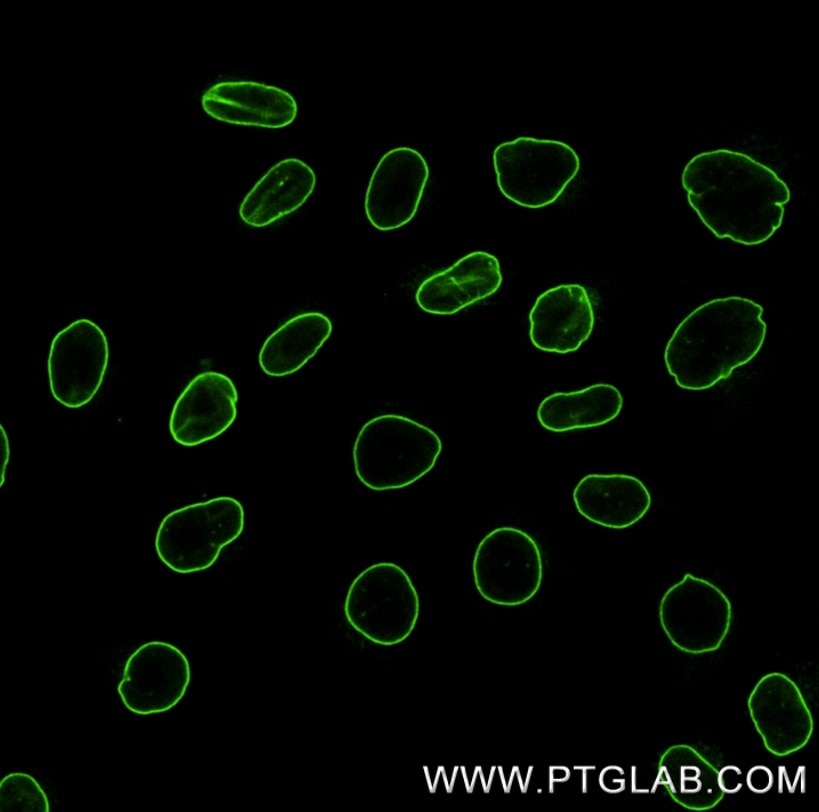
Immunostaining of HeLa cells with rabbit anti-Lamin antibody (12987-1-AP, 1:200, green), which was labeled with a 15-nt DNA oligonucleotide using the KFA151 Kit. Detection was performed by hybridization with an imaging DNA strand carrying ATTO488.
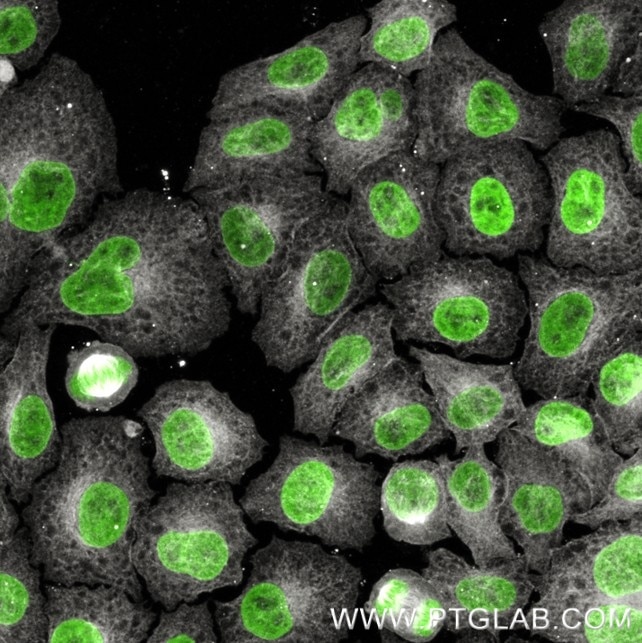
Immunostaining of HeLa cells with mouse IgG2b anti-Tubulin antibodies (66031-1-Ig, 1:100, grey), which was labeled with a 15-nt DNA oligonucleotide using the KFA157 Kit. Detection was performed by hybridization with imaging DNA strands carrying ATTO643. Nuclei are in green.
Oligo偶联抗体可应用于IF
每个FlexLinker可高效偶联1–2条寡核苷酸
Oligo-Ready FlexLinker 提供两种修饰版本:单反应基团和双反应基团(如叠氮)。该叠氮反应基团可与功能化的寡核苷酸(如DBCO修饰)发生点击化学反应而偶联。含有单个反应基团的FlexLinkers可生成标记度(DOL)精确为1的Oligo-FlexLinkers。含有两个反应基团的FlexLinkers可实现1至2之间的DOL。
实验过程包含游离oligo的清除
该实验流程包含一个专门的清除步骤,以确保未结合的Oligo不会进入下游应用。每个FlexLinker都带有His标签,以便与Ni-NTA Agarose进行选择性结合——多余的DNA Oligos会被冲洗掉,而Linker可用咪唑溶液洗脱。随后的换液步骤可去除咪唑,从而得到一个干净、即用型的Oligo-FlexLinker。
高回收率
在样本反应和纯化过程中,化学偶联常常导致大量的样品损失。我们的优化工艺最大限度地减少了这些损失,原料回收率通常能达到60–80%。
试剂盒包含的组分
| 组分 | 规格 | 用途 |
|---|---|---|
| FlexLinker | 50 µl(含100ug) | 与ssDNA oligo反应,生成Oligo-FlexLinker |
| FlexQuencher | 400 µl | 结合抗体标记反应中多余的Oligo-FlexLinker |
| FlexBuffer | 2 ml | 抗体标记反应的稀释缓冲液 |
| Spin columns | 3 pcs | 用于Oligo-FlexLinker的纯化 |
反应所需额外试剂
| 组分 | 所需量 | 用途 |
|---|---|---|
| 寡核苷酸 | 1x DBCO-ready:15 nmol (或5 nmol/ 33 µg) 2x DBCO-ready:30 nmol (或10 nmol/ 33 µg) | 与FlexLinker反应,生成Oligo-FlexLinker |
| Ni-NTA 琼脂糖珠 | 300 µl(或100 µl/33 µg) | 通过与FlexLinker上的His标签结合,清除多余oligo |
| PBS(无DNA酶) | 每次oligo-conjugation需5 ml | 用于清洗 |
| 咪唑(1M 储备液,无DNA酶) | 每次oligo-conjugation需1 ml | 用于洗脱 |
| 脱盐柱 | 每次oligo-conjugation需1个 | 在洗脱后用于去除咪唑 |
1. 一个FlexLinker可以接几条寡核苷酸?
我们提供2种FlexLinker类型,1×Oligo-Ready的FlexLinker可偶联1个寡核苷酸,然后再与抗体结合。2×Oligo-Ready的FlexLinker理论上可偶联2个寡核苷酸,但值得注意的是,2×Oligo-Ready连接产物中,连接体的DOL值会在1至2之间,具体数值取决于连接效率。如有特殊需求(如5个Oligos),我们可提供相应的定制服务。
2. 哪些抗体可以使用该试剂盒进行标记?
FlexAble Oligo-Ready抗体标记试剂盒几乎适用任何抗体。FlexAble标记方案不限抗体浓度,不限抗体缓冲液体系,兼容绝大多数供应商抗体,且标记之前无需进行抗体换液或纯化操作。
3. 还需要额外试剂或耗材吗?
需要。基础FlexAble Oligo-Ready抗体偶联试剂盒不包含Ni2+ beads、咪唑、脱盐柱等,需要自行准备。请参考上面的表格(包含和不包含试剂表)或手册。每个章节都为您列出所需组份的详细信息,基本都是实验室常备试剂和耗材。
4. 该试剂盒最低可标记多少抗体?
该试剂盒单次反应可标记低至0.5 µg的一抗。在制备好带有Oligo标记的FlexLinker后,您可以使用此产品对总共100 µg的一抗进行标记。每次反应最低只需0.5 µg的一抗,这样您就能最大限度地灵活标记少量抗体(每套试剂盒最多可完成200次0.5 µg抗体标记)。
5. 如何扩大或缩小反应规模?
中间产物(Oligo-FlexLinker):将目的oligo偶联到Oligo-Ready FlexLinker上;我们的100 µg试剂盒可用于生成多达3种不同的Oligo-FlexLinker(中间产物)。可根据实验需求灵活调整,偶联物可以从3×33 μg的FlexLinker扩展到1×100 μg的FlexLinker。
抗体的最终标记:使用Oligo-FlexLinker对一抗进行标记;标记量以0.5 µg一抗为最小反应单位,可按0.5 µg的倍数进行扩增。使用100 µg的试剂盒,一次反应可标记最多100 µg的抗体,也可以分成在200次小反应中标记200种不同的抗体(每次反应0.5 µg抗体)。
6. 该试剂盒能否制备超过3种不同的Oligo-FlexLinker?
不推荐制备超过3种Oligo-FlexLinker。我们的实验方案经过验证和优化,100 µg试剂盒可用于生成最多3种不同的Oligo-FlexLinker(中间产物)。该100 ug试剂盒制备Oligo-FlexLinker(中间产物)时需要至少5 nmol的Oligo与33 µg的Oligo-Ready FlexLinker进行偶联(即制备3种Oligo-FlexLinker),若使用量再减少会显著降低效率与得率。
7. 偶联完成后需要纯化吗?
抗体与Oligo-FlexLinker完成最终偶联后,不需要纯化。剩余游离的FlexLinker已被试剂盒提供的FlexQuencher中和;该方案的中间步骤还包含从FlexLinker中去除游离寡核苷酸的清除步骤。
8. 如何确认偶联成功?
建议在偶联过程中取样。SDS-PAGE可以估计Oligo-FlexLinker的偶联效率和产率;常规紫外分光光度法会因寡核苷酸的干扰而使测量数据不准确,因此建议使用BCA法对制备的Oligo-FlexLinker进行产品浓度测定。
9. 产物的稳定性如何?如何储存?
Oligo-FlexLinker:Oligo与FlexLinker偶联后(中间产物)稳定性好,可在−20℃条件下保存长达6个月,或在−80°C条件下保存长达2年。
最终标记抗体:用Oligo-FlexLinker标记一抗后,复合物的稳定性很大程度取决于所标记的抗体。我们建议现标现用,标记过程只需要15分钟;如果您需要将标记的抗体储存更长时间,建议在储存后进行实验前先验证活性以确保其正常功能。
10. FlexAble Oligo-Ready试剂盒适用什么样的oligo?
FlexAble Oligo-Ready试剂盒兼容不同长度和类型的oligo。
11. 该试剂盒中的FlexLinker,FlexQuencher和FlexBuffer是什么?
该试剂盒中的FlexLinker可与oligo偶联,制备Oligo-FlexLinker的中间产物,并最终将Oligo-FlexLinker连接到一抗,制备Oligo标记抗体。 FlexQuencher用于中和多余的Oligo-FlexLinker。FlexBuffer是一个基于PBS的缓冲液。
12. 需要去除未结合的Oligo-FlexLinker吗?
不需要。未结合的Oligo-FlexLinker通过添加FlexQuencher来封闭中和,在标记过程中不需要额外的去除步骤(例如,超滤)。
13. 如果在多重检测过程中使用来自同一种属的两种FlexAble标记抗体,是否存在交叉串色或者脱靶现象?
FlexAble产品用高亲和力的FlexLinker标记一抗,FlexLinker从一种抗体解离再结合到另一种抗体的概率极低。若仍发现串色,建议添加更多的FlexQuencher来中和从而去除游离的FlexLinker,或对标记后的抗体进行分开孵育。
14. FlexAble Antibody Labeling Kit for Mouse IgG1是否适用于其他小鼠亚型一抗?
不适用。该试剂盒为亚型特异性,仅识别Mouse IgG1的一抗。
15. 怎样做能减少背景?
可以减少FlexQuencher的用量或增加染色后的洗涤次数。
16. 使用的一抗浓度上限是多少?
对一抗浓度上限没有要求。若一抗浓度很高,导致移液体积过小,可将抗体在PBS缓冲液中稀释至0.5-1 mg/mL后再取用。
17. 使用的一抗浓度下限是多少?
我们的实验方案中使用的是0.5 µg一抗加7 µL buffer的体系,最终浓度为0.07 mg/mL。如果您的抗体浓度较低,在使用相同比例量的FlexLinker和FlexQuencher时,您也可以使用大于7 µL的体积。
18. 试剂反复冻融50次可以吗?
可以。FlexAble试剂盒在反复冻融过程中其信号依然稳定,仍能正常起作用,但是分装保存可进一步延长有效期。