
Spot Capture and Detection System
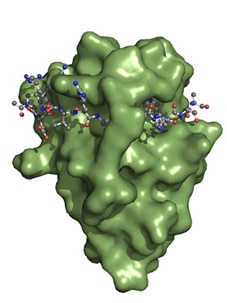
Interaction of Spot-Nanobody (green) with Spot Peptide. The soluble accessible surface of the Spot VHH is shown in green.
ChromoTek’s proprietary and novel Spot-System is the first peptide-tag specific Nanobody for universal capture & detection applications. It comprises the Spot-Tag®, an inert 12 amino acid peptide-tag (PDRVRAVSHWSS), and Spot-Nanobodies that specifically bind to Spot-tagged proteins with high affinity.
Nanobodies against peptide tags
In general, Nanobodies tend to bind to native, discontinuous conformational epitopes (3-dimensional epitopes) rather than to linear peptide epitopes (2-dimensional epitopes). However, ChromoTek has managed to develop exceptional anti-Spot-Tag Nanobody next to anti-Myc Nanobody and anti-V5 Nanobody, which recognize small linear peptide tags, respectively.
Applications
- Immunoprecipitation (IP) / Co-IP: Spot-Trap
- Co-IP/MS: Spot-Trap and iST Spot-Trap Kit
- Protein purification: Spot-Cap
- Immunofluorescence: Spot-Label
- Western Blotting: Spot-tag antibody [28a5]
Introduction and binding mechanism
The Spot Nanobody, also termed Spot VHH, is derived from single-domain alpaca antibody fragments. The Spot Nanobody recognizes the Spot-Tag® sequence motif PDRVRAVSHWSS. Binding occurs when the Spot-Tag peptide is embedded on the surface of the Spot Nanobody and acts like a β-sheet extension of the Spot-VHH. Specificity is determined by interactions of the Spot-Nanobody’s side chains to the Spot-Tag peptide. Notably, the bound Spot-peptide is also clamped by two amino acid side chains of the Spot-Nanobody. This binding mechanism explains the high affinity of the Spot-Nanobody.
Spot-Nanobody is fully validated
- Recombinantly produced for constant high quality
- Sequence known
- Structure determined
- Binding mechanism understood
Spot-Nanobody is better performing in many capture and detection applications than other antibodies. Most of these antibodies are conventional IgGs, which may suffer from stability and size. Spot-Nanobody however is small size to better access the Spot-Tag epitope. In addition, Spot-Nanobody is very stable and binds to Spot-Tag even under harsh conditions. Non-IgG type affinity reagents for affinity-tags can’t be used for detection and imaging of tagged proteins, whereas Spot-Nanobody has an outstanding performance in immunofluorescence and Western blotting. Spot-Nanobody is the first Nanobody/ peptide-tag that was applied in super-resolution microscopy.
Key Features
- Small size of just 14.7 kDa or 2 nm
- High affinity binding of Spot-Tag with KD = 0.7 nM
- High chemical and thermal stability
with Tm = 65.1°C
- No contaminating heavy & light antibody chains
- Native elution with Spot-peptide & by pH shift
- Matrix can be regenerated
- Well characterized
- Optimized Nanobody for gentle elution at 4°C
Key Benefits
- Specific binding with low background
- Robust handling and stable in harsh conditions
- Native & non-native elution
- Highly specific binding
- Higher resolution
- Good epitope access & sample penetration
- Good detection limits
- Validated
- Effective purification of Spot-tagged proteins
Affinity Optimized Short Peptide Tag
The Spot-Tag® has the affinity-optimized 12 amino acid sequence PDRVRAVSHWSS. Spot-Nanobodies bind strongly to the Spot-Tag. The inert tag sequence can be added to the N-terminal and to the C-terminal side of the protein of interest. This works by PCR using modified primers or by using any of the Spot vectors offered . The expression of Spot-tagged proteins has been successfully tested in bacteria, yeast, mammalian cell lines, plant and insect cells.
Spot-Nanobody advantages compared to other antibodies:
- More robust & stable than IgG antibodies
- High affinity of 6 nM to Spot-tagged proteins and 0.7 nM to Spot-Tag
- Less background than other tested affinity resins
- Less unspecific binding than other tested capture and detection antibodies
- Higher resolution than conventional antibodies
- Better epitope accessibility and tissue penetration than conventional IgG antibodies
- Effective and gentle elution at 4°C (Spot-Cap)
Spot-Tag advantages compared to other peptide tags:
- Less negatively charged than FLAG®-, Myc-, and HA-tags
- Short
- Inert, unstructured tag does not interference with fusion protein structure and function
- Binding of a single tag
- Suitable for ubiquitination assays: comprises no lysine