验证数据展示
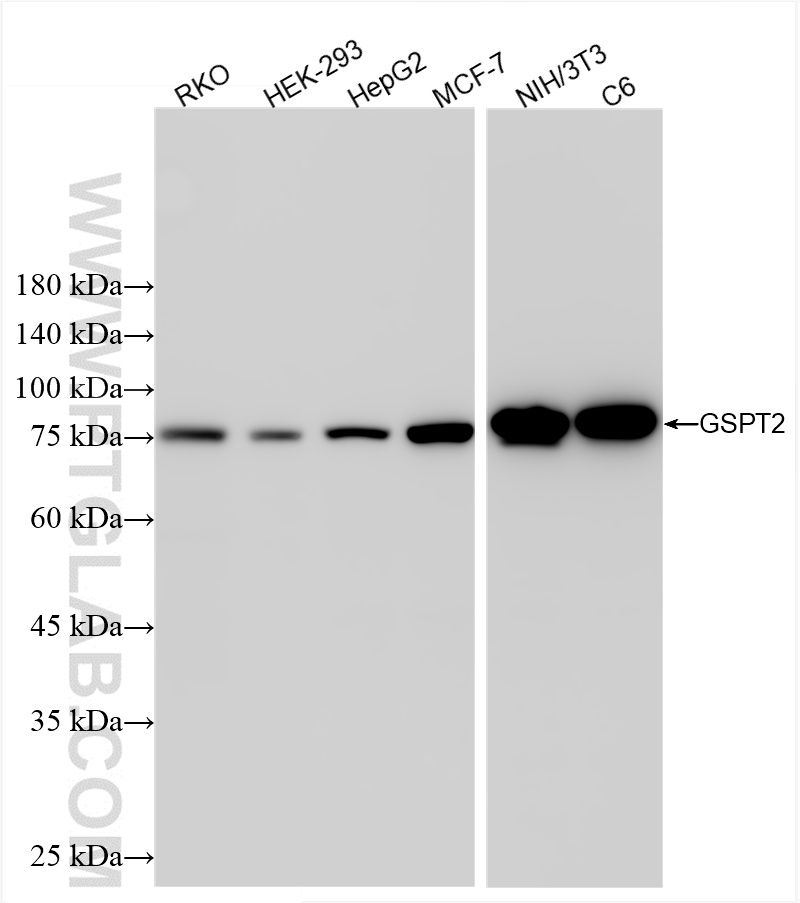
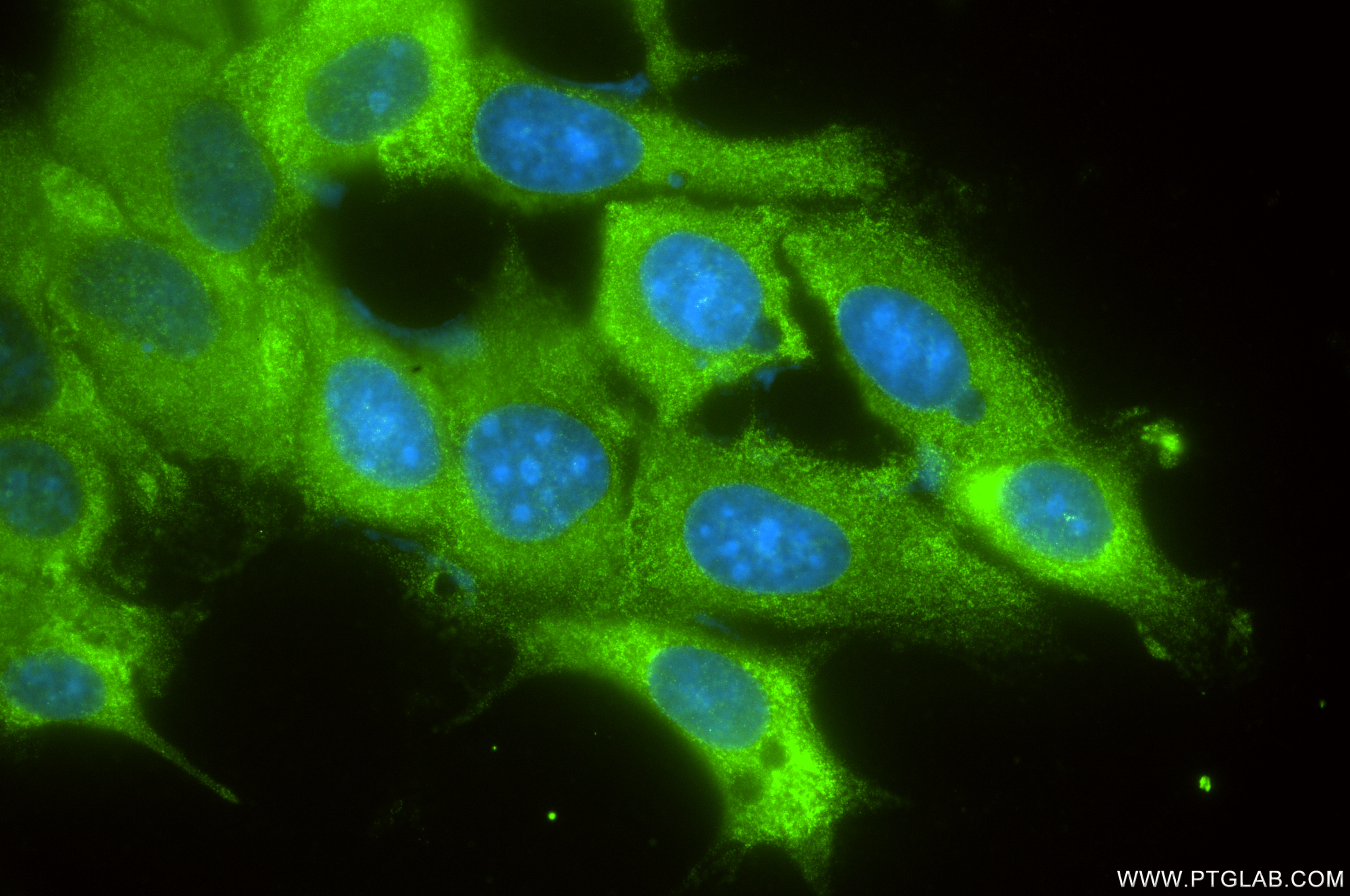
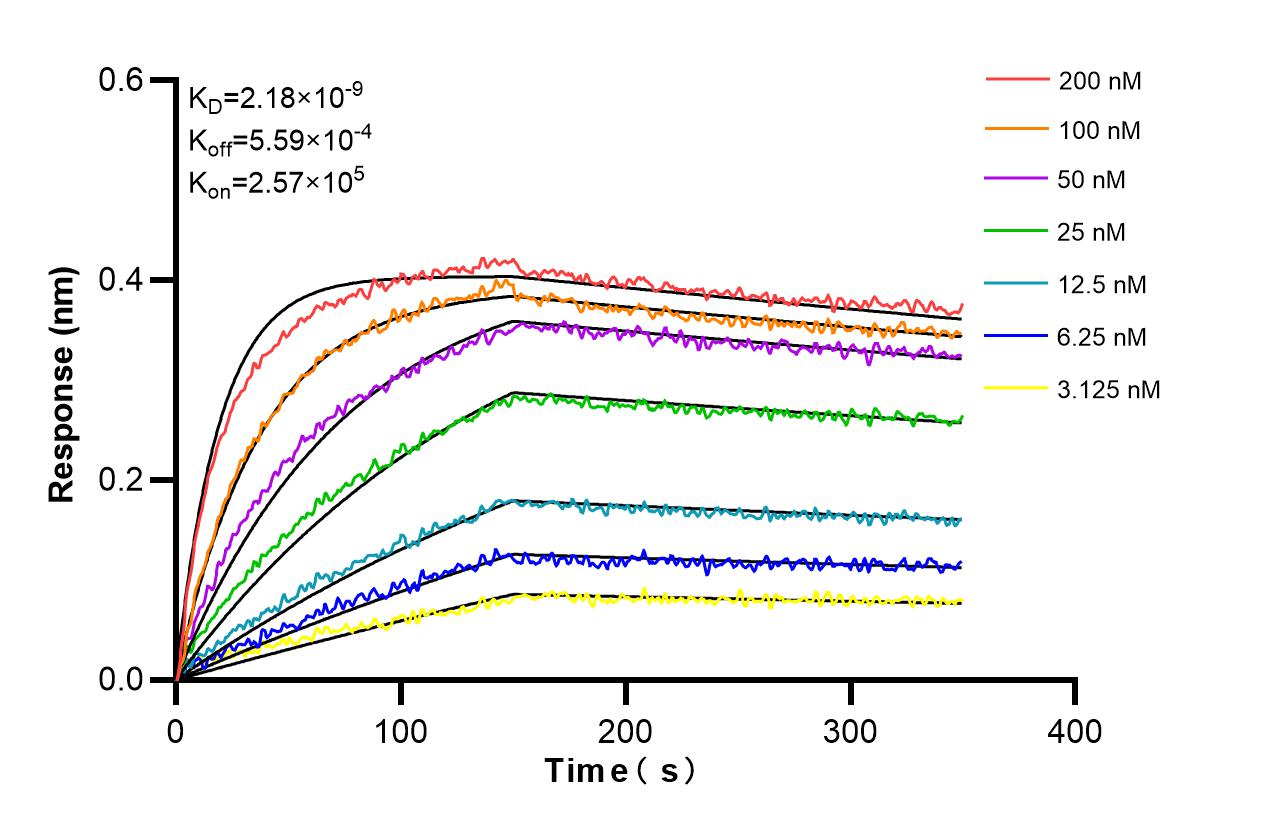
经过测试的应用
| Positive WB detected in | RKO cells, HEK-293 cells, HepG2 cells, MCF-7 cells, NIH/3T3 cells, C6 cells |
| Positive IF/ICC detected in | MCF-7 cells |
推荐稀释比
| 应用 | 推荐稀释比 |
|---|---|
| Western Blot (WB) | WB : 1:2000-1:10000 |
| Immunofluorescence (IF)/ICC | IF/ICC : 1:250-1:1000 |
| It is recommended that this reagent should be titrated in each testing system to obtain optimal results. | |
| Sample-dependent, Check data in validation data gallery. | |
产品信息
86508-3-RR targets GSPT2 in WB, IF/ICC, ELISA applications and shows reactivity with human, mouse, rat samples.
| 经测试应用 | WB, IF/ICC, ELISA Application Description |
| 经测试反应性 | human, mouse, rat |
| 免疫原 |
CatNo: Ag3641 Product name: Recombinant human GSPT2 protein Source: e coli.-derived, PGEX-4T Tag: GST Domain: 1-200 aa of BC036077 Sequence: MDSGSSSSDSAPDCWDQVDMESTGSAPSGDGVSSAVAEAQREPLSSAFSRKLNVNAKPFVPNVHAAEFVPSFLRGPTQPPTLPAGSGSNDETCTGAGYPQGKRMGRGAPVEPSREEPLVSLEGSNSAVTMELSEPVVENGEVEMALEESWEHSKEVSEAEPGGGSSGDSGPPEESGQEMMEEKEEIRKSKSVIVPSGAPK 种属同源性预测 |
| 宿主/亚型 | Rabbit / IgG |
| 抗体类别 | Recombinant |
| 产品类型 | Antibody |
| 全称 | G1 to S phase transition 2 |
| 别名 | EC:3.6.5.-, eRF3b, Eukaryotic peptide chain release factor GTP-binding subunit ERF3B, G1 to S phase transition 2, GST2 |
| 计算分子量 | 628 aa, 69 kDa |
| 观测分子量 | 69-75 kDa |
| GenBank蛋白编号 | BC036077 |
| 基因名称 | GSPT2 |
| Gene ID (NCBI) | 23708 |
| RRID | AB_3744933 |
| 偶联类型 | Unconjugated |
| 形式 | Liquid |
| 纯化方式 | Protein A purification |
| UNIPROT ID | Q8IYD1 |
| 储存缓冲液 | PBS with 0.02% sodium azide and 50% glycerol, pH 7.3. |
| 储存条件 | Store at -20°C. Stable for one year after shipment. Aliquoting is unnecessary for -20oC storage. |
背景介绍
GSPT2, also named as eukaryotic peptide chain release factor GTP-binding subunit ERF3B or G1 to S phase transition protein 2 homolog, is a 628 amino acid protein, which belongs to the GTP-binding elongation factor family ERF3 subfamily. GSPT2 localizes in the cytoplasm and is highly expressed in IUCC stage II colorectal cancer (CRC). GSPT2 is involved in translation termination in response to the termination codons UAA, UAG, and UGA and may play a role as a potent stimulator of the release factor activity of ETF1. It may play a role in cell cycle progression.
实验方案
| Product Specific Protocols | |
|---|---|
| IF protocol for GSPT2 antibody 86508-3-RR | Download protocol |
| WB protocol for GSPT2 antibody 86508-3-RR | Download protocol |
| Standard Protocols | |
|---|---|
| Click here to view our Standard Protocols |