验证数据展示
产品信息
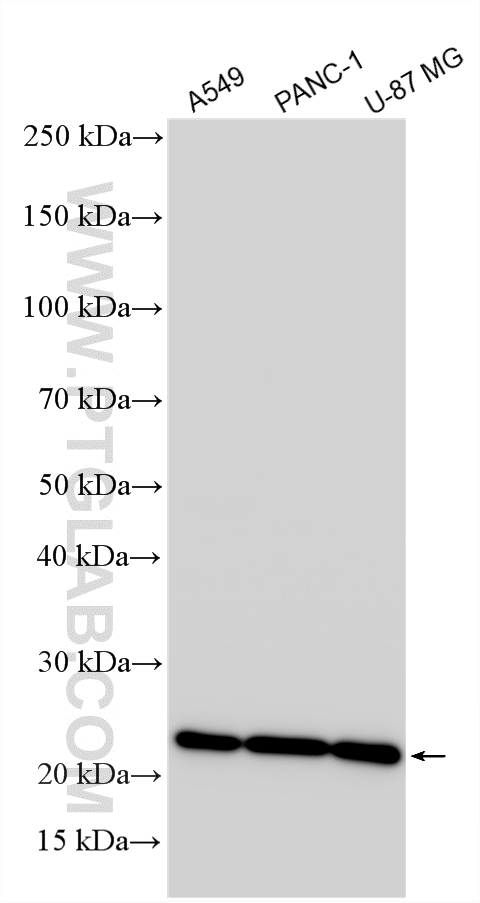
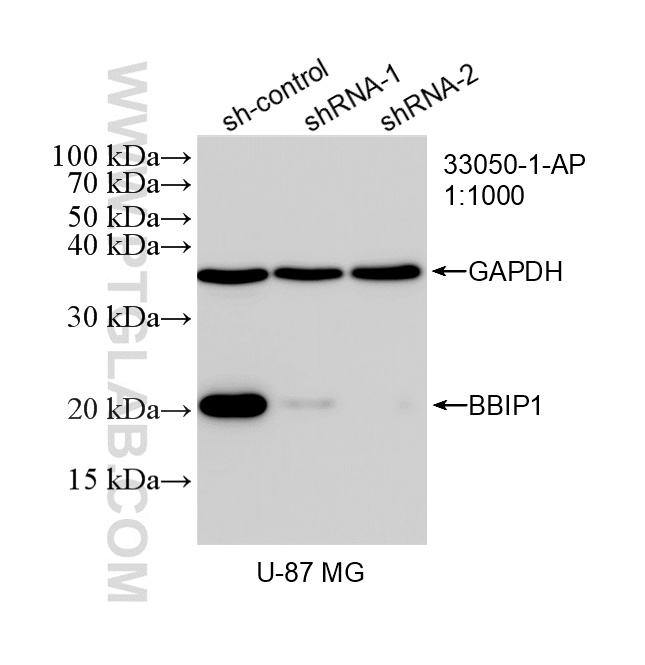
33050-1-PBS targets BBIP1 in WB, Indirect ELISA applications and shows reactivity with human samples.
| 经测试应用 | WB, Indirect ELISA Application Description |
| 经测试反应性 | human |
| 免疫原 |
CatNo: Ag36924 Product name: Recombinant human BBIP1 protein Source: e coli.-derived, PGEX-4T Tag: GST Domain: 1-92 aa of BC015550 Sequence: MLKAAAKRPELSGKNTISNNSDMAEVKSMFREVLPKQGPLFVEDIMTMVLCKPKLLPLKSLTLEKLEKMHQAAQNTIRQQEMAEKDQRQITH* 种属同源性预测 |
| 宿主/亚型 | Rabbit / IgG |
| 抗体类别 | Polyclonal |
| 产品类型 | Antibody |
| 全称 | non-protein coding RNA 81 |
| 别名 | BBIP10, BBSome Interacting Protein 1, BBSome-interacting protein 1, BBSome-interacting protein of 10 kDa, NCRNA00081 |
| 观测分子量 | 22 kDa |
| GenBank蛋白编号 | BC015550 |
| 基因名称 | NCRNA00081 |
| Gene ID (NCBI) | 92482 |
| RRID | AB_3742837 |
| 偶联类型 | Unconjugated |
| 形式 | Liquid |
| 纯化方式 | Antigen affinity Purification |
| UNIPROT ID | A8MTZ0 |
| 储存缓冲液 | PBS only, pH 7.3. |
| 储存条件 | Store at -80°C. The product is shipped with ice packs. Upon receipt, store it immediately at -80°C |
背景介绍
The BBIP1 protein is a key component of the BBSome complex and was identified due to its role in the pathogenesis of Bardet-Biedl syndrome (BBS). This protein localizes to the base of cellular cilia and plays an indispensable role in ciliary assembly, maintenance, and signal transduction. As an adapter for membrane protein trafficking, BBIP1 works in coordination with other members of the BBSome to precisely transport specific cargo proteins into the cilium, an important cellular organelle. Loss of its function disrupts the stability of the BBSome complex, leading to abnormalities in ciliary structure and function. This, in turn, causes various clinical symptoms of BBS, including retinal degeneration, obesity, and polydactyly. Therefore, research on BBIP1 is central to understanding the molecular basis of cilia-related diseases (ciliopathies).