
Validation Data Gallery
Product Information
The small size of VHHs (~15 kDa) enables access to epitopes that may be sterically inaccessible to full size IgGs. Their reduced steric hindrance also facilitates simultaneous staining of multiple targets, making them particularly useful for applications like Nano-Flow. MG-1230CC is an unconjugated recombinant anti-CD33 Nanobody (VHH). Suitable for for dual cysteine conjugation with thiol-reactive reagents, e.g. maleimides. Note: unconjugated VHHs are not suited for usage without prior labeling, since they contain reactive Cysteines. Shipment and storage buffers contain TCEP to keep Cysteines reduced.
| Applications | Conjugation |
| Reactivity | Human |
| Conjugate | Unconjugated |
| Type | Nanobody |
| Class | Recombinant |
| Host | Alpaca |
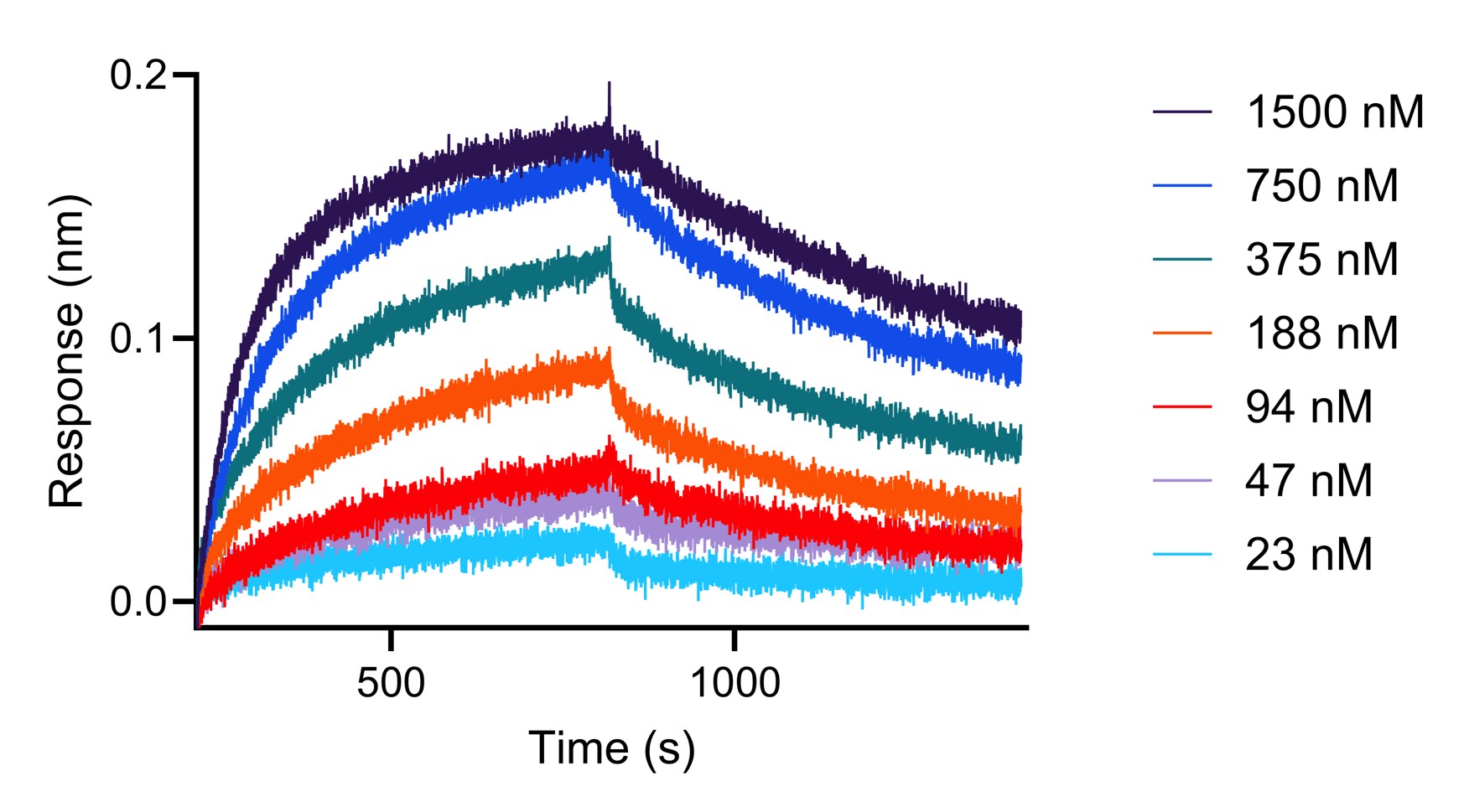
| Affinity | 270 nM |
| Clone | CTK0243 |
| Immunogen | 18-259 aa |
| Molecular Weight | 15.7 kDa |
| Form | Liquid |
| RRID | / |
| Storage Buffer | 10 mM HEPES pH 7.0, 500 mM NaCl, 0.09% sodium azide, 1mM TCEP |
| Storage Condition | Store at -20°C |
| Shipping | dry ice |
| Sizes | 250 µl / 500 µg |
| Background | CD33, also referred to as Siglec-3, is a 67-kDa glycosylated transmembrane protein of sialic acid-binding immunoglobulin-like lactic (siglec) family. CD33 is expressed on monocytes, myeloid progenitors, granulocytes, mast cells, some T cells. It may mediate cell-to-cell adhesion and act as a receptor that inhibits the proliferation of normal and leukemic myeloid cells. |
Documentation
| SDS |
|---|
| MG-1230_SDS_anti-CD33 VHH (EN) |
| Datasheet |
|---|
| anti-CD33 recombinant VHH, for 2x Cys conjugation Datasheet |
