验证数据展示
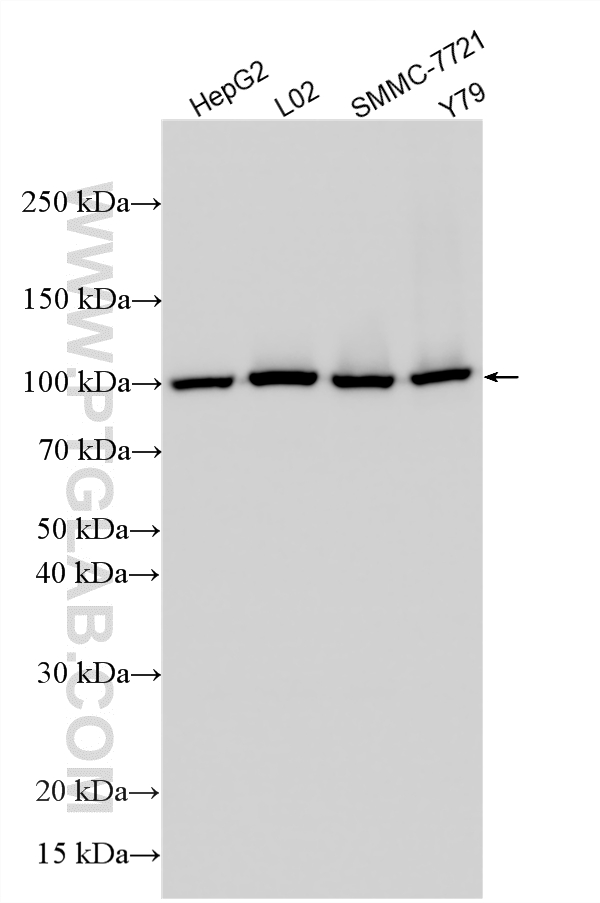
经过测试的应用
| Positive WB detected in | HepG2 cells, L02 cells, SMMC-7721 cells, Y79 cells |
推荐稀释比
| 应用 | 推荐稀释比 |
|---|---|
| Western Blot (WB) | WB : 1:1000-1:4000 |
| It is recommended that this reagent should be titrated in each testing system to obtain optimal results. | |
| Sample-dependent, Check data in validation data gallery. | |
产品信息
12577-1-AP targets XPOT in WB, ELISA applications and shows reactivity with human samples.
| 经测试应用 | WB, ELISA Application Description |
| 经测试反应性 | human |
| 免疫原 |
CatNo: Ag3256 Product name: Recombinant human XPOT protein Source: e coli.-derived, PGEX-4T Tag: GST Domain: 1-366 aa of BC020569 Sequence: MDEQALLGLNPNADSDFRQRALAYFEQLKISPDAWQVCAEALAQRTYSDDHVKFFCFQVLEHQVKYKYSELTTVQQQLIRETLISWLQAQMLNPQPEKTFIRNKAAQVFALLFVTEYLTKWPKFFFDILSVVDLNPRGVDLYLRILMAIDSELVDRDVVHTSEEARRNTLIKDTMREQCIPNLVESWYQILQNYQFTNSEVTCQCLEVVGAYVSWIDLSLIANDRFINMLLGHMSIEVLREEACDCLFEVVNKGMDPVDKMKLVESLCQVLQSAGFFSIDQEEDVDFLARFSKLVNGMGQSLIVSWSKLIKNGDIKNAQEALQAIETKVALMLQLLIHEDDDISSNIIGFCYDYLHILKQLTVLSD 种属同源性预测 |
| 宿主/亚型 | Rabbit / IgG |
| 抗体类别 | Polyclonal |
| 产品类型 | Antibody |
| 全称 | exportin, tRNA (nuclear export receptor for tRNAs) |
| 别名 | Exportin T, Exportin(tRNA), Exportin-T, tRNA exportin, XPO3 |
| 计算分子量 | 962 aa, 110 kDa |
| 观测分子量 | 100-110 kDa |
| GenBank蛋白编号 | BC020569 |
| 基因名称 | XPOT |
| Gene ID (NCBI) | 11260 |
| RRID | AB_3741831 |
| 偶联类型 | Unconjugated |
| 形式 | Liquid |
| 纯化方式 | Antigen affinity purification |
| UNIPROT ID | O43592 |
| 储存缓冲液 | PBS with 0.02% sodium azide and 50% glycerol, pH 7.3. |
| 储存条件 | Store at -20°C. Stable for one year after shipment. Aliquoting is unnecessary for -20oC storage. |
背景介绍
XPOT (also known as Exportin-T) is a key member of the karyopherin-β family of nuclear transport receptors, specifically responsible for the export of a critical class of small non-coding RNAs, transfer RNAs (tRNAs), from the nucleus to the cytoplasm. This process is essential for protein synthesis, as tRNAs must function in the cytoplasm to decode mRNA sequences and deliver amino acids to the growing polypeptide chain. XPOT recognizes mature tRNAs that have been properly processed and aminoacylated in the nucleus, loading them in a RanGTP-dependent manner. Upon translocation through the nuclear pore complex, the hydrolysis of RanGTP to RanGDP in the cytoplasm triggers the release of the tRNA cargo, thereby ensuring that only functional tRNAs are utilized for translation and maintaining the spatial separation of nuclear and cytoplasmic processes.
实验方案
| Product Specific Protocols | |
|---|---|
| WB protocol for XPOT antibody 12577-1-AP | Download protocol |
| Standard Protocols | |
|---|---|
| Click here to view our Standard Protocols |