验证数据展示
产品信息
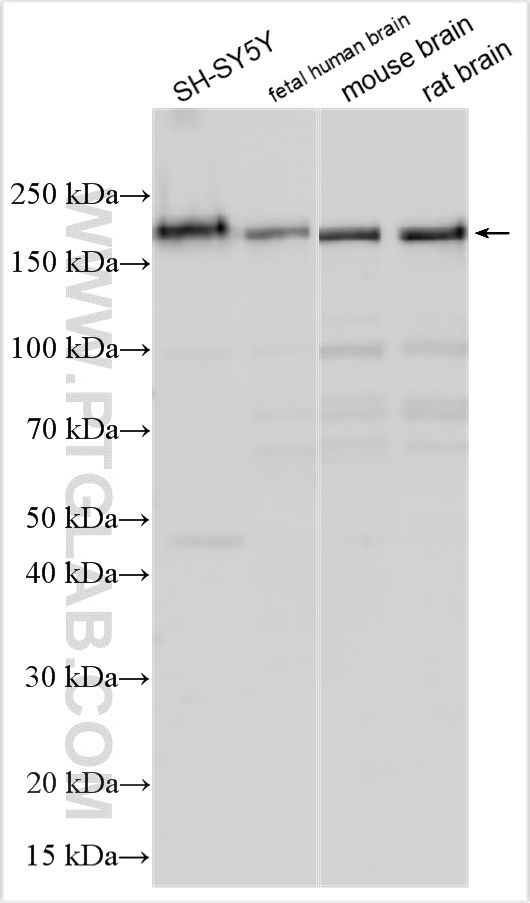
32938-1-PBS targets TTBK1 in WB, Indirect ELISA applications and shows reactivity with human, mouse, rat samples.
| 经测试应用 | WB, Indirect ELISA Application Description |
| 经测试反应性 | human, mouse, rat |
| 免疫原 |
CatNo: Ag36655 Product name: Recombinant human TTBK1 protein Source: e coli.-derived, PGEX-4T Tag: GST Domain: 1060-1321 aa of BC036764 Sequence: LSEEDTGSEPSGSLSAKERWSKRARPQQDLARLVMEKRQGRLLLRLASGASSSSSEEQRRASETLSGTGSEEDTPASEPAAALPRKSGRAAATRSRIPRPIGLRMPMPVAAQQPASRSHGAAPALDTAITSRLQLQTPPGSATAADLRPKQPPGRGLGPGRAQAGARPPAPRSPRLPASTSAARNASASPRSQSLSRRESPSPSHQARPGVPPPRGVPPARAQPDGTPSPGGSKKGPRGKLQAQRATTKGRAGGAEGRAGAR 种属同源性预测 |
| 宿主/亚型 | Rabbit / IgG |
| 抗体类别 | Polyclonal |
| 产品类型 | Antibody |
| 全称 | tau tubulin kinase 1 |
| 别名 | BDTK, Brain-derived tau kinase, EC:2.7.11.1, KIAA1855, Tau-tubulin kinase 1 |
| 计算分子量 | 142/70 kDa |
| 观测分子量 | 200 kDa |
| GenBank蛋白编号 | BC036764 |
| 基因名称 | TTBK1 |
| Gene ID (NCBI) | 84630 |
| RRID | AB_3742798 |
| 偶联类型 | Unconjugated |
| 形式 | Liquid |
| 纯化方式 | Antigen affinity Purification |
| UNIPROT ID | Q5TCY1 |
| 储存缓冲液 | PBS only, pH 7.3. |
| 储存条件 | Store at -80°C. The product is shipped with ice packs. Upon receipt, store it immediately at -80°C |
背景介绍
TTBK1 (Tau Tubulin kinase 1), also known as BDTK (brain-derived Tau kinase), is a 1,321 amino acid protein that contains one protein kinase domain and belongs to the serine/threonine protein kinase family. Localized to the cytoplasm and expressed at high levels in brain and at lower levels in testis and spinal cord, TTBK1 functions as a serine/threonine kinase that can phosphorylate Tau (a protein involved in Tubulin polymerization) on threonine, tyrosine and serine residues. Specifically, TTBK1 uses divalent cations, such as magnesium and manganese, to catalyze the ATP-dependent transfer of a phosphate group onto Tau, creating a phosphoprotein and ADP. Phosphorylation of Tau causes its aggregation and subsequent loss of function, suggesting an important role for TTBK1 in the control of Tubulin dynamics. Two isoforms of TTBK1 are expressed due to alternative splicing events. The molecular weight observed is consistent with what has been described in PMID:16923168.