Recombinant Rat CXCL1 protein (His Tag)
种属
Rat
纯度
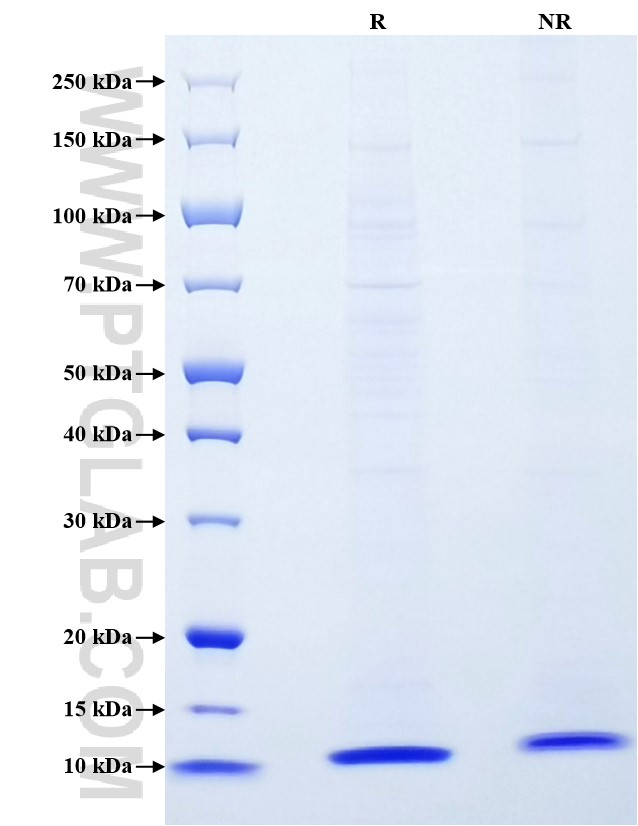
>90 %, SDS-PAGE
标签
His Tag
生物活性
未测试
验证数据展示
产品信息
| 纯度 | >90 %, SDS-PAGE |
| 内毒素 | <0.1 EU/μg protein, LAL method |
| 生物活性 |
Not tested |
| 来源 | HEK293-derived Rat CXCL1 protein Ala25-Lys96 (Accession# P14095) with a His tag at the N-terminus. |
| 基因ID | 81503 |
| 蛋白编号 | P14095 |
| 预测分子量 | 8.9 kDa |
| SDS-PAGE | 10-12 kDa, reducing (R) conditions |
| 组分 | Lyophilized from 0.22 μm filtered solution in 20 mM Tris, 150 mM NaCl, pH 7.4. Normally 5% trehalose and 5% mannitol are added as protectants before lyophilization. |
| 复溶 | Briefly centrifuge the tube before opening. Reconstitute at 0.1-0.5 mg/mL in sterile water. |
| 储存条件 |
It is recommended that the protein be aliquoted for optimal storage. Avoid repeated freeze-thaw cycles.
|
| 运输条件 | The product is shipped at ambient temperature. Upon receipt, store it immediately at the recommended temperature. |
背景信息
CXC motif chemokine ligand 1 (CXCL1), a CXC chemokine, is also known as growth-regulated (or-related) oncogene-α (Gro-α) and melanoma growth-stimulatory activity (MGSA).It is one of seven chemokines that activate the CXC motif chemokine receptor 2 (CXCR2) and one of the most studied CXC chemokines. CXCL1 is a chemoattractant cytokine. Its most important property is to cause chemotaxis of immune cells, mainly neutrophils, and to a lesser extent CD14+ monocytes and basophils, but not T cells. It also reduces neutrophil apoptosis and thus increases the accumulation of these cells at sites of inflammatory reactions. CXCL1 also causes the chemotaxis of endothelial cells and thus participates in angiogenesis.
参考文献:
1.Hughes. et al. (2018). FEBS J. 285, 2944–2971.
2.Haskill.et al (1990). Proc.Natl. Acad. Sci.87, 7732–7736.
3.Richmond.et al (1985).Cancer Res.45, 6390–6394.
4.Maheshwari.et al (2005).Cytokine. 29, 135–140.
5.Yadav.et al (2019). J.Leukoc.Biol.105, 755–766.
6.Spangler.et al(2013).Genesis. 51, 587–595.
7.Geissmann.et al (2003).Immunity. 19, 71–82.
8.Geiser.et al(1993).J.Biol.Chem. 268, 15419–15424.