
Recombinant Rat CD126/IL-6R alpha protein (rFc Tag)
种属
Rat
纯度
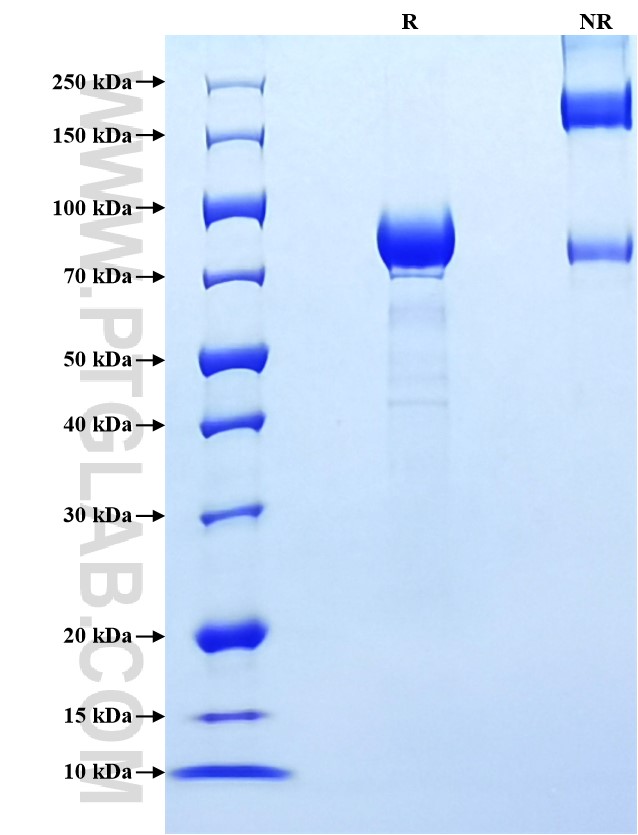
>90 %, SDS-PAGE
标签
rFc Tag
生物活性
未测试
验证数据展示
产品信息
| 纯度 | >90 %, SDS-PAGE |
| 内毒素 | <0.1 EU/μg protein, LAL method |
| 生物活性 |
Not tested |
| 来源 | HEK293-derived Rat IL-6R alpha protein Leu20-Pro364 (Accession# NP_058716.2) with a rabbit IgG Fc tag at the C-terminus. |
| 基因ID | 24499 |
| 蛋白编号 | NP_058716.2 |
| 预测分子量 | 64.3 kDa |
| SDS-PAGE | 70-95 kDa, reducing (R) conditions |
| 组分 | Lyophilized from 0.22 μm filtered solution in PBS, pH 7.4. Normally 5% trehalose and 5% mannitol are added as protectants before lyophilization. |
| 复溶 | Briefly centrifuge the tube before opening. Reconstitute at 0.1-0.5 mg/mL in sterile water. |
| 储存条件 |
It is recommended that the protein be aliquoted for optimal storage. Avoid repeated freeze-thaw cycles.
|
| 运输条件 | The product is shipped at ambient temperature. Upon receipt, store it immediately at the recommended temperature. |
背景信息
Interleukin-6 (IL-6) is a pleiotropic cytokine produced by various cells during infection, trauma, and immunological challenges. IL-6 acts via a receptor complex consisting of two distinct membrane-bound glycoproteins, an 80-kDa IL-6 receptor α (IL-6Rα) subunit (CD126, gp80) and a 130-kDa signal-transducing element (gp130, CD130). After binding of IL-6 to membrane-bound IL-6R alpha, the complex of IL-6 and IL-6Rα associates with gp130, thus activating the receptor. Expression of gp130 is found in almost all organs while IL-6R alpha is predominantly confined to hepatocytes and leukocyte subpopulations (monocytes, neutrophils, T cells, and B cells). IL-6Rα is produced by proteolytic shedding and alternative splicing to produce soluble IL-6Rα.
参考文献:
1. Tilg H.et al. (1994). Blood. 1;83(1):113-8.
2. Heinrich PC.et al. (1998). Biochem J. 1;334 ( Pt 2)(Pt 2):297-314.
3. Jones SA.et al. (2001). FASEB J. 15(1):43-58.
4. Horiuchi S.et al. (1994).  Eur J Immunol. 24(8):1945-8.
5. Müllberg J.et al. (1993).  Eur J Immunol. 23(2):473-80.
6. Rose-John S.et al. (2012). Int J Biol Sci. 8(9):1237-47.
