验证数据展示
产品信息
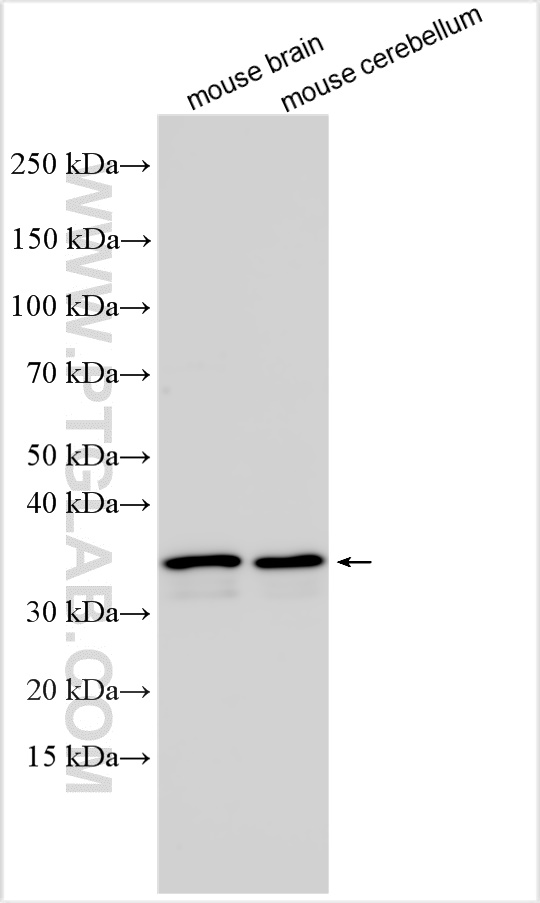
26763-1-PBS targets OLIG1 in WB, Indirect ELISA applications and shows reactivity with human, mouse samples.
| 经测试应用 | WB, Indirect ELISA Application Description |
| 经测试反应性 | human, mouse |
| 免疫原 |
CatNo: Ag25128 Product name: Recombinant human OLIG1 protein Source: e coli.-derived, PGEX-4T Tag: GST Domain: 1-87 aa of BC026989 Sequence: MLRPQRPGDLQLGASLYELVGYRQPPSSSSSSTSSTSSTSSSSTTAPLLPKAAREKPEAPAEPPGPGPGSGAHPGGSARPDAKEEQQ 种属同源性预测 |
| 宿主/亚型 | Rabbit / IgG |
| 抗体类别 | Polyclonal |
| 产品类型 | Antibody |
| 全称 | oligodendrocyte transcription factor 1 |
| 别名 | Oligo1, Class E basic helix-loop-helix protein 21, Class B basic helix-loop-helix protein 6, bHLHe21, bHLHb6 |
| 计算分子量 | 28 kDa |
| 观测分子量 | 34 kDa |
| GenBank蛋白编号 | BC026989 |
| 基因名称 | OLIG1 |
| Gene ID (NCBI) | 116448 |
| RRID | AB_3742201 |
| 偶联类型 | Unconjugated |
| 形式 | Liquid |
| 纯化方式 | Antigen affinity purification |
| UNIPROT ID | Q8TAK6 |
| 储存缓冲液 | PBS only, pH 7.3. |
| 储存条件 | Store at -80°C. The product is shipped with ice packs. Upon receipt, store it immediately at -80°C |
背景介绍
The oligodendrocyte lineage-specific basic helix-loop-helix (OLIG) family of transcription factors includes OLIG1-OLIG3, which differ in tissue expression. OLIG1 and OLIG2 are specifically expressed in nervous tissue as gene regulators of oligodendrogenesis. OLIG1 and OLIG2 interact with the Nkx-2.2 homeodomain protein, which is responsible for directing ventral neuronal patterning in response to graded Sonic hedgehog signaling in the embryonic neural tube. These interactions between OLIG proteins and Nkx-2.2 appear to promote the formation of alternate cell types by inhibiting V3 interneuron development. OLIG1 and OLIG2 are abundantly expressed in oligodendroglioma and nearly absent in astrocytomas. Therefore, OLIG proteins are candidates for molecular markers of human glial brain tumors, which are the most common primary malignancies of the human brain.