Recombinant Mouse Hgf protein (His Tag)
种属
Mouse
纯度
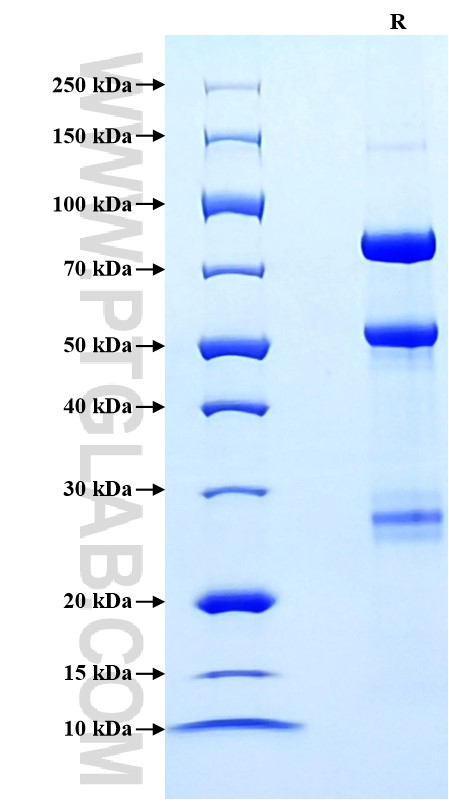
>90 %, SDS-PAGE
标签
His Tag
生物活性
未测试
验证数据展示
产品信息
| 纯度 | >90 %, SDS-PAGE |
| 内毒素 | <0.1 EU/μg protein, LAL method |
| 生物活性 |
Not tested |
| 来源 | CHO-derived Mouse Hgf protein Gln33-Leu728 (Accession# Q08048-1) with a His tag at the C-terminus. |
| 基因ID | 15234 |
| 蛋白编号 | Q08048-1 |
| 预测分子量 | 80.4 kDa |
| SDS-PAGE | 28 kDa, 50-55kDa and 72-85 kDa, reducing (R) conditions |
| 组分 | Lyophilized from 0.22 μm filtered solution in PBS, pH 7.4. Normally 5% trehalose and 5% mannitol are added as protectants before lyophilization. |
| 复溶 | Briefly centrifuge the tube before opening. Reconstitute at 0.1-0.5 mg/mL in sterile water. |
| 储存条件 |
It is recommended that the protein be aliquoted for optimal storage. Avoid repeated freeze-thaw cycles.
|
| 运输条件 | The product is shipped at ambient temperature. Upon receipt, store it immediately at the recommended temperature. |
背景信息
Hepatocyte growth factor (HGF) is the most potent mitogen of mature hepatocytes in primary culture. HGF is derived from a biologically inactive single-chain precursor of 728 amino acids (pro-HGF) localized mostly on the cell surface and in the extracellular matrix. The mature form produced following proteolytic cleavage is composed of a 69-kDa alpha-subunit (containing four kringle domains) and the 34 kDa beta-subunit, similar to the catalytic domain of serine proteases, but with amino acid substitutions in the active site. HGF is a pleiotropic cytokine that exerts a variety of effects on several cells, being involved in the regulation of many biological processes, such as inflammation, tissue repair, morphogenesis, angiogenesis, tumor propagation, immunomodulation of viral infections and cardio-metabolic activities
参考文献:
1. Matsumoto K. et al.(1991). J Gastroenterol Hepatol. 6(5): 509-19.
2. Mizuno K. et al.(1993).EXS. 65:1-29.
3. Bardelli A. et al. (1994). J Biotechnol. 37(2):109-22.
4. Stuart KA. et al. (2000). Int J Exp Pathol. 81(1):17-30.
5. Libetta C. et al. (2016). Clin Exp Nephrol. 20(3):371-8.