Recombinant Human IL-33 protein (His Tag)
种属
Human
纯度
>90 %, SDS-PAGE
标签
His Tag
生物活性
未测试
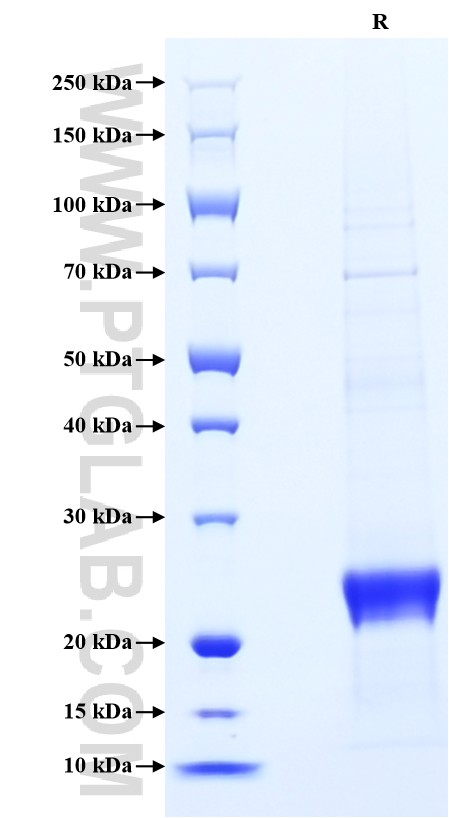
验证数据展示
产品信息
| 纯度 | >90 %, SDS-PAGE |
| 内毒素 | <0.1 EU/μg protein, LAL method |
| 生物活性 |
Not tested |
| 来源 | HEK293-derived Human IL-33 protein Ser112-Thr270 (Accession# O95760) with a His tag at the N-terminus. |
| 基因ID | 90865 |
| 蛋白编号 | O95760 |
| 预测分子量 | 19.1 kDa |
| SDS-PAGE | 21-26 kDa, reducing (R) conditions |
| 组分 | Lyophilized from 0.22 μm filtered solution in PBS, pH 7.4. Normally 5% trehalose and 5% mannitol are added as protectants before lyophilization. |
| 复溶 | Briefly centrifuge the tube before opening. Reconstitute at 0.1-0.5 mg/mL in sterile water. |
| 储存条件 |
It is recommended that the protein be aliquoted for optimal storage. Avoid repeated freeze-thaw cycles.
|
| 运输条件 | The product is shipped at ambient temperature. Upon receipt, store it immediately at the recommended temperature. |
背景信息
Interleukin-33 (IL-33) is a tissue-derived nuclear cytokine from the IL-1 family abundantly expressed in endothelial cells, epithelial cells and fibroblast-like cells, both during homeostasis and inflammation. IL-33 activates many immune cell types involved in type-2 immunity and allergic inflammation, including ILC2s, mast cells, Th2 cells, eosinophils, basophils, dendritic cells and alternatively activated macrophages (AAM). As a cytokine, IL-33 interacts with the receptors ST2 (also known as IL1RL1) and IL-1 Receptor Accessory Protein (IL1RAP), activating intracellular molecules in the NF-κB and MAP kinase signaling pathways that drive production of type 2 cytokines (e.g. IL-5 and IL-13) from polarized Th2 cells. IL-33 is also effective in reversing Alzheimer-like symptoms in APP/PS1 mice, by reversing the buildup and preventing the new formation of amyloid plaques.
参考文献:
1. Jochen Schmitz. et al. Immunity. (2005) 23(5):479-90.
2. Corinne Cayrol. et al. (2014) Curr Opin Immunol. 31:31-7.
3. Molofsky AB. et al. (2015) Immunity. 2015 Jun 16;42(6):1005-19.
4. Foo YewLiew. et al. (2016)Nat Rev Immunol .16(11):676-689.
5. Amy K Y Fu. et al. (2016) Proc Natl Acad Sci U S A.113(19):E2705-13.