Recombinant Human CD109 protein (rFc Tag)
种属
Human
纯度
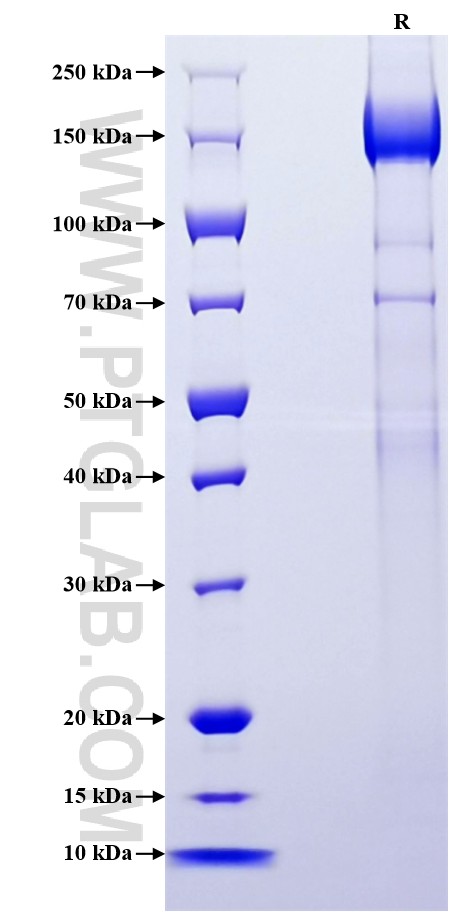
>90 %, SDS-PAGE
标签
rFc Tag
生物活性
未测试
验证数据展示
产品信息
| 纯度 | >90 %, SDS-PAGE |
| 内毒素 | <0.1 EU/μg protein, LAL method |
| 生物活性 |
Not tested |
| 来源 | HEK293-derived Human CD109 protein Val22-Ser1268 (Accession# Q6YHK3-1, Tyr703Ser and Tyr1241Met) with a rabbit IgG Fc tag at the C-terminus. |
| 基因ID | 135228 |
| 蛋白编号 | Q6YHK3-1 |
| 预测分子量 | 165.2 kDa |
| SDS-PAGE | 135-220 kDa, reducing (R) conditions |
| 组分 | Lyophilized from 0.22 μm filtered solution in PBS, pH 7.4. Normally 5% trehalose and 5% mannitol are added as protectants before lyophilization. |
| 复溶 | Briefly centrifuge the tube before opening. Reconstitute at 0.1-0.5 mg/mL in sterile water. |
| 储存条件 |
It is recommended that the protein be aliquoted for optimal storage. Avoid repeated freeze-thaw cycles.
|
| 运输条件 | The product is shipped at ambient temperature. Upon receipt, store it immediately at the recommended temperature. |
背景信息
CD109, also named as CPAMD7, is a member of the alpha2-macroglobulin/complement superfamily and is preferentially expressed on hematopoietic stem as well as progenitor cell subsets. It is a glycosylphosphatidylinositol (GPI)-anchored protein, first identified as a marker for activated T cells and platelets. CD109 stands out as the most potent negative regulator of canonical TGF-β signaling and responses. Additionally, CD109 might be a useful molecular target for the development of new therapeutics for malignant tumors, such as squamous cell carcinoma.
参考文献:
1. Lin, Martin et al. Blood vol. 99,5 (2002): 1683-91.
2. Murray, L J et al. Experimental hematology vol. 27,8 (1999): 1282-94.
3. Sutherland, D R et al. Blood vol. 77,1 (1991): 84-93.
4. Tam, B Y et al. Journal of cellular biochemistry vol. 70,4 (1998): 573-86.
5. Tam, B Y et al. Journal of cellular biochemistry vol. 83,3 (2001): 494-507.
6. Hashimoto, Mizuo et al. Oncogene vol. 23,20 (2004): 3716-20.