Human CCL3 ELISA Kit
Cat no : KE00092
Synonyms
C C motif chemokine 3, CCL3, chemokine (C C motif) ligand 3, G0S19 1, LD78 alpha(4 69), LD78ALPHA, MIP 1 alpha, MIP1A, PAT 464.1, SCYA3, SIS beta, Small inducible cytokine A3
Validation Data Gallery
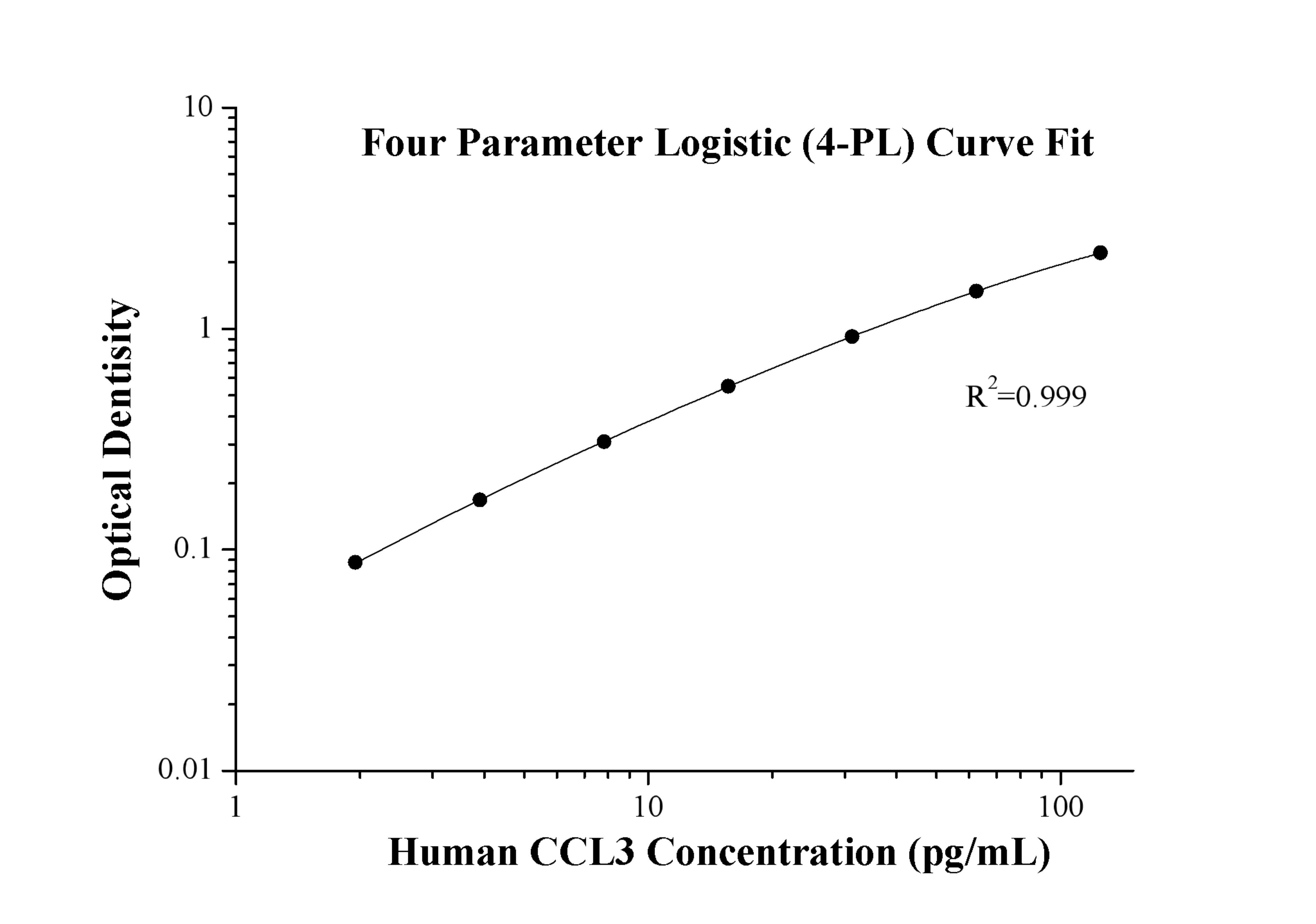
Product Information
KE00092 is a solid phase sandwich Enzyme Linked-Immuno-Sorbent Assay (Sandwich ELISA). The human CCL3 ELISA kit is to be used to detect and quantify protein levels of endogenous human CCL3. The assay recognizes human CCL3. An antibody specific for human CCL3 has been pre-coated onto the microwells. The human CCL3 protein in samples is captured by the coated antibody after incubation. Following extensive washing, another antibody of biotinylated specific for human CCL3 is added to detect the captured human CCL3 protein. For signal development, Streptavidin-HRP is added, followed by Tetramethyl-benzidine (TMB) reagent. Solution containing sulfuric acid is used to stop color development and the color intensity which is proportional to the quantity of bound protein is measurable at 450 nm with the correction wavelength set at 630 nm.
| Product name | Human CCL3 ELISA Kit |
| Tests | 1 X 96 well plate |
| Sample type | Serum, Plasma, Cell culture supernatants 备注:对未验证样本,我们提供技术支持和售后保障。 |
| Assay type | Sandwich |
| Sensitivity | 0.06 pg/mL |
| Range | 1.95 - 125 pg/mL |
| Reactivity | Human |
| Tested applications | Sandwich ELISA |
| Gene ID (NCBI) | 6348 |
Recovery
| Sample Type | Average | Range |
|---|---|---|
| Human plasma | 96% | 84%-106% |
| Cell culture supernatants | 97% | 86%-107% |
IntraAssay
| Sample | n | mean ( pg/mL) | SD | CV% |
|---|---|---|---|---|
| 1 | 20 | 106.8 | 4.4 | 4.1 |
| 2 | 20 | 26.7 | 0.8 | 3.0 |
| 3 | 20 | 2.4 | 0.1 | 5.1 |
InterAssay
| Sample | n | mean ( pg/mL) | SD | CV% |
|---|---|---|---|---|
| 1 | 24 | 119.4 | 5.9 | 5.0 |
| 2 | 24 | 27.8 | 1.3 | 4.6 |
| 3 | 24 | 2.4 | 0.1 | 4.3 |
Background Information
Chemokine (C-C motif) ligand 3 (CCL3), also known as MIP-1α, belongs to the family of chemokines. CCL3 has been found in the central nervous system and its cognate receptors, CCR1 and CCR5, have been reported to be expressed by astrocytes, microglia and neurons. CCL3 and its receptors, CCR1 and CCR5, also contribute to the development of bone disease in multiple myeloma by supporting tumor growth and regulating osteoclast differentiation. CCL3 is also associated with the regulation of cell growth, angiogenesis, and metastasis of different tumors such as melanoma, renal cell carcinoma, and colorectal cancer. Moreover, CCL3 enhances cell migration and metastasis by up-regulating matrix metalloproteinase-2 (MMP)-2 expression in chondrosarcoma cells.
Properties
| Storage Instructions | All the reagents are stored at 2-8℃ for 6 months or -20℃ for 12 months. Refer to the protocol for further storage instructions. |
| Synonyms | C C motif chemokine 3, CCL3, chemokine (C C motif) ligand 3, G0S19 1, LD78 alpha(4 69), LD78ALPHA, MIP 1 alpha, MIP1A, PAT 464.1, SCYA3, SIS beta, Small inducible cytokine A3 |
FAQ
1、我的样本稀释液有限,如何处理稀释倍数较大的样本?
我们建议您对样本进行梯度稀释。例如,人血清样本需要1000000倍稀释时,您可以分3个梯度,每个梯度100倍,进行稀释:
第一步:取2 uL人血清样本,加入198 uL样本稀释液,混匀得到100倍稀释的人血清样本
第二步:取2uL 100倍稀释的人血清样本+ 198 uL样本稀释液进行稀释,混匀得到10000倍稀释的人血清样本
第三步:取2uL 10000倍稀释的人血清样本+ 198 uL样本稀释液进行稀释,混匀得到1000000倍稀释的人血清样本。
如果样本需要进一步稀释,您可以使用更多梯度。除了我们推荐的样本稀释液,不建议您使用其他溶液或者水稀释。如果您的样本稀释液仍然不足,请联系我们的客服为您提供更多样本稀释液。
Publications
| Species | Sample Type | Title |
|---|---|---|
Adv Sci (Weinh) BCAT2 Shapes a Noninflamed Tumor Microenvironment and Induces Resistance to Anti-PD-1/PD-L1 Immunotherapy by Negatively Regulating Proinflammatory Chemokines and Anticancer Immunity | ||
Adv Sci (Weinh) S100A5 Attenuates Efficiency of Anti-PD-L1/PD-1 Immunotherapy by Inhibiting CD8+ T Cell-Mediated Anti-Cancer Immunity in Bladder Carcinoma | ||
BMC Med Plasma CCL3 predicts adverse heart failure outcomes in patients with arrhythmogenic cardiomyopathy | ||
Life Sci Vertebral bone marrow clot breakthrough: a powerful osteogenic and antibacterial scaffold for spinal fusion surgery. | ||
Cancer Immunol Immunother Longitudinal plasma proteomic analysis identifies biomarkers and combinational targets for anti-PD1-resistant cancer patients. | ||
Int J Chron Obstruct Pulmon Dis Bufei Yishen Formula Inhibits the Cell Senescence in COPD by Up-Regulating the ZNF263 and Klotho Expression |