验证数据展示
产品信息
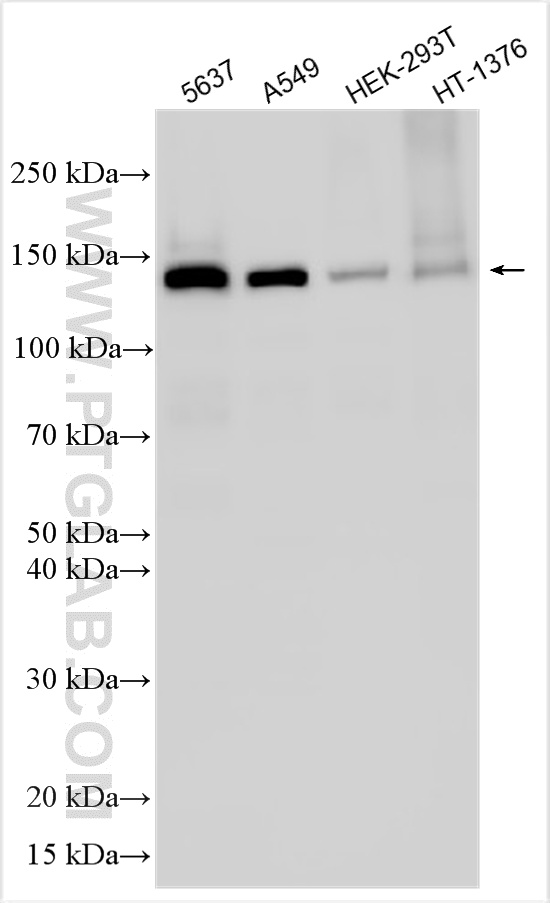
31974-1-PBS targets FAM83H in WB, Indirect ELISA applications and shows reactivity with human samples.
| 经测试应用 | WB, Indirect ELISA Application Description |
| 经测试反应性 | human |
| 免疫原 |
CatNo: Ag37139 Product name: Recombinant human FAM83H protein Source: e coli.-derived, PGEX-4T Tag: GST Domain: 1000-1179 aa of BC033256 Sequence: RRLSLGQGDSTEAATEERGPRARLSSATANALYSSNLRDDTKAILEQISAHGQKHRAVPAPSPGPTHNSPELGRPPAAGVLAPDMSDKDKCSAIFRSDSLGTQGRLSRTLPASAEERDRLLRRMESMRKEKRVYSRFEVFCKKEEASSPGAGEGPAEEGTRDSKVGKFVPKILGTFKSKK 种属同源性预测 |
| 宿主/亚型 | Rabbit / IgG |
| 抗体类别 | Polyclonal |
| 产品类型 | Antibody |
| 全称 | family with sequence similarity 83, member H |
| 别名 | Protein FAM83H |
| 计算分子量 | 127 kDa |
| 观测分子量 | 140 kDa |
| GenBank蛋白编号 | BC033256 |
| 基因名称 | FAM83H |
| Gene ID (NCBI) | 286077 |
| RRID | AB_3742503 |
| 偶联类型 | Unconjugated |
| 形式 | Liquid |
| 纯化方式 | Antigen affinity Purification |
| UNIPROT ID | Q6ZRV2 |
| 储存缓冲液 | PBS only, pH 7.3. |
| 储存条件 | Store at -80°C. The product is shipped with ice packs. Upon receipt, store it immediately at -80°C |
背景介绍
FAM83H was first discovered during extensive computational analysis of the human genomic sequence [PMID: 18252228] and reported to be essential in dental enamel formation [PMID: 26142250, PMID: 21127961]. Mutation of FAM83H is the main etiological factor for human autosomal dominant hypocalcified amelogenesis imperfecta. Moreover, recently, research into FAM83H has focused on its roles in the development and progression of human cancers. However, there are controversial reports for the role of FAM83H in human cancers. Earlier reports, which used microarray analysis, showed higher FAM83H expression in ovarian cancers compared with normal ovarian tissue [PMID: 21617380]. In addition, higher expression of the FAM83H gene is presented in the cancers of lung, breast, colon, liver, ovary, pancreas, and stomach [PMID: 28078827]. The roles of FAM83H in the progression of human cancers involve changes in the proliferation and invasiveness of cancer cells. In colon cancer cells, overexpression of FAM83H is suggested to be involved in the progression of cancer cells by disorganizing keratin cytoskeleton structures [PMID: 23902688, PMID: 27681590]. In addition, FAM83H increases proliferation of prostatic cancer cells [PMID: 26512949], hepatocellular carcinoma cells [PMID: 28607447], and clear cell renal cell carcinoma cells [PMID: 30723706]. In hepatocellular carcinoma cells, activation of the MYC-FAM83H pathway increases the proliferation and invasion activity of cancer cells [PMID: 28607447]. Moreover, higher expression of FAM83H is associated with an increased recurrence rate of prostatic cancer patients and shorter survival of uterine cancer [PMID: 28078827], hepatocellular carcinoma [PMID: 28607447], and clear cell renal cell carcinoma patients [PMID: 21057535]. These findings suggest that FAM83H has a vital role in tumorigenesis and progression of human malignant tumors, and might be involved in the progression of various types of human cancers. However, the expression of FAM83H is down-regulated in astrocytoma and oligodendroglioma of the brain, and higher expression of FAM83H is associated with favorable prognosis of glioma and head and neck cancer patients [PMID: 28078827]. Therefore, there is a possibility that the role of FAM83H might be different according to the type of cells and further study is needed [PMID: 21057535].