验证数据展示
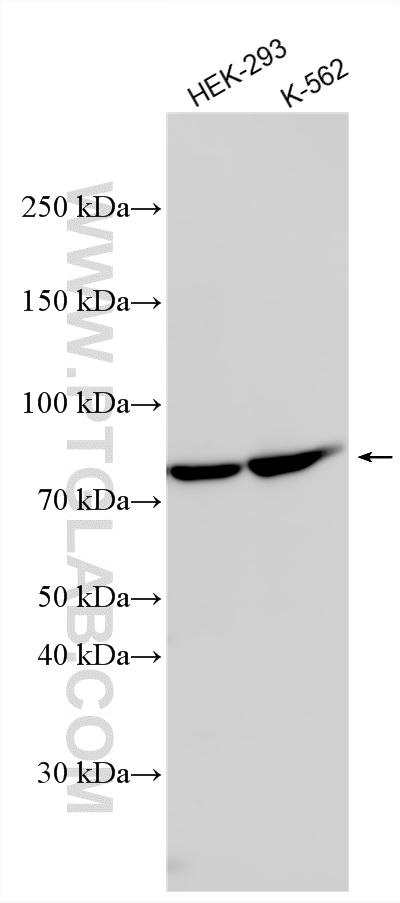
经过测试的应用
| Positive WB detected in | HEK-293 cells, K-562 cells |
推荐稀释比
| 应用 | 推荐稀释比 |
|---|---|
| Western Blot (WB) | WB : 1:1000-1:6000 |
| It is recommended that this reagent should be titrated in each testing system to obtain optimal results. | |
| Sample-dependent, Check data in validation data gallery. | |
产品信息
27758-1-AP targets AVL9 in WB, ELISA applications and shows reactivity with human samples.
| 经测试应用 | WB, ELISA Application Description |
| 经测试反应性 | human |
| 免疫原 |
CatNo: Ag26208 Product name: Recombinant human AVL9 protein Source: e coli.-derived, PGEX-4T Tag: GST Domain: 188-463 aa of BC027724 Sequence: RHKVLILFKLILLEKKVLFYISPVNKLVGALMTVLSLFPGMIEHGLSDCSQYRPRKSMSEDGGLQESNPCADDFVSASTADVSHTNLGTIRKVMAGNHGEDAAMKTEEPLFQVEDSSKGQEPNDTNQYLKPPSRPSPDSSESDWETLDPSVLEDPNLKEREQLGSDQTNLFPKDSVPSESLPITVQPQANTGQVVLIPGLISGLEEDQYGMPLAIFTKCTQDVLPQANHSFKFLITDRRITPRPLRRRLVSATLTNMLQEKSCWKKHIKCRRRVQK 种属同源性预测 |
| 宿主/亚型 | Rabbit / IgG |
| 抗体类别 | Polyclonal |
| 产品类型 | Antibody |
| 全称 | AVL9 homolog (S. cerevisiase) |
| 别名 | AVL9 homolog (S. cerevisiase), KIAA0241 |
| 观测分子量 | 72 kDa |
| GenBank蛋白编号 | BC027724 |
| 基因名称 | AVL9 |
| Gene ID (NCBI) | 23080 |
| RRID | AB_3742254 |
| 偶联类型 | Unconjugated |
| 形式 | Liquid |
| 纯化方式 | Antigen affinity purification |
| UNIPROT ID | Q8NBF6 |
| 储存缓冲液 | PBS with 0.02% sodium azide and 50% glycerol, pH 7.3. |
| 储存条件 | Store at -20°C. Stable for one year after shipment. Aliquoting is unnecessary for -20oC storage. |
背景介绍
AVL9 is primarily involved in cell migration and late secretory pathway transport . In yeast, Avl9p functions in post-Golgi vesicle-mediated transport, where loss of the protein causes defects in secretory vesicle generation and polarized growth . In humans, the protein has been shown to function in cell migration, though the precise molecular mechanism remains under investigation.(PMID: 34991461,PMID: 41542567)
实验方案
| Product Specific Protocols | |
|---|---|
| WB protocol for AVL9 antibody 27758-1-AP | Download protocol |
| Standard Protocols | |
|---|---|
| Click here to view our Standard Protocols |