Recombinant Mouse LCAT protein (rFc Tag)
种属
Mouse
纯度
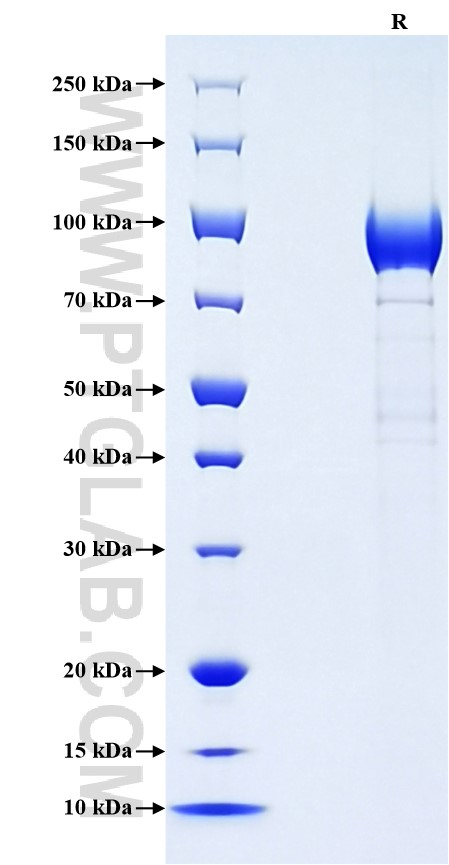
>90 %, SDS-PAGE
标签
rFc Tag
生物活性
未测试
验证数据展示
产品信息
| 纯度 | >90 %, SDS-PAGE |
| 内毒素 | <0.1 EU/μg protein, LAL method |
| 生物活性 |
Not tested |
| 来源 | HEK293-derived Mouse LCAT protein Phe25-Glu438 (Accession# P16301) with a rabbit IgG Fc tag at the C-terminus. |
| 基因ID | 16816 |
| 蛋白编号 | P16301 |
| 预测分子量 | 73.3 kDa |
| SDS-PAGE | 80-110 kDa, reducing (R) conditions |
| 组分 | Lyophilized from 0.22 μm filtered solution in PBS, pH 7.4. Normally 5% trehalose and 5% mannitol are added as protectants before lyophilization. |
| 复溶 | Briefly centrifuge the tube before opening. Reconstitute at 0.1-0.5 mg/mL in sterile water. |
| 储存条件 |
It is recommended that the protein be aliquoted for optimal storage. Avoid repeated freeze-thaw cycles.
|
| 运输条件 | The product is shipped at ambient temperature. Upon receipt, store it immediately at the recommended temperature. |
背景信息
Lecithin-cholesterolacyltransferase (LCAT) is an enzyme that acts as a catalyst in plasma, is synthesized by the liver and released into the bloodstream, and exists either free or bound to lipoproteins. The main function of LCAT is to transfer unsaturated fatty acids at the C2 position of HDL lecithin to free cholesterol to generate hemolytic lecithin and cholesteryl esters. The main function of LCAT is to transfer unsaturated fatty acids from the C2 site of HDL lecithin to free cholesterol, resulting in the production of hemolysed lecithin and cholesteryl esters, which are catalyzed by LCAT in almost 70-80% of plasma cholesterol.Reduced or complete lack of normal function of LCAT leads to two autosomal recessive disorders, familial LCAT deficiency and fish-eye disease, respectively. (PMID: 35121343)
参考文献:
1. Yang K, et al. Biomed Pharmacother. 2022;147:112677.
2. Lin X, et al. J Adv Res. 2024;63:187-194.
3. Leal-Gonzalez R, et al. Obstet Med. 2021;14(3):193-196.
4. Mehta R, et al. Lipids Health Dis. 2021;20(1):70.