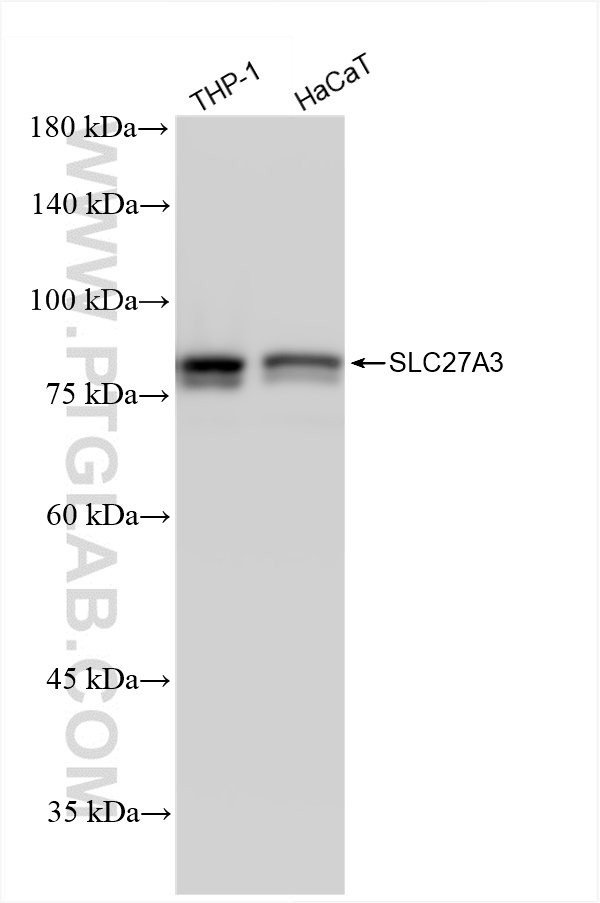
验证数据展示
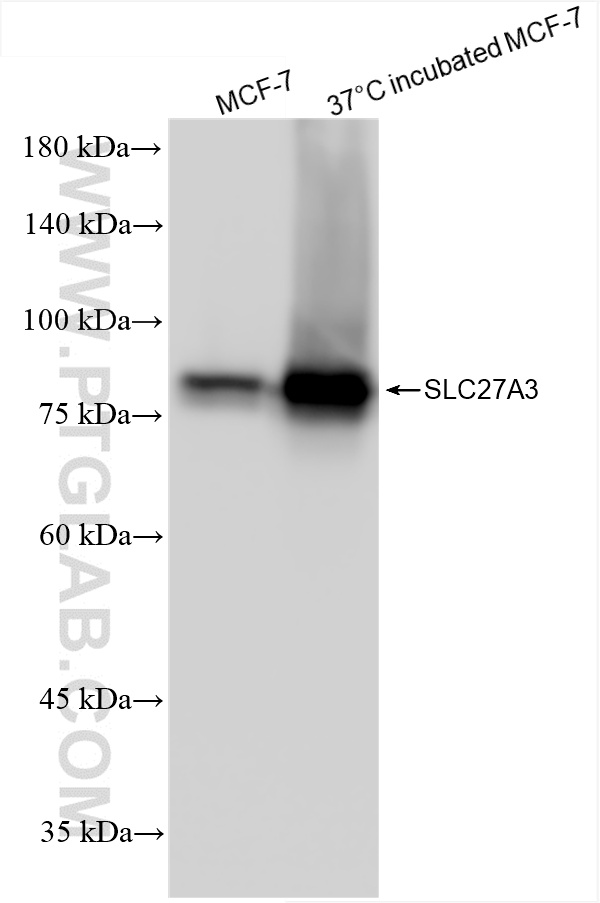
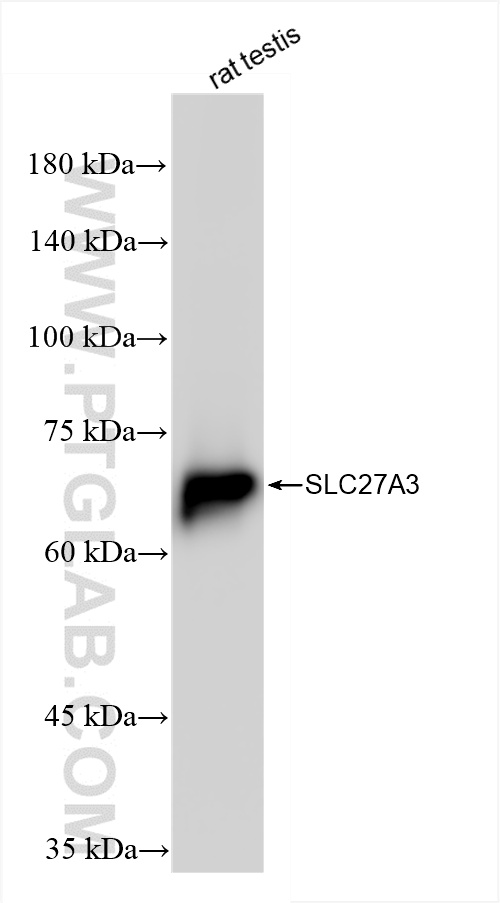
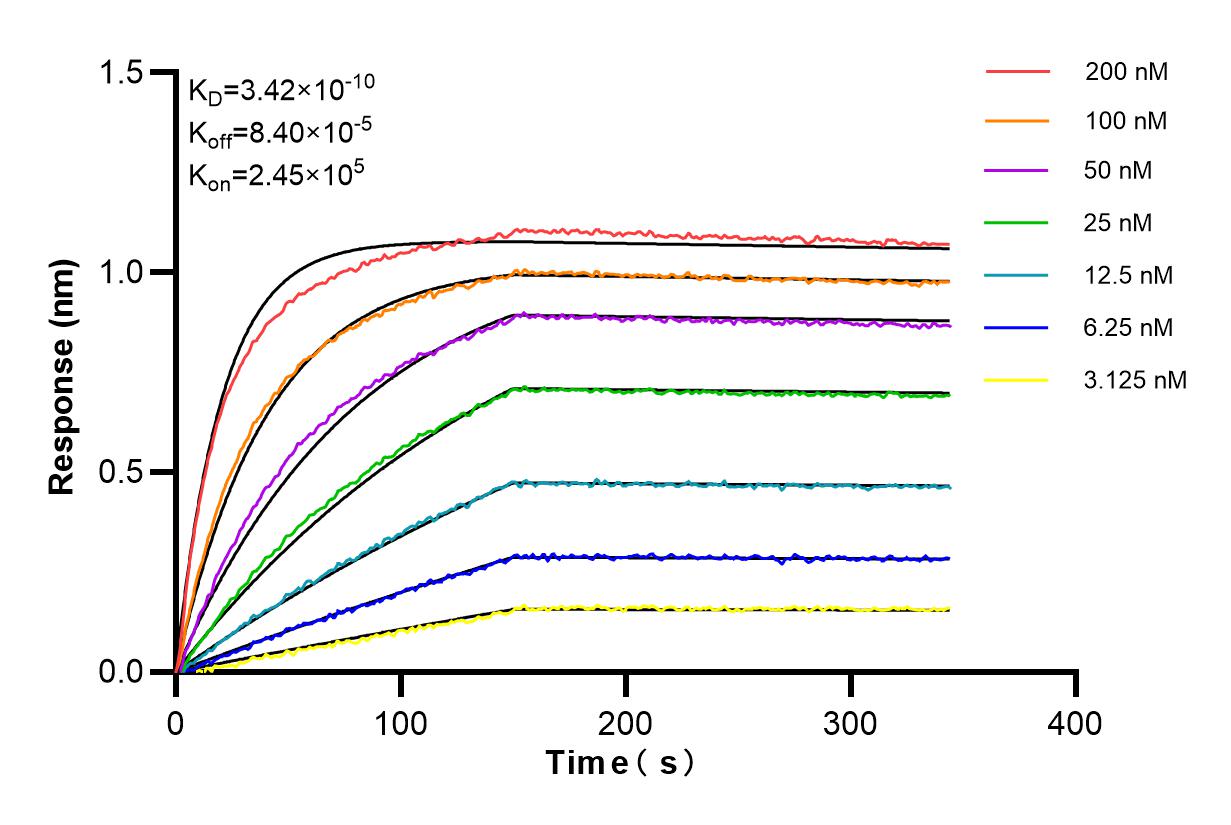
经过测试的应用
| Positive WB detected in | MCF-7 cells, rat testis tissue, THP-1 cells, HaCaT cells |
推荐稀释比
| 应用 | 推荐稀释比 |
|---|---|
| Western Blot (WB) | WB : 1:2000-1:10000 |
| It is recommended that this reagent should be titrated in each testing system to obtain optimal results. | |
| Sample-dependent, Check data in validation data gallery. | |
产品信息
86047-1-RR targets SLC27A3 in WB, ELISA applications and shows reactivity with human, rat samples.
| 经测试应用 | WB, ELISA Application Description |
| 经测试反应性 | human, rat |
| 免疫原 |
CatNo: Ag4015 Product name: Recombinant human SLC27A3 protein Source: e coli.-derived, PGEX-4T Tag: GST Domain: 500-700 aa of BC029792 Sequence: GEPGLLVAPVSQQSPFLGYAGGPELAQGKLLKDVFRPGDVFFNTGDLLVCDDQGFLRFHDRTGDTFRWKGENVATTEVAEVFEALDFLQEVNVYGVTVPGHEGRAGMAALVLRPPHALDLMQLYTHVSENLPPYARPRFLRLQESLATTETFKQQKVRMANEGFDPSTLSDPLYVLDQAVGAYLPLTTARYSALLAGNLRI 种属同源性预测 |
| 宿主/亚型 | Rabbit / IgG |
| 抗体类别 | Recombinant |
| 产品类型 | Antibody |
| 全称 | solute carrier family 27 (fatty acid transporter), member 3 |
| 别名 | ACSVL3, Arachidonate--CoA ligase, EC:6.2.1.-, EC:6.2.1.15, EC:6.2.1.3 |
| 计算分子量 | 75 kDa |
| 观测分子量 | 70-79 kDa |
| GenBank蛋白编号 | BC029792 |
| 基因名称 | SLC27A3 |
| Gene ID (NCBI) | 11000 |
| 偶联类型 | Unconjugated |
| 形式 | Liquid |
| 纯化方式 | Protein A purification |
| UNIPROT ID | Q5K4L6 |
| 储存缓冲液 | PBS with 0.02% sodium azide and 50% glycerol, pH 7.3. |
| 储存条件 | Store at -20°C. Stable for one year after shipment. Aliquoting is unnecessary for -20oC storage. |
背景介绍
SLC27A3, also named as FATP3, is a member of the solute carrier 27A (SLC27A) gene family which encodes fatty acid transport proteins. SLC27A3 is expressed in human neural stem cells and plays a key role in the developmental stage of the central nervous system. It is associated with autism spectrum disorders (ASD) that caused by impaired early brain development.(PMID: 26548558).
实验方案
| Product Specific Protocols | |
|---|---|
| WB protocol for SLC27A3 antibody 86047-1-RR | Download protocol |
| Standard Protocols | |
|---|---|
| Click here to view our Standard Protocols |