
Recombinant Mouse TGF beta 1 protein (rFc Tag)
种属
Mouse
纯度
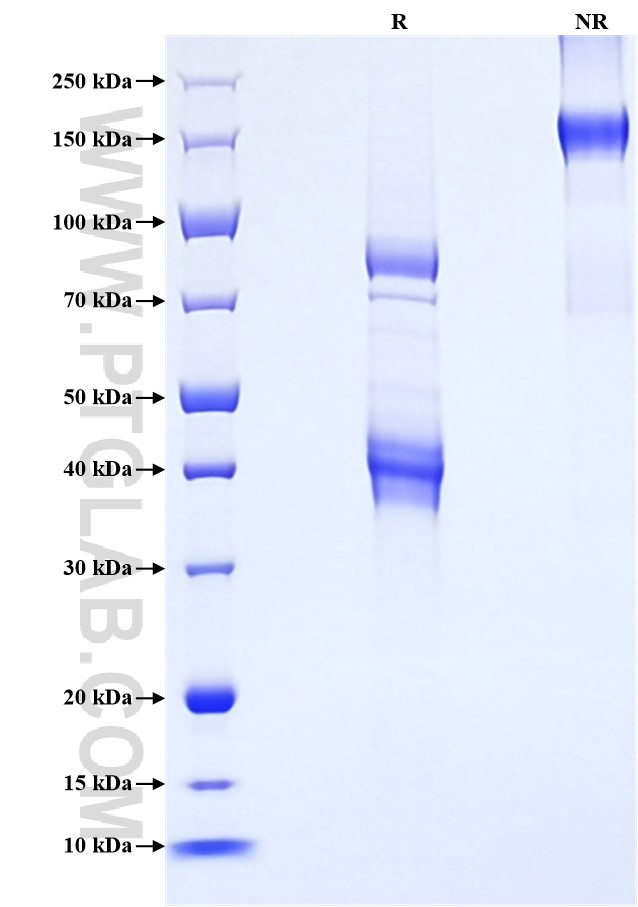
>90 %, SDS-PAGE
标签
rFc Tag
生物活性
未测试
验证数据展示
产品信息
| 纯度 | >90 %, SDS-PAGE |
| 内毒素 | <0.1 EU/μg protein, LAL method |
| 生物活性 |
Not tested |
| 来源 | HEK293-derived Mouse TGF beta 1 protein Leu30-Ser390 (Accession# P04202) with a rabbit IgG Fc tag at the C-terminus. |
| 基因ID | 21803 |
| 蛋白编号 | P04202 |
| 预测分子量 | 67.5 kDa |
| SDS-PAGE | 38-45kDa and 80-90 kDa, reducing (R) conditions |
| 组分 | Lyophilized from 0.22 μm filtered solution in PBS, pH 7.4. Normally 5% trehalose and 5% mannitol are added as protectants before lyophilization. |
| 复溶 | Briefly centrifuge the tube before opening. Reconstitute at 0.1-0.5 mg/mL in sterile water. |
| 储存条件 |
It is recommended that the protein be aliquoted for optimal storage. Avoid repeated freeze-thaw cycles.
|
| 运输条件 | The product is shipped at ambient temperature. Upon receipt, store it immediately at the recommended temperature. |
背景信息
TGF-beta is a member of the transforming growth factor beta (TGFB) family of cytokines, which are multifunctional peptides that regulate proliferation, differentiation, adhesion, migration, and other functions in many cell types. TGF-beta is produced by a number of cell types including regulatory T cells, fibroblasts, epithelial cells, and endothelial cells. TGF-beta acts synergistically with TGFA in inducing transformation. It also acts as a negative autocrine growth factor. TGF-beta plays an important role in bone remodeling as it is a potent stimulator of osteoblastic bone formation, causing chemotaxis, proliferation and differentiation in committed osteoblasts. Mice lacking TGF-beta develop severe multifocal inflammatory disease, yolk sac defects and colon cancer.
参考文献:
1. Siegel PM. et al. (2003) Nat Rev Cancer 3: 807-21.
2. Bierie B. et al. (2006) Nat Rev Cancer 6: 506-20.
3. Tian M. et al. (2009) Future Oncol 5: 259-71.
4. Priyadarshi S. et al. (2013) 28: 2490-7.
