
Recombinant Mouse Midkine protein (mFc Tag)
种属
Mouse
纯度
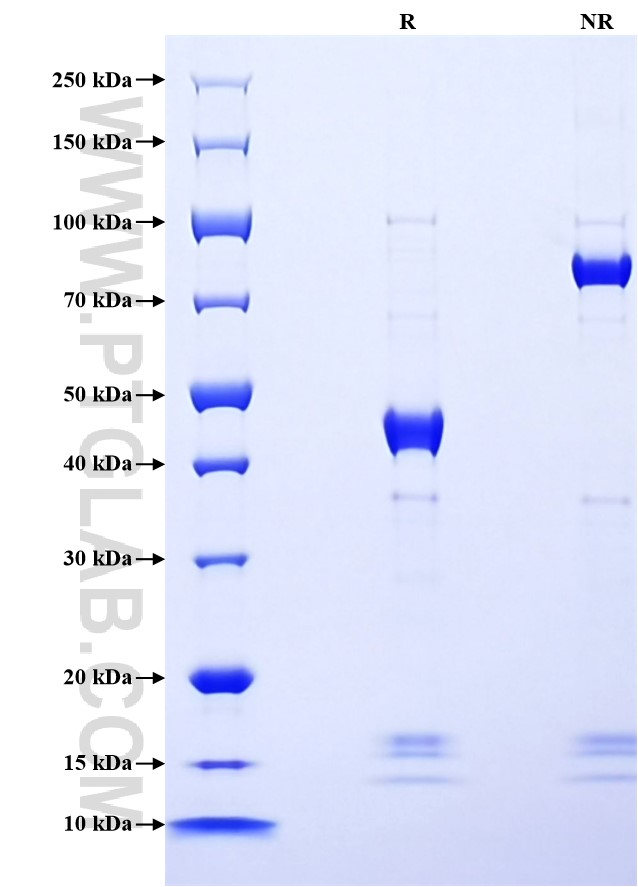
>90 %, SDS-PAGE
标签
mFc Tag
生物活性
未测试
验证数据展示
产品信息
| 纯度 | >90 %, SDS-PAGE |
| 内毒素 | <0.1 EU/μg protein, LAL method |
| 生物活性 |
Not tested |
| 来源 | HEK293-derived Mouse Mdk protein Lys23-Asp140 (Accession# P12025) with a mouse IgG Fc tag at the C-terminus. |
| 基因ID | 17242 |
| 蛋白编号 | P12025 |
| 预测分子量 | 39.7 kDa |
| SDS-PAGE | 42-48 kDa, reducing (R) conditions |
| 组分 | Lyophilized from 0.22 μm filtered solution in PBS, pH 7.4. Normally 5% trehalose and 5% mannitol are added as protectants before lyophilization. |
| 复溶 | Briefly centrifuge the tube before opening. Reconstitute at 0.1-0.5 mg/mL in sterile water. |
| 储存条件 |
It is recommended that the protein be aliquoted for optimal storage. Avoid repeated freeze-thaw cycles.
|
| 运输条件 | The product is shipped at ambient temperature. Upon receipt, store it immediately at the recommended temperature. |
背景信息
Midkine (MK) is a heparin-binding growth factor and a cytokine, identified as a product of a retinoic acid-responsive gene involved in embryonic development. MK promotes cell survival, migration, differentiation, and growth, and is involved in various physiological and pathological processes such as neuronal development, tissue repair, inflammation, and malignancies. It is upregulated in numerous injured tissues and most human malignant tumors, suggesting its role in tissue repair and cancer progression. It also has been implicated in Alzheimer's disease, with increased levels in sera from patients, and is being explored as a potential biomarker and therapeutic target in various diseases.
参考文献:
1.Muramatsu T. et al. (2010). Proc Jpn Acad Ser B Phys Biol Sci. 86(4):410-425.
2.Cai YQ. et al. (2020). Cytokine. 135:155242.
3.Weckbach LT. et al. (2011). ScientificWorldJournal. 11:2491-2505.
4.Jones DR. et al. (2014). Br J Pharmacol. 171(12):2925-2939.
5.Filippou PS. et al. (2020). Oncogene. 39(10):2040-2054.
