
Recombinant Mouse IL-7 protein (rFc Tag)
种属
Mouse
纯度
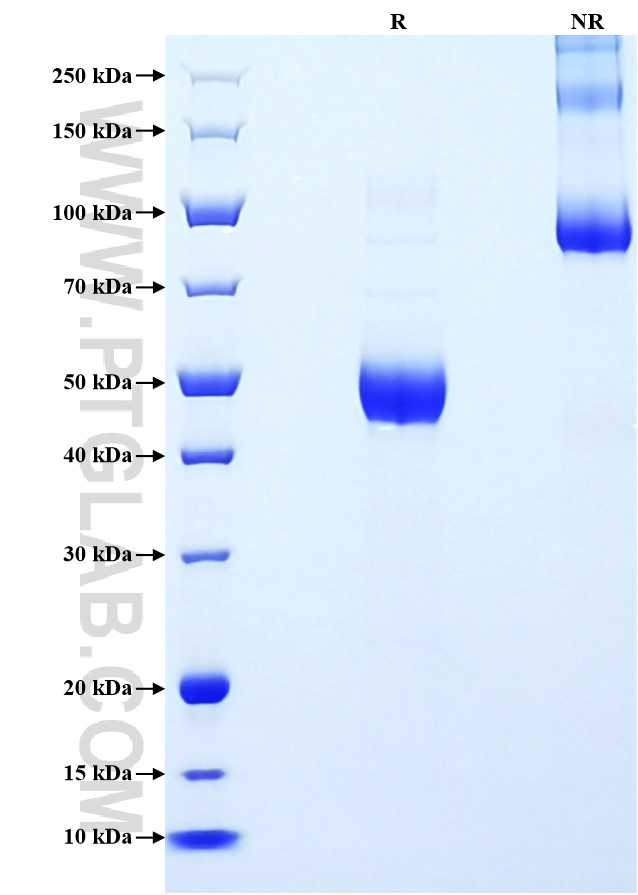
>90 %, SDS-PAGE
标签
rFc Tag
生物活性
未测试
验证数据展示
产品信息
| 纯度 | >90 %, SDS-PAGE |
| 内毒素 | <0.1 EU/μg protein, LAL method |
| 生物活性 |
Not tested |
| 来源 | HEK293-derived Mouse IL-7 protein Met+Glu26-Ile154 (Accession# Q544C8) with a rabbit IgG Fc tag at the C-terminus. |
| 基因ID | 16196 |
| 蛋白编号 | Q544C8 |
| 预测分子量 | 41.3 kDa |
| SDS-PAGE | 45-52 kDa, reducing (R) conditions |
| 组分 | Lyophilized from 0.22 μm filtered solution in PBS, pH 7.4. Normally 5% trehalose and 5% mannitol are added as protectants before lyophilization. |
| 复溶 | Briefly centrifuge the tube before opening. Reconstitute at 0.1-0.5 mg/mL in sterile water. |
| 储存条件 |
It is recommended that the protein be aliquoted for optimal storage. Avoid repeated freeze-thaw cycles.
|
| 运输条件 | The product is shipped at ambient temperature. Upon receipt, store it immediately at the recommended temperature. |
背景信息
IL-7 is one of the members of IL-2 superfamily. IL-7 is a hematopoietic growth factor secreted by stromal cells in the bone marrow and thymus. It is also produced by keratinocytes, dendritic cells, hepatocytes, neurons, and epithelial cells, but is not produced by normal lymphocytes. IL-7 plays an active role in the development, survival, maintaining and restoring homeostasis of mature T lymphocytes. It is also a key regulator of the commitment, survival, proliferation and maturation of B cells during development. Severe acute respiratory syndrome coronavirus 2 (SARS-CoV-2) infection can be a potent inducer of proinflammatory cytokines and chemokines which may defend against the infection, but may also mediate destructive lung injury. Elevated serum IL-7 levels, together with several other circulating cytokines and chemokines, has been found to be associated with the severity of Coronavirus Disease 19 (COVID-19).
参考文献:
1. Steven A Corfe. et al. (2012) Semin Immunol. 24(3):198-208.
2. Sarah R Jacobs. et al. (2010) J Immunol. 184(7):3461-9.
3. C Heufler. et al. (1993) J Exp Med. 178(3):1109-14.
4. R Kröncke. et al. (1996) Eur J Immunol. 26(10):2541-4.
5. Yukihisa Sawa. et al. (2009) Immunity.30(3):447-57.
6. Pierre Francois Laterre. et al. (2020) JAMA Netw Open. 3(7):e2016485.
