
Recombinant Mouse CD37 protein (rFc Tag)
种属
Mouse
纯度
>90 %, SDS-PAGE
标签
rFc Tag
生物活性
未测试
验证数据展示
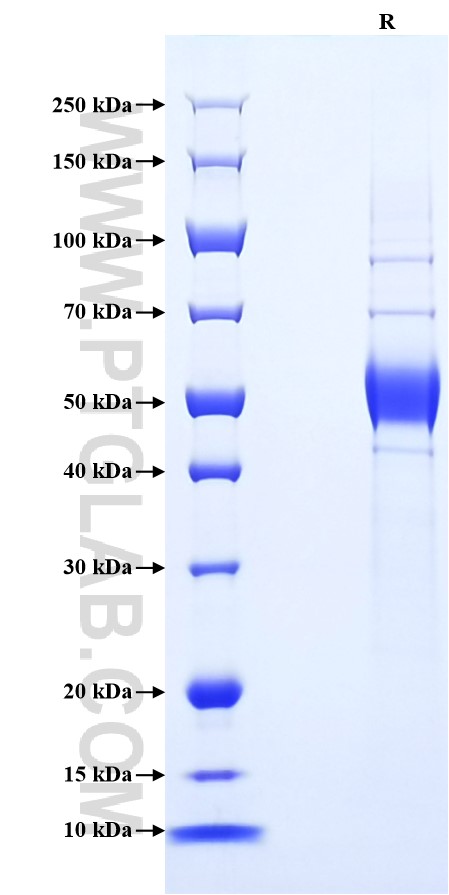
产品信息
| 纯度 | >90 %, SDS-PAGE |
| 内毒素 | <0.1 EU/μg protein, LAL method |
| 生物活性 |
Not tested |
| 来源 | HEK293-derived Mouse CD37 protein Arg112-Asn241 (Accession# Q61470) with a rabbit IgG Fc tag at the C-terminus. |
| 基因ID | 12493 |
| 蛋白编号 | Q61470 |
| 预测分子量 | 41.2 kDa |
| SDS-PAGE | 46-60 kDa, reducing (R) conditions |
| 组分 | Lyophilized from 0.22 μm filtered solution in PBS, pH 7.4. Normally 5% trehalose and 5% mannitol are added as protectants before lyophilization. |
| 复溶 | Briefly centrifuge the tube before opening. Reconstitute at 0.1-0.5 mg/mL in sterile water. |
| 储存条件 |
It is recommended that the protein be aliquoted for optimal storage. Avoid repeated freeze-thaw cycles.
|
| 运输条件 | The product is shipped at ambient temperature. Upon receipt, store it immediately at the recommended temperature. |
背景信息
CD37 (TSPAN26) is a cell surface glycoprotein that is a member of the transmembrane tetrasuperfamily of proteins (TM4SF), which are predominantly expressed on the surface of a variety of immune cells. Due to the additional carbohydrate chains, the molecular weight of CD37 fluctuates between approximately 40 and 64 kDa, CD37 is predominantly expressed in B-cells and is critical in regulating B-cell survival, shaping immune responses and immune evasion.CD37 plays a role in immune regulation and tumor suppression, and its immunotherapeutic targeting may provide additional benefit to patients with refractory B-cell malignancies. (PMID: 33333768) In acute myeloid leukemia (AML), CD37 has also been shown to be expressed on AML cells but not on normal hematopoietic stem cells (HSCs), which provides new therapeutic directions for the development of antibody-drug couplings (ADCs) targeting CD37.
参考文献:
1. Bobrowicz M,et al. Int J Mol Sci. 2020;21(24):9531.
2. Caulier B, et al. Cell Rep Med. 2024;5(6):101572.
3. van Deventer S,et al. Biophys J. 2024;123(15):2301-2311.
4. Xu-Monette ZY, et al. Blood. 2016;128(26):3083-3100.
