验证数据展示
产品信息
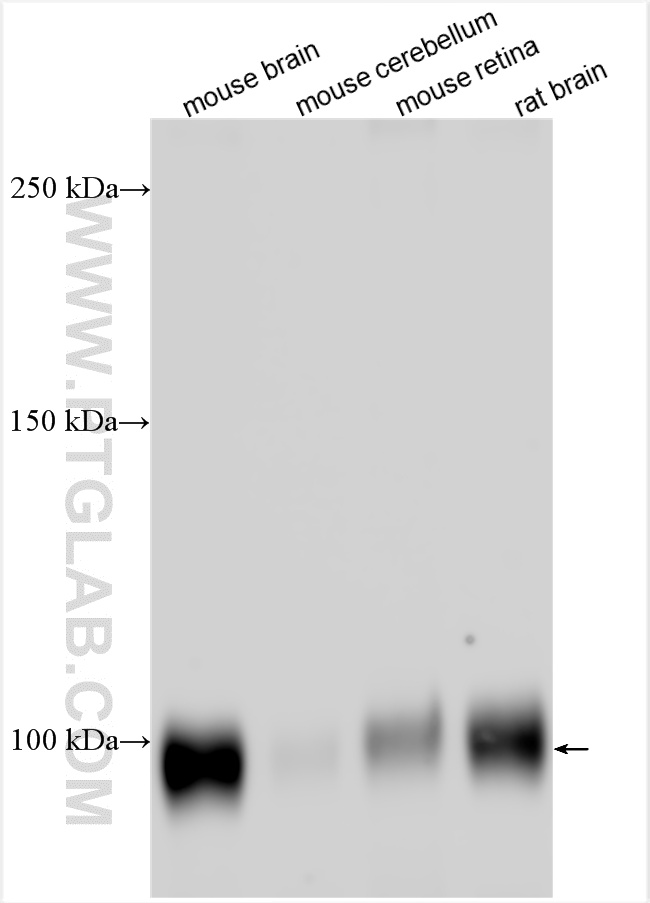
27576-1-PBS targets LRFN2 in WB, Indirect ELISA applications and shows reactivity with human, mouse, rat samples.
| 经测试应用 | WB, Indirect ELISA Application Description |
| 经测试反应性 | human, mouse, rat |
| 免疫原 |
CatNo: Ag24558 Product name: Recombinant human LRFN2 protein Source: e coli.-derived, PET28a Tag: 6*His Domain: 371-486 aa of BC142616 Sequence: MVEVSIVQLPHLSNSTSRTAPPKSRLSDITGSSKTSRGGGGSGGGEPPKSPPERAVLVSEVTTTSALVKWSVSKSAPRVKMYQLQYNCSDDEVLIYRMIPASNKAFVVNNLVSGTG 种属同源性预测 |
| 宿主/亚型 | Rabbit / IgG |
| 抗体类别 | Polyclonal |
| 产品类型 | Antibody |
| 全称 | leucine rich repeat and fibronectin type III domain containing 2 |
| 别名 | FIGLER2, KIAA1246, RP11 535K1.2, SALM1 |
| 计算分子量 | 789 aa, 85 kDa |
| 观测分子量 | 85-100 kDa |
| GenBank蛋白编号 | BC142616 |
| 基因名称 | LRFN2 |
| Gene ID (NCBI) | 57497 |
| RRID | AB_3742240 |
| 偶联类型 | Unconjugated |
| 形式 | Liquid |
| 纯化方式 | Antigen affinity purification |
| UNIPROT ID | Q9ULH4 |
| 储存缓冲液 | PBS only, pH 7.3. |
| 储存条件 | Store at -80°C. The product is shipped with ice packs. Upon receipt, store it immediately at -80°C |
背景介绍
LRFN2, also known as SALM1. It is mainly located in cell membrane and cytoplasm, and it is expressed at the synaptic contact at the base of cone cells, especially at the base of presynaptic endings, which is closely related to the dendrites of OFF bipolar cells (PMID: 40251167). In mammals, LRFN2 is mainly expressed in cone cells, but not in rod cells, and its expression in other retinal neurons is limited. In addition, the expression level in embryonic nerve cells is relatively low, mainly in more mature cells. LRFN2 plays a key role in synaptic transmission between cone cells and OFF bipolar cells. It can maintain the physical connection between cone cells and OFF bipolar cells, and gather glutamate receptors at the postsynaptic membrane to ensure strong dendritic transmission in OFF pathway, thus participating in the transmission of visual signals, which is very important for the coding of visual contrast and the defense behavior driven by looming. In bladder cancer, the increased expression of LRFN2 will inhibit the infiltration and functional transformation of CD8+ T cells, thus weakening the anti-tumor immune response, leading to bladder cancer resistance to immune checkpoint inhibitors, and its high expression is related to the poor prognosis of bladder cancer patients (PMID:37802603).