Recombinant Human ALPI protein (rFc Tag)
种属
Human
纯度
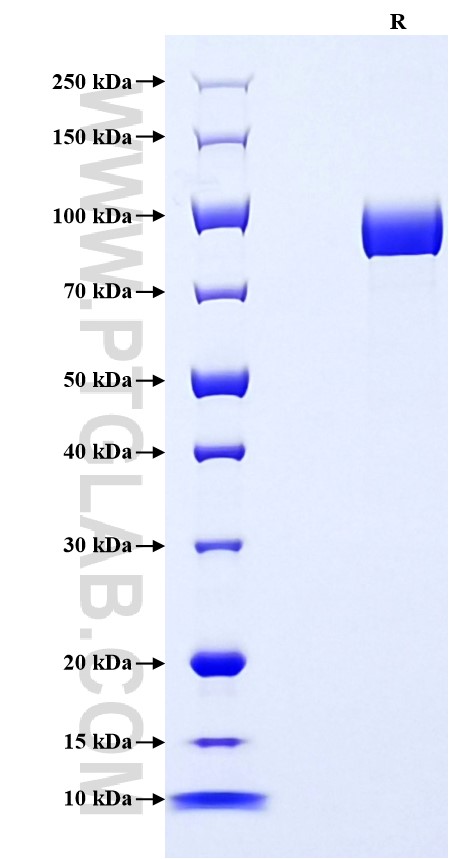
>90 %, SDS-PAGE
标签
rFc Tag
生物活性
未测试
验证数据展示
产品信息
| 纯度 | >90 %, SDS-PAGE |
| 内毒素 | <0.1 EU/μg protein, LAL method |
| 生物活性 |
Not tested |
| 来源 | HEK293-derived Human ALPI protein Val20-Asp503 (Accession# P09923) with a rabbit IgG Fc tag at the C-terminus. |
| 基因ID | 248 |
| 蛋白编号 | P09923 |
| 预测分子量 | 78.7 kDa |
| SDS-PAGE | 83-100 kDa, reducing (R) conditions |
| 组分 | Lyophilized from 0.22 μm filtered solution in PBS, pH 7.4. Normally 5% trehalose and 5% mannitol are added as protectants before lyophilization. |
| 复溶 | Briefly centrifuge the tube before opening. Reconstitute at 0.1-0.5 mg/mL in sterile water. |
| 储存条件 |
It is recommended that the protein be aliquoted for optimal storage. Avoid repeated freeze-thaw cycles.
|
| 运输条件 | The product is shipped at ambient temperature. Upon receipt, store it immediately at the recommended temperature. |
背景信息
There are at least four alkaline phosphatase isozymes (ALPs), i.e., tissue-unspecific (liver/bone/kidney), intestinal (I-), placental (P-) and germ cell or placental-like (P-like). IAP (Intestinal-type alkaline phosphatase), also known as ALPI, is found exclusively in tubuloepithelial cells of the S3-segment of the proximal tubule. IAP is mainly distributed in the intestines, but exigous synthesis has been observed in kidney, liver, and lung tissue. The sucrase and IAP are useful functional markers for intestinal epithelial cell-type cancer cells.
参考文献:
1. Verpooten, G. F., et al. (1989). Kidney Int. Oct;36(4):617-25.
2. Giatromanolaki A, et al. (2002). Semin Oncol. Dec;29(6 Suppl 19):14-21.
3. Nakamura W, et al. (1998). Jpn J Cancer Res. Feb;89(2):186-91.
4. Harada T, et al. (2003). Am J Physiol Gastrointest Liver Physiol. Feb;284(2):G255-G262.