
验证数据展示



经过测试的应用
| Positive WB detected in | HEK-293 cells, LNCaP cells, HeLa cells, MCF-7 cells, K-562 cells, HSC-T6 cells, NIH/3T3 cells, 4T1 cells, Jurkat cells |
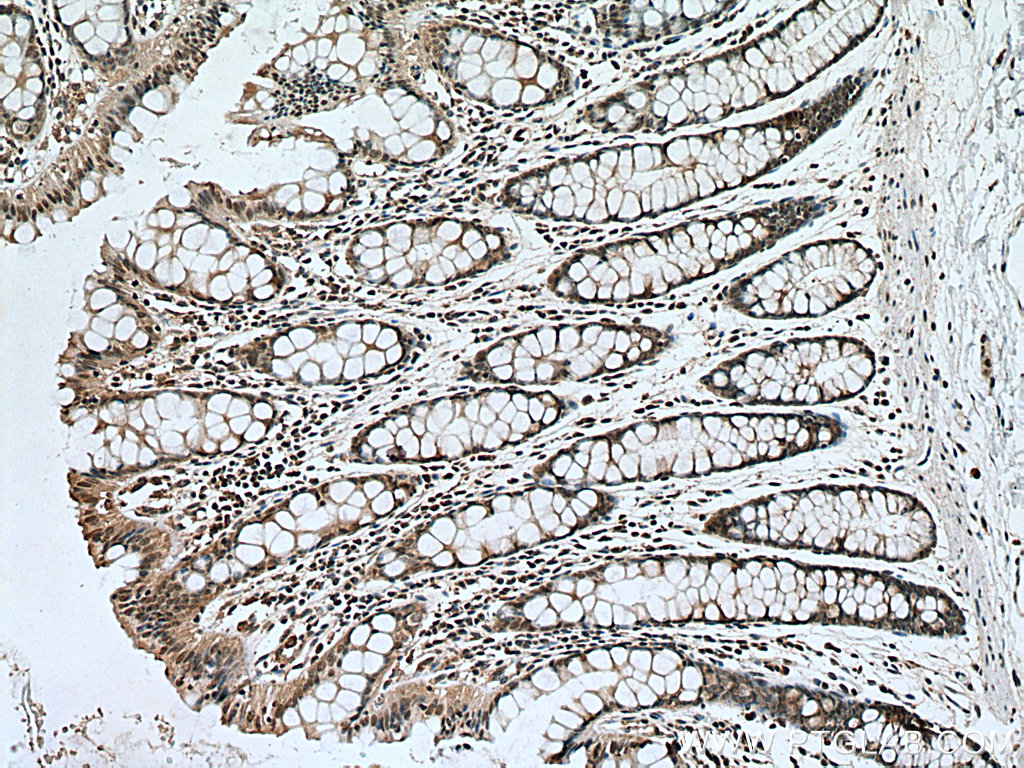
| Positive IHC detected in | human colon tissue Note: suggested antigen retrieval with TE buffer pH 9.0; (*) Alternatively, antigen retrieval may be performed with citrate buffer pH 6.0 |
| Positive IF/ICC detected in | HeLa cells |
推荐稀释比
| 应用 | 推荐稀释比 |
|---|---|
| Western Blot (WB) | WB : 1:5000-1:50000 |
| Immunohistochemistry (IHC) | IHC : 1:200-1:800 |
| Immunofluorescence (IF)/ICC | IF/ICC : 1:400-1:1600 |
| It is recommended that this reagent should be titrated in each testing system to obtain optimal results. | |
| Sample-dependent, Check data in validation data gallery. | |
产品信息
67644-1-Ig targets PI3 Kinase p85 Beta in WB, IHC, IF/ICC, ELISA applications and shows reactivity with human, mouse, rat samples.
| 经测试应用 | WB, IHC, IF/ICC, ELISA Application Description |
| 文献引用应用 | WB, IHC, IF |
| 经测试反应性 | human, mouse, rat |
| 文献引用反应性 | human, mouse, rat |
| 免疫原 |
CatNo: Ag14369 Product name: Recombinant human PIK3R2 protein Source: e coli.-derived, PET28a Tag: 6*His Domain: 1-324 aa of BC014170 Sequence: YRHESLAQYNAKLDTRLLYPVSKYQQDQIVKEDSVEAVGAQLKVYHQQYQDKSREYDQLYEEYTRTSQELQMKRTAIEAFNETIKIFEEQGQTQEKCSKEYLERFRREGNEKEMQRILLNSERLKSRIAEIHESRTKLEQQLRAQASDNREIDKRMNSLKPDLMQLRKIRDQYLVWLTQKGARQKKINEWLGIKNETEDQYALMEDEDDLPHHEERTWYVGKINRTQAEEMLSGKRDGTFLIRESSQRGCYACSVVVDGDTKHCVIYRTATGFGFAEPYNLYGSLKELVLHYQHASLVQHNDALTVTLAHPVRAPGPGPPPAAR 种属同源性预测 |
| 宿主/亚型 | Mouse / IgG2b |
| 抗体类别 | Monoclonal |
| 产品类型 | Antibody |
| 全称 | phosphoinositide-3-kinase, regulatory subunit 2 (beta) |
| 别名 | PI3K p85 β, PI3K p85(beta), PI3K p85β, PIK3R2, 2B3B6 |
| 计算分子量 | 728 aa, 82 kDa |
| 观测分子量 | 85 kDa |
| GenBank蛋白编号 | BC014170 |
| 基因名称 | PI3 Kinase p85 Beta |
| Gene ID (NCBI) | 5296 |
| RRID | AB_2882844 |
| 偶联类型 | Unconjugated |
| 形式 | Liquid |
| 纯化方式 | Protein A purification |
| UNIPROT ID | O00459 |
| 储存缓冲液 | PBS with 0.02% sodium azide and 50% glycerol, pH 7.3. |
| 储存条件 | Store at -20°C. Stable for one year after shipment. Aliquoting is unnecessary for -20oC storage. |
背景介绍
PI3 Kinase p85 is also named as PIK3R2 and belongs to the PI3K p85 subunit family. PI3 Kinase p85 is a regulatory subunit of phosphoinositide-3-kinase (PI3K) which is a kinase that phosphorylates phosphatidylinositol 4,5-bisphosphate to generate PIP3. PI3 Kinase p85 binds to activated (phosphorylated) protein-tyrosine kinases through its SH2 domain, and then acts as an adapter to mediate the association of the p110 catalytic unit to the plasma membrane. It promotes nuclear translocation of XBP1 isoform 2 in a ER stress or insulin-dependent manner during metabolic overloading in the liver and hence plays a role in glucose tolerance improvement (PMID:23604317).
实验方案
| Product Specific Protocols | |
|---|---|
| IF protocol for PI3 Kinase p85 Beta antibody 67644-1-Ig | Download protocol |
| IHC protocol for PI3 Kinase p85 Beta antibody 67644-1-Ig | Download protocol |
| WB protocol for PI3 Kinase p85 Beta antibody 67644-1-Ig | Download protocol |
| Standard Protocols | |
|---|---|
| Click here to view our Standard Protocols |
发表文章
| Species | Application | Title |
|---|---|---|
Cell Death Dis NAT10-mediated N4-acetylcytidine (ac4C) modification of PIK3R2 mRNA promotes malignant progression of glioblastoma. | ||
J Ethnopharmacol Longdan Xiegan Tang attenuates liver injury and hepatic insulin resistance by regulating the angiotensin-converting enzyme 2/Ang (1-7)/Mas axis-mediated anti-inflammatory pathway in rats. | ||
Liver Int MiR-126-3p and MiR-195-5p as Novel Therapeutic Attenuators of Liver Fibrosis by Targeting the IRS1/PI3K Signalling Pathway | ||
Pharmaceuticals (Basel) Exploring the Anti-Cervical Cancer Effect and Hepatotoxicity Risk of Gossypol Based on Untargeted Metabolomics and Network Toxicology. | ||
Int Immunopharmacol Characterization of PANoptosis-related genes with immunoregulatory features in osteoarthritis | ||
Front Pharmacol YX-112, a novel celastrol-derived PROTAC, inhibits the development of triple-negative breast cancer by targeting the degradation of multiple proteins |
