
Recombinant Human ICOS/CD278 protein (hFc Tag, Myc Tag, His Tag)
种属
Human
纯度
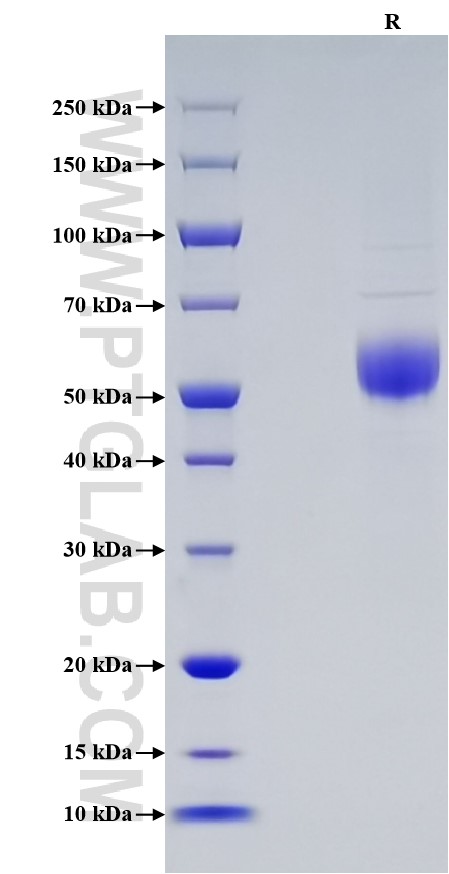
>90 %, SDS-PAGE
标签
hFc Tag, Myc Tag, His Tag
生物活性
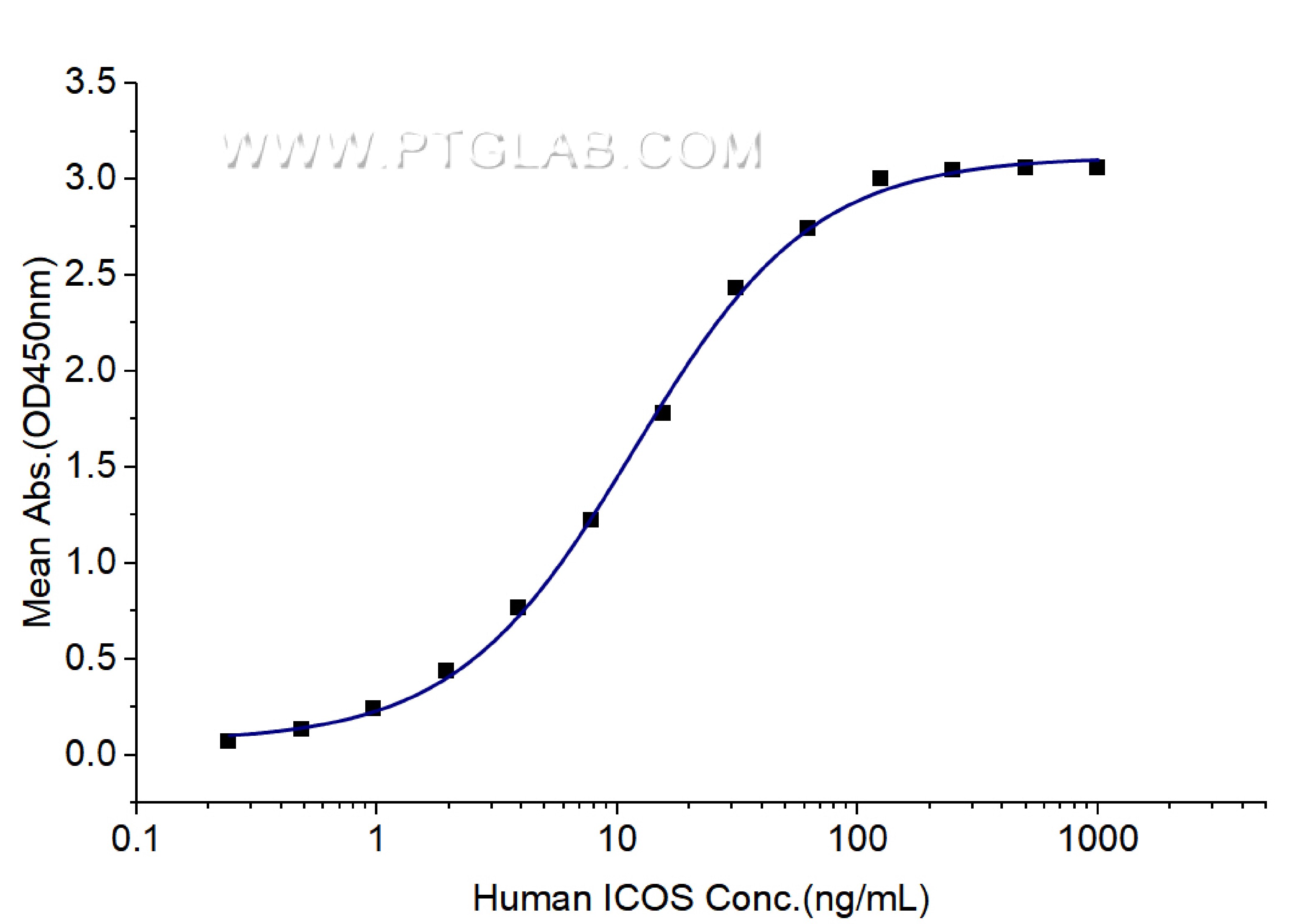
EC50: 6-24 ng/mL
验证数据展示
产品信息
| 纯度 | >90 %, SDS-PAGE |
| 内毒素 | <0.1 EU/μg protein, LAL method |
| 生物活性 |
Immobilized Human ICOSLG (Myc tag, His tag) at 0.5 μg/mL (100 μL/well) can bind Human ICOS (hFc tag, Myc tag, His tag) with a linear range of 6-24 ng/mL. |
| 来源 | HEK293-derived Human ICOS protein Glu21-Lys140 (Accession# Q9Y6W8) with a human IgG1 Fc tag, a Myc tag,a His tag at the C-terminus. |
| 基因ID | 29851 |
| 蛋白编号 | Q9Y6W8 |
| 预测分子量 | 42.1 kDa |
| SDS-PAGE | 50-60 kDa, reducing (R) conditions |
| 组分 | Lyophilized from 0.22 μm filtered solution in PBS, pH 7.4. Normally 5% trehalose and 5% mannitol are added as protectants before lyophilization. |
| 复溶 | Briefly centrifuge the tube before opening. Reconstitute at 0.1-0.5 mg/mL in sterile water. |
| 储存条件 |
It is recommended that the protein be aliquoted for optimal storage. Avoid repeated freeze-thaw cycles.
|
| 运输条件 | The product is shipped at ambient temperature. Upon receipt, store it immediately at the recommended temperature. |
背景信息
Inducible T-cell costimulator (ICOS) is an activation-dependent, T cell-specific cell surface molecule related to CD28 and CTLA-4. ICOS enhances all basic T-cell responses to a foreign antigen, namely proliferation, secretion of lymphokines, up-regulation of molecules that mediate cell-cell interaction, and effective help for antibody secretion by B-cells. ICOS has to be de novo induced on the T-cell surface, does not upregulate the production of interleukin-2, but superinduces the synthesis of interleukin-10, a B-cell-differentiation factor. ICOS activated T-cells, Highly expressed on tonsillar T-cells, are closely associated with B-cells in the apical light zone of germinal centers, the site of terminal B-cell maturation. It is expressed at lower levels in thymus, lung, lymph node, and peripheral blood leukocytes. It is also expressed in the medulla of the fetal and newborn thymus.
参考文献:
1. Beier KC, et al. (2000). Eur J Immunol. 30(12):3707-17.
2. Hutloff A, et al. (1999). Nature. 397(6716):263-266.
3. Tezuka K, et al. (2000). Biochem Biophys Res Commun. 276(1):335-345.
