
Recombinant Mouse CLEC9A protein (mFc Tag)
种属
Mouse
纯度
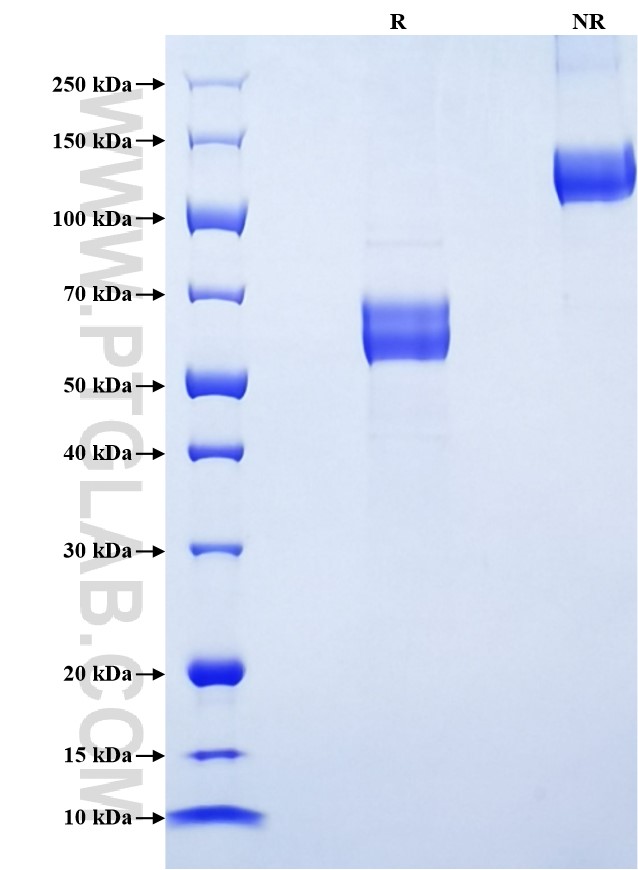
>90 %, SDS-PAGE
标签
mFc Tag
生物活性
未测试
验证数据展示
产品信息
| 纯度 | >90 %, SDS-PAGE |
| 内毒素 | <0.1 EU/μg protein, LAL method |
| 生物活性 |
Not tested |
| 来源 | HEK293-derived Mouse CLEC9A protein Lys57-Ile264 (Accession# Q8BRU4-4) with a mouse IgG Fc tag at the C-terminus. |
| 基因ID | 232414 |
| 蛋白编号 | Q8BRU4-4 |
| 预测分子量 | 50.3 kDa |
| SDS-PAGE | 55-70 kDa, reducing (R) conditions |
| 组分 | Lyophilized from 0.22 μm filtered solution in PBS, pH 7.4. Normally 5% trehalose and 5% mannitol are added as protectants before lyophilization. |
| 复溶 | Briefly centrifuge the tube before opening. Reconstitute at 0.1-0.5 mg/mL in sterile water. |
| 储存条件 |
It is recommended that the protein be aliquoted for optimal storage. Avoid repeated freeze-thaw cycles.
|
| 运输条件 | The product is shipped at ambient temperature. Upon receipt, store it immediately at the recommended temperature. |
背景信息
CLEC9A (C-type lectin domain family 9 member A), also known as DNGR1, CD370, is a type II membrane protein that contains C-type lectin domain. The C-type lectin domain family members share a common protein fold and have diverse functions, such as cell adhesion, cell-cell signaling, glycoprotein turnover, and roles in inflammation and immune response. Mouse Clec9A is primarily restricted to dendritic cells (DCs) and selectively expressed in mouse CD8+ conventional DCs (cDCs) and plasmacytoid DCs (pDCs), whereas human CLEC9A is also expressed on human DC subtypes. CLEC9A functions as an activating receptor that recruits Syk kinase and can induce the production of proinflammatory cytokines.
参考文献:
1.Dambuza IM, et al. (2015) Curr Opin Immunol. 32:21-7.
2.McGreal EP, et al. (2004) Mol Immunol. 41(11):1109-21.
3.Caminschi I, et al. (2008)  Blood. 15;112(8):3264-73
4.Huysamen C, et al. (2008) J Biol Chem. 13;283(24):16693-701.
