
Recombinant Human Nectin-1/PVRL1 protein (rFc Tag)(HPLC verified)
种属
Human
纯度
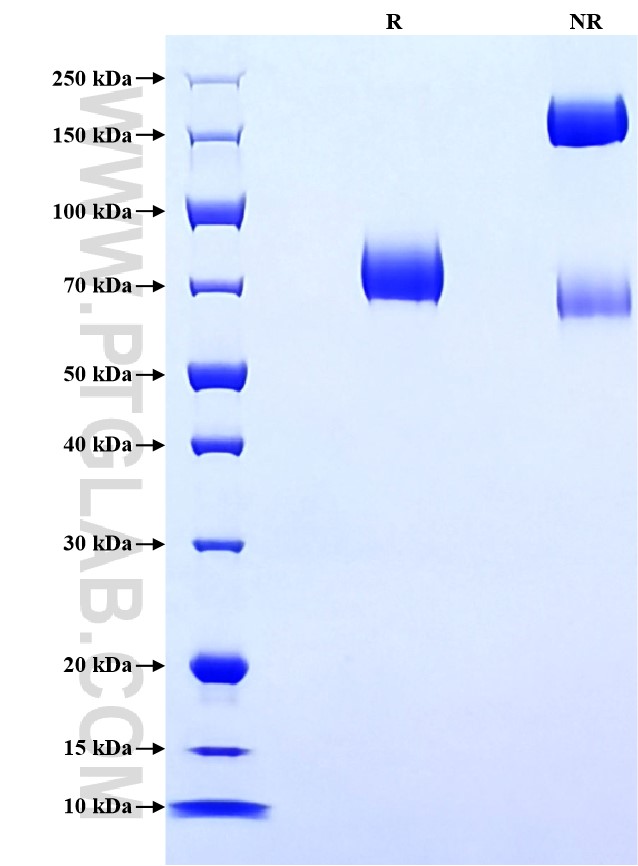
>90 %, SDS-PAGE
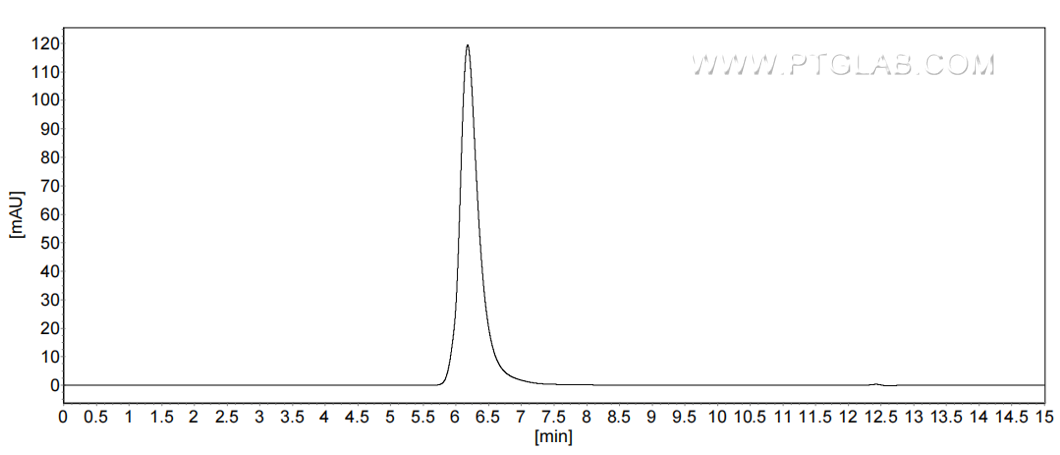
>90 %, SEC-HPLC
标签
rFc Tag
生物活性
未测试
验证数据展示
产品信息
| 纯度 | >90 %, SDS-PAGE >90 %, SEC-HPLC |
| 内毒素 | <0.1 EU/μg protein, LAL method |
| 生物活性 |
Not tested |
| 来源 | HEK293-derived Human Nectin-1 protein Gln31-Thr334 (Accession# Q15223-1) with a rabbit IgG Fc tag at the C-terminus. |
| 基因ID | 5818 |
| 蛋白编号 | Q15223-1 |
| 预测分子量 | 60.2 kDa |
| SDS-PAGE | 65-85 kDa, reducing (R) conditions |
| 组分 | Lyophilized from 0.22 μm filtered solution in PBS, pH 7.4. Normally 5% trehalose and 5% mannitol are added as protectants before lyophilization. |
| 复溶 | Briefly centrifuge the tube before opening. Reconstitute at 0.1-0.5 mg/mL in sterile water. |
| 储存条件 |
It is recommended that the protein be aliquoted for optimal storage. Avoid repeated freeze-thaw cycles.
|
| 运输条件 | The product is shipped at ambient temperature. Upon receipt, store it immediately at the recommended temperature. |
背景信息
Nectins are a family of immunoglobulin-like cell adhesion molecules comprising four members, nectin-1 to nectin-4, each consisting of an extracellular region with three immunoglobulin-like loops, a single transmembrane domain and a cytoplasmic domain (PMID: 12901789, 18703497). Nectins are involved in cell adhesion, migration, polarization, morphogenesis, proliferation, differentiation, and survival. Nectin-1, also known as PVRL1, HVEC and CD111, is widely expressed in a variety of cell types including epithelial cells, neurons, and fibroblasts (PMID: 12901789). It promotes cell-cell contacts by forming homophilic or heterophilic trans-dimers. Nectin-1 acts as a receptor for several alphaherpesviruses, including herpes simplex viruses (HSV) 1 and 2, porcine pseudorabies virus (PRV), and bovine herpesvirus 1 (BHV-1) (PMID: 9616127). Nectin-1 is a glycoprotein, the glycosylated form has a larger apparent molecular weight than the calculated molecular weight (PMID: 12376527; 15731277).
参考文献:
1. Takai Y. et al. (2003). Cancer Sci. 94(8):655-667.
2. Barron MJ. et al. (2008). Hum Mol Genet. 17(22):3509-3520.
3. Geraghty RJ. et al. (1998). Science. 280(5369):1618-1620.
4. Kim DY. et al. (2002). J Biol Chem. 277(51):49976-49981.
5. Struyf F. et al. (2005). J Virol. 79(6):3841-3845.
