
Recombinant Human CD122/IL-2RB protein (His Tag)
种属
Human
纯度
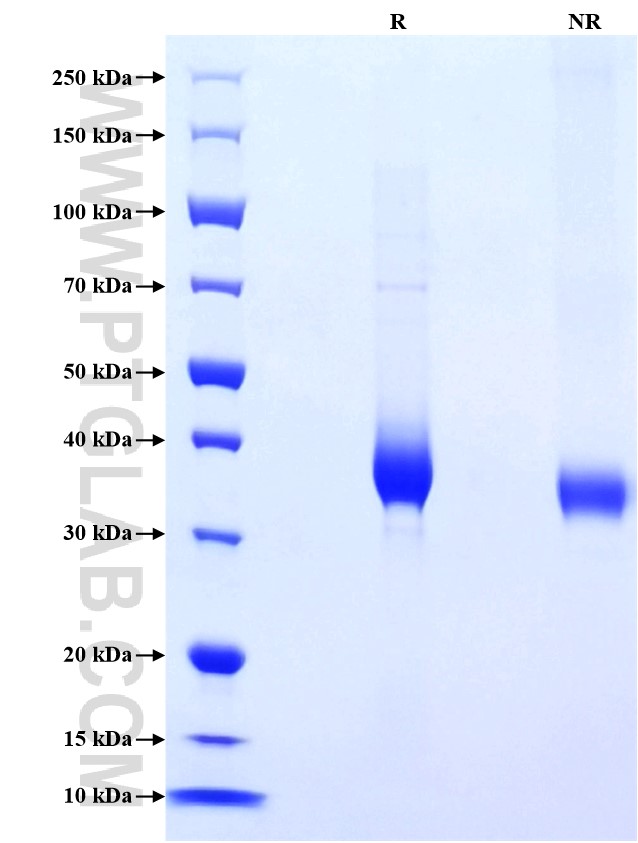
>90 %, SDS-PAGE
标签
His Tag
生物活性
未测试
验证数据展示
产品信息
| 纯度 | >90 %, SDS-PAGE |
| 内毒素 | <0.1 EU/μg protein, LAL method |
| 生物活性 |
Not tested |
| 来源 | HEK293-derived Human CD122 protein Ala27-Asp239 (Accession# P14784) with a His tag at the C-terminus. |
| 基因ID | 3560 |
| 蛋白编号 | P14784 |
| 预测分子量 | 25.7 kDa |
| SDS-PAGE | 32-40 kDa, reducing (R) conditions |
| 组分 | Lyophilized from 0.22 μm filtered solution in PBS, pH 7.4. Normally 5% trehalose and 5% mannitol are added as protectants before lyophilization. |
| 复溶 | Briefly centrifuge the tube before opening. Reconstitute at 0.1-0.5 mg/mL in sterile water. |
| 储存条件 |
It is recommended that the protein be aliquoted for optimal storage. Avoid repeated freeze-thaw cycles.
|
| 运输条件 | The product is shipped at ambient temperature. Upon receipt, store it immediately at the recommended temperature. |
背景信息
The interleukin 2 receptor, which is involved in T cell-mediated immune responses, is present in 3 forms with respect to ability to bind interleukin 2. The low affinity form is a monomer of the alpha subunit and is not involved in signal transduction. The intermediate affinity form consists of an alpha/beta subunit heterodimer, while the high affinity form consists of an alpha/beta/gamma subunit heterotrimer. The beta subunit (IL2RB, also known as CD122 and p75) is involved in receptor mediated endocytosis and transduces the mitogenic signals of nterleukin 2. As one of subunits for interleukin-2 receptor (IL-2R), CD122 can bind to IL-2 and then activate downstream signal transduction to participate in adaptive immune response. IL-2RB is receptor for interleukin-2. This beta subunit is involved in receptor mediated endocytosis and transduces the mitogenic signals of IL2. It is probably in association with IL15RA, involved in the stimulation of neutrophil phagocytosis by IL15.
参考文献:
1.Geng M, et al. (2024). Fish Shellfish Immunol. 153:109839.
2.Ratthé C, Girard D. (2004). J Leukoc Biol. 76(1):162-8.
3.Zhang Z, et al. (2019). J Exp Med. 216(6):1311-1327.
