
Recombinant Human EPHB6 protein (rFc Tag)
种属
Human
纯度
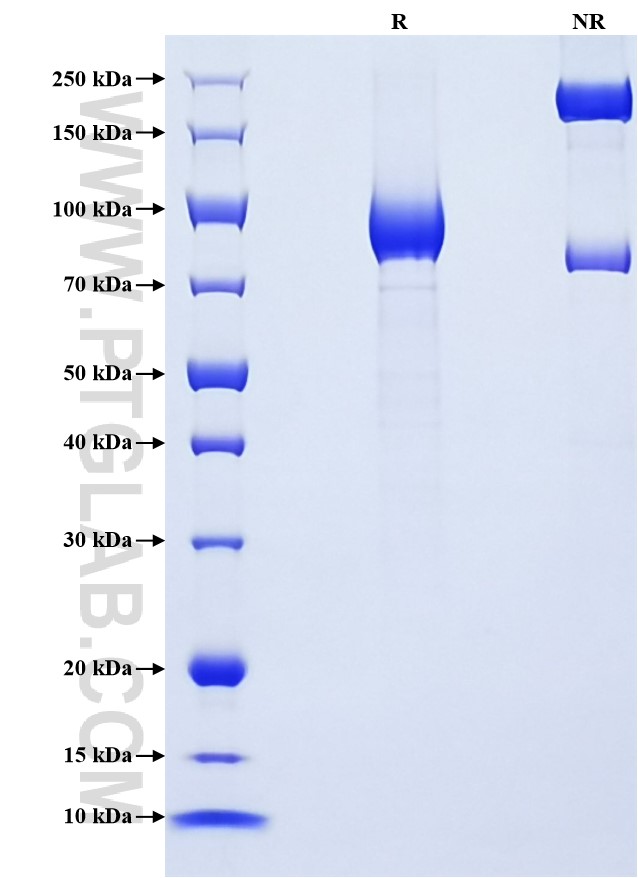
>90 %, SDS-PAGE
标签
rFc Tag
生物活性
未测试
验证数据展示
产品信息
| 纯度 | >90 %, SDS-PAGE |
| 内毒素 | <0.1 EU/μg protein, LAL method |
| 生物活性 |
Not tested |
| 来源 | HEK293-derived Human EPHB6 protein Leu32-Ser594 (Accession# O15197-1) with a rabbit IgG Fc tag at the C-terminus. |
| 基因ID | 2051 |
| 蛋白编号 | O15197-1 |
| 预测分子量 | 86.4 kDa |
| SDS-PAGE | 85-100 kDa, reducing (R) conditions |
| 组分 | Lyophilized from 0.22 μm filtered solution in PBS, pH 7.4. Normally 5% trehalose and 5% mannitol are added as protectants before lyophilization. |
| 复溶 | Briefly centrifuge the tube before opening. Reconstitute at 0.1-0.5 mg/mL in sterile water. |
| 储存条件 |
It is recommended that the protein be aliquoted for optimal storage. Avoid repeated freeze-thaw cycles.
|
| 运输条件 | The product is shipped at ambient temperature. Upon receipt, store it immediately at the recommended temperature. |
背景信息
EPHB6 (Eph receptor B6) belongs to the Eph receptor family and is a receptor tyrosine pseudokinase that lacks intrinsic kinase activity and regulates cell adhesion and migration by binding to ephrin-B family proteins. EphB6 is a protein expressed in all tissues, and has been shown to be important for the maintenance of physiological homeostasis in areas such as the kidneys, vascular smooth muscle, and immune system T cells. EphB6 is a protein expressed in all tissues and has been shown to be important for the maintenance of physiological homeostasis in areas such as the kidney, vascular smooth muscle and T cells of the immune system. (PMID: 34360976) The role of EphB6 in cancer is quite complex as it not only down-regulates and inhibits the invasiveness of a wide range of malignant tumors and cancer cells, but also supports tumorigenesis in colorectal and breast cancers. It is now suggested that the interaction of EphB6 and hepcidin B1 may control tumorigenesis, e.g., the co-aggregation of EphB6 and ephrinB1 reduced the invasiveness of the breast cancer cell line MDA-MB-231.
参考文献:
1. Strozen TG, et al. Int J Mol Sci. 2021;22(15):8211.
2. Liang LY, et al. Commun Biol. 2024;7(1):461.
