验证数据展示
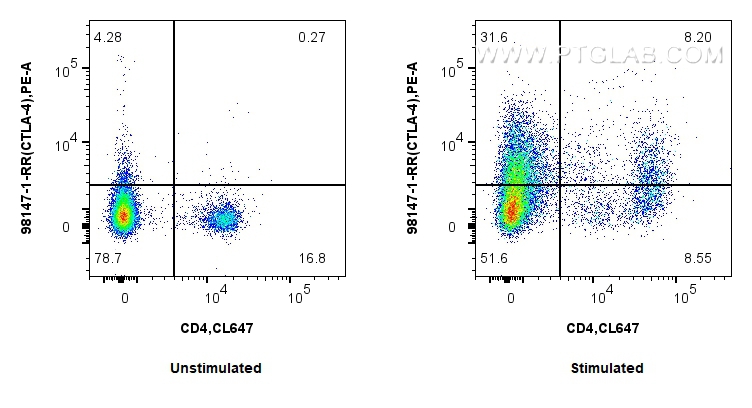
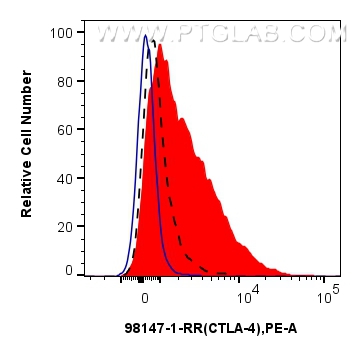
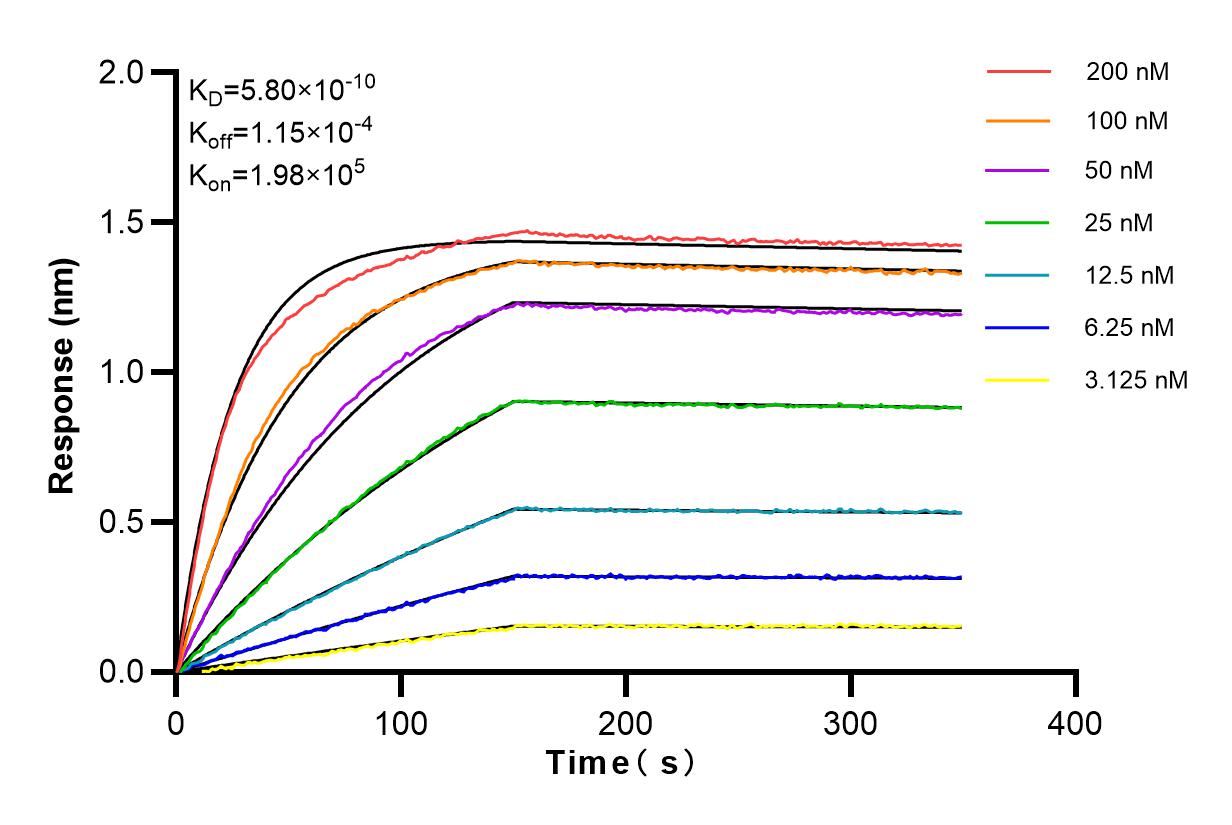
经过测试的应用
| Positive FC detected in | Con A treated mouse splenocytes |
推荐稀释比
| 应用 | 推荐稀释比 |
|---|---|
| Flow Cytometry (FC) | FC : 0.25 ug per 10^6 cells in 100 μl suspension |
| This reagent has been tested for flow cytometric analysis. It is recommended that this reagent should be titrated in each testing system to obtain optimal results. | |
| Sample-dependent, Check data in validation data gallery. | |
发表文章中的应用
| FC | See 1 publications below |
产品信息
98147-1-RR targets CTLA-4/CD152 in FC applications and shows reactivity with mouse samples.
| 经测试应用 | FC Application Description |
| 文献引用应用 | FC |
| 经测试反应性 | mouse |
| 文献引用反应性 | mouse |
| 免疫原 |
CatNo: Eg0632 Product name: Recombinant Mouse CTLA-4 protein (His Tag) Source: mammalian cells-derived, pHZ-KIsec-C-6*HIS Tag: C-6*HIS Domain: 36-162 aa of NM_009843.4 Sequence: EAIQVTQPSVVLASSHGVASFPCEYSPSHNTDEVRVTVLRQTNDQMTEVCATTFTEKNTVGFLDYPFCSGTFNESRVNLTIQGLRAVDTGLYLCKVELMYPPPYFVGMGNGTQIYVIDPEPCPDSDF 种属同源性预测 |
| 宿主/亚型 | Rabbit / IgG |
| 抗体类别 | Recombinant |
| 产品类型 | Antibody |
| 全称 | cytotoxic T-lymphocyte-associated protein 4 |
| 别名 | Ctla4, 241100B8, Cd152, CTLA-4, Ly 56 |
| 计算分子量 | 25 kDa |
| GenBank蛋白编号 | NM_009843.4 |
| 基因名称 | CTLA-4 |
| Gene ID (NCBI) | 12477 |
| RRID | AB_3672292 |
| 偶联类型 | Unconjugated |
| 形式 | Liquid |
| 纯化方式 | Protein A purfication |
| UNIPROT ID | P09793 |
| 储存缓冲液 | PBS with 0.09% sodium azide, pH 7.3. |
| 储存条件 | Store at 2 - 8°C. Stable for one year after shipment. |
背景介绍
CTLA-4, also known as CD152, belonging to the immunoglobulin superfamily, is primarily found on activated T cells and regulatory T cells (Tregs). CTLA-4 is closely related to the T-cell costimulatory CD28, and both molecules bind to B7-1 and B7-2 on antigen-presenting cells. CTLA-4 acts as a negative regulatory molecule of T-cell responses. Besides the full-length transmembrane form, CTLA-4 also exists in a truncated soluble form (sCTLA-4).
实验方案
| Product Specific Protocols | |
|---|---|
| FC protocol for CTLA-4/CD152 antibody 98147-1-RR | Download protocol |
| Standard Protocols | |
|---|---|
| Click here to view our Standard Protocols |