Use Able AI chat for product recommendations

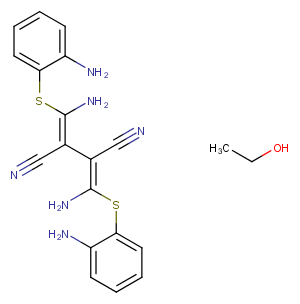
U0126-EtOH

U0126-EtOH (U0126 Ethanol) 是一种非 ATP 竞争性的MEK1 (IC50=72 nM) 和MEK2 (IC50=58 nM) 抑制剂,具有选择性。U0126-EtOH 可抑制自噬和线粒体自噬。

CAS号

1173097-76-1

分子式

C18H16N6S2·C2H6O

主要靶点

MEK|Mitophagy|Autophagy|Influenza Virus

仅限科研使用

Cat No : CM05075

Print datasheet

Synonyms

Autophagy|competitive|MAPKK|MAP2K|non-ATP|Mitochondrial Autophagy|Mitogen-activated protein kinase kinase|Mitophagy|Inhibitor|inhibit|MEK1|MEK2|MEK|InfluenzaVirus|Influenza Virus|virus|progeny|U-0126|U0126 Ethanol|U0126 EtOH|U0126EtOH|U-0126-EtOH|U0126-EtOH|U0126|U 0126


产品信息

U0126-etoh (U0126 Ethanol) is a non-ATP competitive inhibitor of MEK1 (IC50=72 nM) and MEK2 (IC50=58 nM) with selectivity. U0126-EtOH inhibited autophagy and mitophagy.

CAS号 1173097-76-1
分子式 C18H16N6S2·C2H6O
主要靶点 MEK|Mitophagy|Autophagy|Influenza Virus
主要通路 自噬|MAPK 信号通路|微生物学|自噬
分子量 426.6
纯度 99.88%, 此纯度可做参考,具体纯度与批次有关系,可咨询客服
储存条件 Powder: -20°C for 3 years | In solvent: -80°C for 1 year Shipping with blue ice/Shipping at ambient temperature.
别名 Autophagy|competitive|MAPKK|MAP2K|non-ATP|Mitochondrial Autophagy|Mitogen-activated protein kinase kinase|Mitophagy|Inhibitor|inhibit|MEK1|MEK2|MEK|InfluenzaVirus|Influenza Virus|virus|progeny|U-0126|U0126 Ethanol|U0126 EtOH|U0126EtOH|U-0126-EtOH|U0126-EtOH|U0126|U 0126

靶点活性

MDCKII cells (H1N1v):74.7 ± 1.0 μM (EC50)|MEK2:60 nM (cell free)|MEK1:70 nM (cell free)|A549 cells (H1N1v):1.2 ± 0.4 μM (EC50)

体内活性

方法:为研究U0126-EtOH的抗肿瘤活性,每天将U0126-EtOH(10.5 mg/kg)腹腔注射给小鼠治疗。 结果:U0126-EtOH导致肿瘤植入和早期生长显著减少,注射9天后的肿瘤体积减少了60-70%,此后一直保持这种状态。[4] 方法:为研究U0126-EtOH对血管收缩的影响,大鼠接受120分钟的暂时性中脑动脉阻塞(tMCAO),再将U0126-EtOH(30 mg/kg)腹腔注射给大鼠。 结果:用U0126-EtOH处理后,对S6c的血管收缩显著减少。[5]

体外活性

方法:COS-7细胞用U0126-EtOH处理后检测AP-1转录活性。 结果:U0126-EtOH抑制AP-1转录活性(IC50=1 μM)。[1] 方法:HCT116细胞用U0126-EtOH处理后使用软琼脂生长实验检测克隆形成,HeLa细胞用U0126-EtOH处理后检测Elk1-荧光素酶报告基因。 结果:U0126-EtOH抑制贴壁非依赖性集落形成(IC50=19.4 μM),U0126-EtOH抑制EGF刺激的Elk1荧光素酶报告基因(IC50=0.29 μM)。[2] 方法:小鼠RAS-3T3细胞用U0126-EtOH处理后使用ELISA方法检测ERK1/2磷酸化水平。 结果:10-40 μM的U0126-EtOH抑制MEK介导的ERK1/2磷酸化。[3]

溶解度

DMSO:255 mg/mL (597.75 mM);10% DMSO+40% PEG300+5% Tween 80+45% Saline:7.9 mg/mL (18.52 mM);Ethanol:< 1 mg/mL (insoluble or slightly soluble)

细胞实验

HEK293 cells were maintained in Dulbecco's modification of Eagle's medium (low glucose) plus 10% foetal bovine serum. HeLa cells stably expressing wild type or kinase-dead LKB1 have been described. AMPK activity was determined by immunoprecipitate kinase assays using anti-AMPK-a1 and -a2 antibodies. Antibodies recognising AMPK phosphorylated on Thr-172 (anti-pT172), AMPK-α1 and -α2 and acetyl-CoA carboxylase-1 (ACC1) phosphorylated on Ser-80 [16] were described previously. Quantification of ratios of signals from phosphorylated and total protein using these antibodies was performed by dual labelling using the LI-COR Odyssey IR imager as described. Contents of ATP and ADP were determined for cells in 6 cm culture dishes by quickly pouring off the medium, adding 350 μl of ice-cold 5% perchloric acid, scraping the cells off with a plastic scraper, and centrifuging (14 000 · g; 3 min, 4 °C) to remove insoluble material. The perchloric acid was then extracted from the supernatant and nucleotides analysed by capillary electrophoresis of perchloric acid extracts as described previously. All incubations of cells were performed in triplicate and results are expressed as means ± S.E.M [3].

动物实验

Prior to injection, FI cells were labeled with a stable fluorescent dye molecule, DiA at 10 μg/ml for 5 h at 37 1C. After washing to remove free DiA, cells were trypsinized for inoculation (U0126 experiments) or transfection (RNAi experiments). Biliary epithelial cells were injected subcutaneously, at the indicated times, into the tibia of nude mice. In the chemical experiments, 3h after inoculation, mice were treated with U0126 (10.5 mg/kg) daily by intraperitoneal injection. The length and width of each tumor were measured every day by using a caliper. The following formula was used to calculate tumor volumes ? width2 length/2. Mice were killed at the end of experiment. Tumors were immediately frozen in liquid nitrogen [5].

参考文献

1.Wityak J, et al. Beyond U0126.  Dianion chemistry leading to the rapid synthesis of a series of potent MEK inhibitors. Bioorg Med Chem Lett. 2004 Mar 22;14(6):1483-6.
2.Zhou B, Yan J, Guo L, et al. Hepatoma cell-intrinsic TLR9 activation induces immune escape through PD-L1 upregulation in hepatocellular carcinoma[J]. Theranostics. 2020, 10(14): 6530.
3.Lu Y, et al. Solution phase parallel synthesis and evaluation of MAPK inhibitory activities of close structural analogues of a Ras pathway modulator. Bioorg Med Chem Lett. 2004 Aug 2;14(15):3957-62.
4.Szymanski W, et al. Synthesis of novel, peptidic kinase inhibitors with cytostatic/cytotoxic activity. Bioorg Med Chem. 2014 Mar 1;22(5):1773-81.
5.Bessard A, et al. RNAi-mediated ERK2 knockdown inhibits growth of tumor cells in vitro and in vivo. Oncogene. 2008 Sep 11;27(40):5315-25.
6.Ahnstedt H, et al. U0126 attenuates cerebral vasoconstriction and improves long-term neurologic outcome after stroke in female rats. J Cereb Blood Flow Metab. 2015 Mar;35(3):454-60.
7.Ahnstedt H, et al. U0126 attenuates cerebral vasoconstriction and improves long-term neurologic outcome after stroke in female rats. J Cereb Blood Flow Metab. 2015 Mar;35(3):454-60.
8.Zeng H, Pathak J L, Shi Y, et al. Indirect selective laser sintering-printed microporous biphasic calcium phosphate scaffold promotes endogenous bone regeneration via activation of ERK1/2 signaling[J]. Biofabrication. 2020, 12(2): 025032.
9.Shao S, Xia H, Hu M, et al. Isotalatizidine, a C 19-diterpenoid alkaloid, attenuates chronic neuropathic pain through stimulating ERK/CREB signaling pathway-mediated microglial dynorphin A expression[J]. Journal of Neuroinflammation. 2020, 17(1): 1-11.
10.Zeng H, Pathak J L, Shi Y, et al. Indirect selective laser sintering printed microporous biphasic calcium phosphate scaffold promotes endogenous bone regeneration via activation of ERK1/2 signaling[J]. Biofabrication. 2020.

The molarity calculator equation

Mass (g) = Concentration (mol/L) × Volume (L) × Molecular Weight (g/mol)

质量   浓度   体积   分子量 *
=
×
×

The dilution calculator equation

Concentration (start) × Volume (start) = Concentration (final) × Volume (final)
This equation is commonly abbreviated as: C1V1 = C2V2

浓度 (start) × 体积 (start) = 浓度 (final) × 体积 (final)
×
=
×
C1   V1   C2   V2
||
New chat

Able

正在加载,请稍候...