Use Able AI chat for product recommendations

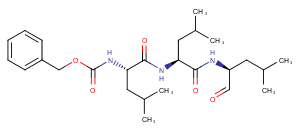
MG-132

CAS号

133407-82-6

分子式

C26H41N3O5

主要靶点

Proteasome|Apoptosis|Autophagy

仅限科研使用

Cat No : CM00367

Print datasheet

Synonyms

Apoptosis|aldehyde|20S proteasome|26S|complex|calpain|Autophagy|peptide|Proteasome|proteolytic|MG132|MG-132|MG 132|Inhibitor|inhibit|Z-LLL-al|Z-Leu-Leu-Leu-CHO


产品信息

CAS号 133407-82-6
分子式 C26H41N3O5
主要靶点 Proteasome|Apoptosis|Autophagy
主要通路 泛素化|蛋白酶体|凋亡|自噬
分子量 475.62
纯度 99.99%, 此纯度可做参考,具体纯度与批次有关系,可咨询客服
储存条件 store at low temperature | Powder: -20°C for 3 years | In solvent: -80°C for 1 year | Shipping with blue ice.
别名 Apoptosis|aldehyde|20S proteasome|26S|complex|calpain|Autophagy|peptide|Proteasome|proteolytic|MG132|MG-132|MG 132|Inhibitor|inhibit|Z-LLL-al|Z-Leu-Leu-Leu-CHO

靶点活性

20S proteasome:100 nM (cell free)|Calpain:1.2 μM (cell free)

体内活性

方法:为检测体内抗肿瘤活性,将 MG-132 (1 mg/kg) 静脉注射给携带人宫颈癌肿瘤 HeLa、CaSki 或 C33A 的 C.B‐17/lcr‐scid/scidJcl 小鼠,每周两次,持续四周。 结果:MG-132 治疗显著抑制人宫颈癌肿瘤的生长,表明在体内具有抗肿瘤活性。[4] 方法:为研究 MG-132 长期治疗对心肌肥大的影响及其相关分子机制,将 MG-132 (0.1 mg/kg) 腹腔注射给具有腹主动脉束带(AAB)的大鼠,每天一次,持续八周。 结果:MG-132 治疗显著减弱了 AAB 大鼠的左心室肌细胞面积、左心室重量/体重和肺重量/体重比,降低了左心室舒张直径和壁厚,并增加了缩短分数。MG-132 治疗可显著逆转 AAB 大鼠 ERK1/2 和 JNK1 磷酸化水平的升高。[5]

体外活性

方法:人宫颈癌细胞 HeLa 用 MG-132 (0.5-30 μM) 处理 24 h,使用 MTT 方法检测细胞生长抑制情况。 结果:MG-132 剂量依赖性地抑制 HeLa 细胞生长,IC50 约为 5 μM。[1] 方法:人间皮瘤细胞 NCI-H2452 用 MG-132 (0.25-2 μM) 处理 36 h,使用 Western Blot 方法检测靶点蛋白表达水平。 结果:MG-132 处理诱导 NCI-H2052 细胞中 caspases 3、caspases 7、Bid 和 PARP 的切割,诱导 caspase 依赖性凋亡。[2] 方法:人类黑色素瘤细胞 MeWo 用 MG-132 (0.01-1 μM) 处理 24 h,使用 Flow Cytometry 方法分析细胞周期情况。 结果:MG-132 诱导 MeWo 细胞的细胞周期阻滞在 G2 期。[3]

溶解度

Ethanol:47.5 mg/mL (99.87 mM); DMSO:45 mg/mL (94.61 mM); H2O:Insoluble;

细胞实验

The effect of MG132 on HeLa cell growth was determined by trypan blue exclusion cell counting or measuring MTT dye absorbance of living cells as previously described. In brief, cells (5x10^5 cells per well) were seeded in 24-well plates for cell counting, and cells (5x10^4 cells per well) were seeded in 96-well microtiter plates for the MTT assay. After exposure to indicated amounts of MG132 for 24 h, cells in 24-well plates or 96-well plates were collected with trypsin digestion for trypan blue exclusion cell counting or were used for the MTT assay. Twenty microliters of MTT solution (2 mg/ml in PBS) was added to each well of 96-well plates. The plates were again incubated for 4 h at 37?C. MTT solution in the medium was aspirated off and 200 μl of DMSO was added to each well to solubilize the formazan crystals formed in viable cells. Optical density was measured at 570 nm using a microplate reader. Each plate contained multiple wells at a given experimental condition and multiple control wells. This procedure was replicated for 2-4 plates per condition [3].

动物实验

Male Sprague–Dawley rats (8 weeks old, 180 – 230 g) were used to establish a pressure-overload model as described previously. All animals were separated into four groups (10 rats per group): (i) vehicle-treated sham group; (ii) MG132-treated sham group; (iii) vehicle-treated abdominal aortic banding (AAB) group; and (iv) MG132-treated AAB group. Under intraperitoneal pentobarbital (50 mg/kg) anesthesia, AAB was created using a 5-0 suture tied twice around the abdominal aorta in which. a 21-gauge needle was inserted. The needle was then retracted yielding a 70 – 80% constriction with an outer aortic diameter of 0.8 mm. In the sham surgery rats, the same surgery was performed as described above except the aorta was constricted. At Day 3 after the surgery, MG132-treated rats were intraperitoneally injected with 0.1 mg/kg/day of MG132 for 8 weeks. All control animals were injected with a corresponding volume of vehicle only (0.1% DMSO) [4]. Sixteen-week-old male CD1 mice were used for all our experiments. Thirty minutes before the immobilization procedure, 0.1 mg/kg of buprenorphine was administrated IP. The mice were then anesthetized using isoflurane. The right hindlimb was immobilized as previously described. Briefly, the hindlimb was immobilized 7 days by stapling the foot exploiting normal dorso-tibial flexion using an Autosuture Royal 35W skin stapler. One tine was inserted close to the toe at the plantar portion of the foot while the other was inserted in the distal portion of the gastrocnemius. The other hindlimb was used as a control. During the immobilization period, the mice were injected subcutaneously with MG132 (7.5 mg/kg/dose) or vehicle (DMSO) twice daily. DMSO containing or not MG132 was diluted in sterile pure corn oil (1:100, injected volume 150 μL). After 7 days, the tibialis anterior (TA) muscles of immobilized and non-i

参考文献

1.Han YH, et al. The effect of MG132, a proteasome inhibitor on HeLa cells in relation to cell growth, reactive oxygen species and GSH. Oncol Rep. 2009 Jul;22(1):215-21.
2.Yuan BZ, et al. Proteasome Inhibitor MG132 Induces Apoptosis and Inhibits Invasion of Human Malignant Pleural Mesothelioma Cells. Transl Oncol. 2008 Sep;1(3):129-40.
3.Braun HA, et al. Tripeptide mimetics inhibit the 20 S proteasome by covalent bonding to the active threonines. J Biol Chem. 2005 Aug 5;280(31):28394-401.
4.Matsumoto Y, et al. Enhanced efficacy against cervical carcinomas through polymeric micelles physically incorporating the proteasome inhibitor MG132. Cancer Sci. 2016 Jun;107(6):773-81.
5.Chen B, et al. MG132, a proteasome inhibitor, attenuates pressure-overload-induced cardiac hypertrophy in rats by modulation of mitogen-activated protein kinase signals. Acta Biochim Biophys Sin (Shanghai). 2010 Apr;42(4):253-8.
6.Caron AZ, et al. The proteasome inhibitor MG132 reduces immobilization-induced skeletal muscle atrophy in mice. BMC Musculoskelet Disord. 2011 Aug 15;12:185.
7.Tsubuki S, et al. Differential inhibition of calpain and proteasome activities by peptidyl aldehydes of di-leucine and tri-leucine. J Biochem. 1996 Mar;119(3):572-6.
8.Guzmán-Téllez P, Martínez-Valencia D, Silva-Olivares A, et al. Naegleria fowleri and Naegleria gruberi 20S proteasome: identification and characterization[J]. European Journal of Cell Biology. 2020: 151085

The molarity calculator equation

Mass (g) = Concentration (mol/L) × Volume (L) × Molecular Weight (g/mol)

质量   浓度   体积   分子量 *
=
×
×

The dilution calculator equation

Concentration (start) × Volume (start) = Concentration (final) × Volume (final)
This equation is commonly abbreviated as: C1V1 = C2V2

浓度 (start) × 体积 (start) = 浓度 (final) × 体积 (final)
×
=
×
C1   V1   C2   V2
||
New chat

Able

正在加载,请稍候...