Use Able AI chat for product recommendations

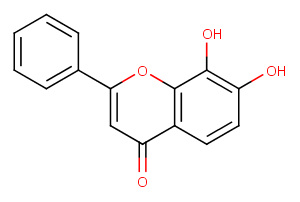
7,8-Dihydroxyflavone

CAS号

38183-03-8

分子式

C15H10O4

主要靶点

Apoptosis|Trk receptor

仅限科研使用

Cat No : CM00048

Print datasheet

Synonyms

7,8Dihydroxyflavone|7,8-Dihydroxyflavone|7,8 Dihydroxyflavone|7,8-DHF|Apoptosis|TrkB|Trkreceptor|Trk Receptor|Trk receptor|Tropomyosin related kinase receptor|二羟基黄酮水合物|Inhibitor|inhibit


产品信息

CAS号 38183-03-8
分子式 C15H10O4
主要靶点 Apoptosis|Trk receptor
主要通路 凋亡|蛋白酪氨酸激酶
分子量 254.24
纯度 99.47%, 此纯度可做参考,具体纯度与批次有关系,可咨询客服
储存条件 Powder: -20°C for 3 years | In solvent: -80°C for 1 year | Shipping with blue ice.
别名 7,8Dihydroxyflavone|7,8-Dihydroxyflavone|7,8 Dihydroxyflavone|7,8-DHF|Apoptosis|TrkB|Trkreceptor|Trk Receptor|Trk receptor|Tropomyosin related kinase receptor|二羟基黄酮水合物|Inhibitor|inhibit

靶点活性

TrkB receptor:320 nM(Kd)

体内活性

7,8-Dihydroxyflavone是一种具有生物活性的化学物质,能够通过血脑屏障(BBB)影响小鼠大脑中TrkB及其下游的PI3K/Akt和MAPK激活,通过腹腔或口服给药方式实现。7,8-DHF在创伤性脑损伤的皮质神经元中促进存活,减少凋亡,7,8-DHF在伤后3小时给药可以通过PI3K/Akt途径减少脑组织损伤。其治疗未引起小鼠明显的毒性反应,在慢性治疗期间对小鼠无毒性。7,8-DHF在治疗阿尔茨海默病方面显示出强大的疗效,并通过激活肌肉中的TrkB[1]抑制肥胖。

体外活性

7,8-DHF是一种特异性激活TrkB的正向化合物,不激活TrkA或TrkC,浓度为250 nM。除了皮质和海马神经元外,7,8-DHF还保护包括RGC(视网膜神经节细胞)和PC12细胞在内的其他细胞类型,使其免受兴奋毒性和氧化应激诱导的凋亡和细胞死亡。因此,它具有神经保护特性[1]。

溶解度

H2O:< 1 mg/mL (insoluble or slightly soluble);DMSO:45 mg/mL (177 mM);Ethanol:1 mg/mL (3.93 mM)

细胞实验

PC12 cells are seeded in 96-well plates at 104/well. After pretreatment with 7,8-DHF (1-25 μM) for 1 h, the cells are exposed to 6-OHDA (100 μM) for subsequent 24 h. The PI3k inhibitor LY294002 or MEK inhibitor PD98059 is added 30 min before 7,8-DHF treatment. At the end of the experiment, PC12 cells are incubated with 20 μl of MTT solution (5 mg/ml in PBS) for 4 h at 37 ?C. The dark blue formazan product due to the reduction of MTT is dissolved in 150 μl of DMSO, and the absorbance at 570 nm is recorded with a microplate reader. The viability is expressed as the percentage of the untreated control cells. (Only for Reference)

参考文献

1.Liu C, et al. Transl Neurodegener. 2016, 5:2.
2.Bollen E, et al. Behav Brain Res. 2013, 257:8-12.
3.Han XH, et al. Neurosci Lett. 2014, 581:85-8.

The molarity calculator equation

Mass (g) = Concentration (mol/L) × Volume (L) × Molecular Weight (g/mol)

质量   浓度   体积   分子量 *
=
×
×

The dilution calculator equation

Concentration (start) × Volume (start) = Concentration (final) × Volume (final)
This equation is commonly abbreviated as: C1V1 = C2V2

浓度 (start) × 体积 (start) = 浓度 (final) × 体积 (final)
×
=
×
C1   V1   C2   V2
||
New chat

Able

正在加载,请稍候...