Recombinant Human KIM-1/HAVCR1 protein (rFc Tag)
种属
Human
纯度
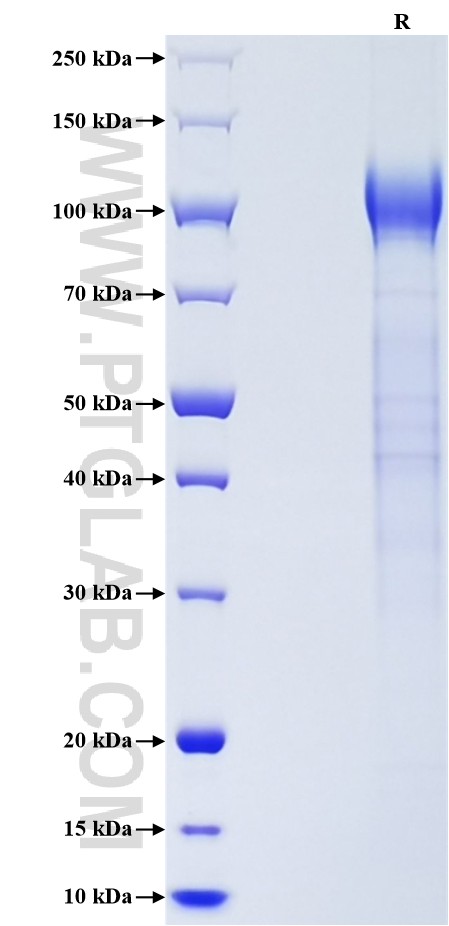
>80 %, SDS-PAGE
标签
rFc Tag
生物活性
未测试
验证数据展示
产品信息
| 纯度 | >80 %, SDS-PAGE |
| 内毒素 | <0.1 EU/μg protein, LAL method |
| 生物活性 |
Not tested |
| 来源 | HEK293-derived Human KIM-1 protein Ser21-Gly295 (Accession# Q96D42) with a rabbit IgG Fc tag at the C-terminus. |
| 基因ID | 26762 |
| 蛋白编号 | Q96D42 |
| 预测分子量 | 55.8 kDa |
| SDS-PAGE | 90-120 kDa, reducing (R) conditions |
| 组分 | Lyophilized from 0.22 μm filtered solution in 30 mM Tris, 0.5 M Arg, pH 8.0. Normally 5% trehalose and 5% mannitol are added as protectants before lyophilization. |
| 复溶 | Briefly centrifuge the tube before opening. Reconstitute at 0.1-0.5 mg/mL in sterile water. |
| 储存条件 |
It is recommended that the protein be aliquoted for optimal storage. Avoid repeated freeze-thaw cycles.
|
| 运输条件 | The product is shipped at ambient temperature. Upon receipt, store it immediately at the recommended temperature. |
背景信息
Kidney injury molecule 1 (KIM-1), also known as Hepatitis A virus cellular receptor 1 (HAVCR1), CD365, or T-cell immunoglobulin and mucin domain 1 (TIM-1), is a class I integral membrane glycoprotein, with an ectodomain containing Ig-like domain and a mucin domain. KIM-1 acts as a membrane receptor for hepatitis A virus (HAV). KIM-1 provides a costimulatory signal for T cell activation and inhibits the development of peripheral tolerance. KIM-1 may be involved in the regulation of asthma and allergic diseases. It has been reported that KIM-1 is shed into urine after acute kidney damage and is a marker of renal tubular injury.
参考文献:
1. G Kaplan, et al. (1996) Comparative Study EMBO J. 15(16):4282-96.
2. D Feigelstock, et al. (1998) J Virol. 72(8):6621-8.
3. Jennifer J McIntire, et al. (2003) Nature. 425(6958):576.
4. Takaharu Ichimura, et al. (2003) Am J Physiol Renal Physiol. 286(3):F552-63.
5. Anjali J de Souza, et al. (2005) Proc Natl Acad Sci U S A. 102(47):17113-8.
6. Sarah E Umetsu, et al. (2005) Nat Immunol. 6(5):447-54.