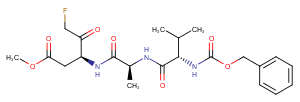
1.Shimizu T, et al. Camptothecin-induced apoptosis in p53-null human leukemia HL60 cells and their isolated nuclei: effects of the protease inhibitors Z-VAD-fmk and dichloroisocoumarin suggest an involvement of both caspases and serine proteases. Leukemia. 1997 Aug;11(8):1238-44.
2.Wang S, Li F, Qiao R, et al. Arginine-Rich Manganese Silicate Nanobubbles as a Ferroptosis-Inducing Agent for Tumor-Targeted Theranostics[J]. ACS nano. 2018 Dec 26;12(12):12380-12392.
3.Davies CW, et al. The co-crystal structure of ubiquitin carboxy-terminal hydrolase L1 (UCHL1) with a tripeptide fluoromethyl ketone (Z-VAE(OMe)-FMK). Bioorg Med Chem Lett. 2012 Jun 15;22(12):3900-4.
4.Jantalika T, et al. Human chorion-derived mesenchymal stem cells suppress JAK2/STAT3 signaling and induce apoptosis of cholangiocarcinoma cell lines. Sci Rep. 2022 Jul 5;12(1):11341.
5.Castrogiovanni C, et al. Decrease of mitochondrial p53 during late apoptosis is linked to its dephosphorylation on serine 20. Cancer Biol Ther. 2015;16(9):1296-307.
6.Equils O, et al. Pretreatment with pancaspase inhibitor (Z-VAD-FMK) delays but does not prevent intraperitoneal heat-killed group B Streptococcus-induced preterm delivery in a pregnant mouse model. Infect Dis Obstet Gynecol. 2009;2009:749432.
7.Kawasaki M, et al. Protection from lethal apoptosis in lipopolysaccharide-induced acute lung injury in mice by a caspase inhibitor. Am J Pathol. 2000 Aug;157(2):597-603.
8.Lu Z, Zhang G, Zhang Y, et al. Isoalantolactone induces apoptosis through reactive oxygen species-dependent upregulation of death receptor 5 in human esophageal cancer cells[J]. Toxicology and applied pharmacology. 2018, 352: 46-58.
9.Shao C S, Zhou X H, Zheng X X, et al. Ganoderic acid D induces synergistic autophagic cell death except for apoptosis in ESCC cells[J]. Journal of Ethnopharmacology. 2020, 262: 113213.
10.Wu X, Luo Q, Zhao P, et al. JOSD1 inhibits mitochondrial apoptotic signalling to drive acquired chemoresistance in gynaecological cancer by stabilizing MCL1[J]. Cell Death & Differentiation. 2020, 27(1): 55-70.
11.Zhu Q, Ding L, Zi Z, et al. Viral-Mediated AURKB Cleavage Promotes Cell Segregation and Tumorigenesis[J]. Cell reports. 2019 Mar 26;26(13):3657-3671.e5.