Recombinant Human LILRA3 protein (rFc Tag)
种属
Human
纯度
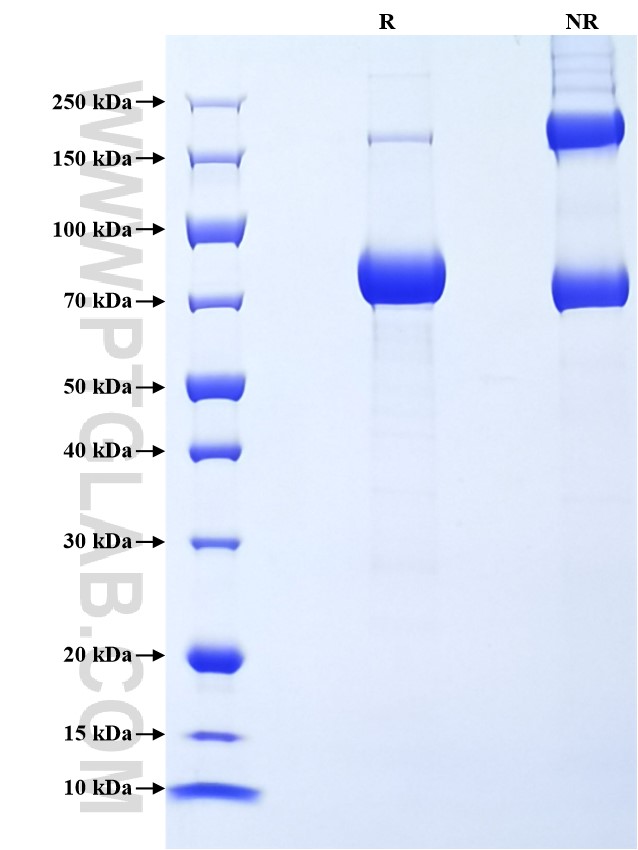
>90 %, SDS-PAGE
标签
rFc Tag
生物活性
未测试
验证数据展示
产品信息
| 纯度 | >90 %, SDS-PAGE |
| 内毒素 | <0.1 EU/μg protein, LAL method |
| 生物活性 |
Not tested |
| 来源 | HEK293-derived Human LILRA3 protein Gly24-Glu439 (Accession# Q8N6C8-1) with a rabbit IgG Fc tag at the C-terminus. |
| 基因ID | 11026 |
| 蛋白编号 | Q8N6C8-1 |
| 预测分子量 | 71.0 kDa |
| SDS-PAGE | 70-90 kDa, reducing (R) conditions |
| 组分 | Lyophilized from 0.22 μm filtered solution in PBS, pH 7.4. Normally 5% trehalose and 5% mannitol are added as protectants before lyophilization. |
| 复溶 | Briefly centrifuge the tube before opening. Reconstitute at 0.1-0.5 mg/mL in sterile water. |
| 储存条件 |
It is recommended that the protein be aliquoted for optimal storage. Avoid repeated freeze-thaw cycles.
|
| 运输条件 | The product is shipped at ambient temperature. Upon receipt, store it immediately at the recommended temperature. |
背景信息
LILRA3 (Leukocyte Immunoglobulin Like Receptor A3) is a member of the human leukocyte immunoglobulin-like receptor family and is the only soluble receptor in this group, also known as CD85e, ILT6, or LIR-4. LILRA3 is produced as a soluble molecule by monocytes and macrophages and exhibits the presence or absence of a 6.7 kb variant between individuals. LILRA3 is produced by monocytes and macrophages as a soluble molecule, and exhibits the presence or absence of a 6.7 kb variant between individuals. the 6.7 kb deletion consists of the first six of a total of seven exons and removes all four Ig-like structural domains, resulting in a truncated protein. lILRA3 has been implicated as a novel susceptibility factor for systemic lupus erythematosus (SLE) and primary desiccation syndrome (pSS). variants of the lILRA3 gene have been associated with increased susceptibility to autoimmune diseases, including prophylactic lupus. increased susceptibility, including primary Sjogren's syndrome (SS) and non-Hodgkin's B-cell lymphoma (B-NHL).
参考文献:
1. Wu X, et al. (2021). Iran J Basic Med Sci. 24(2):196-202.
2. Liu H, et al. (2022). Rheumatology (Oxford). 8;61(12):4962-4974.
3. Ryu M, et al. (2011). PLoS One. 6(4):e19245.
4. Wang H, et al. (2019). Front Genet. 10:869.