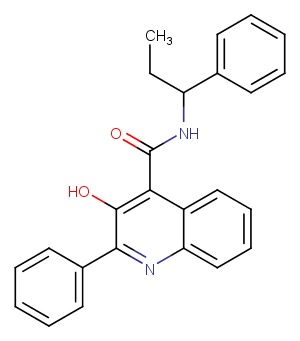
Talnetant

CAS号

174636-32-9

分子式

C25H22N2O2

主要靶点

Neurokinin receptor

仅限科研使用

Cat No : CM05281

Print datasheet

Synonyms

Inhibitor|inhibit|NK receptor|NK3|NK3 receptor|Neurokininreceptor|Neurokinin Receptor|Neurokinin receptor|schizophrenia|SB 223412|SB223412|SB-223412|Tachykinin receptor|Talnetant|hNK-2


产品信息

CAS号 174636-32-9
分子式 C25H22N2O2
主要靶点 Neurokinin receptor
主要通路 G 蛋白偶联受体|神经科学
分子量 382.45
纯度 ≥95%, 此纯度可做参考,具体纯度与批次有关系,可咨询客服
储存条件 Powder: -20°C for 3 years | In solvent: -80°C for 1 year | Shipping with blue ice.
别名 Inhibitor|inhibit|NK receptor|NK3|NK3 receptor|Neurokininreceptor|Neurokinin Receptor|Neurokinin receptor|schizophrenia|SB 223412|SB223412|SB-223412|Tachykinin receptor|Talnetant|hNK-2

靶点活性

NK-3-CHO cells (human):1.4 nM(ki)

体内活性

Talnetant 在人类重组受体上竞争性拮抗神经激肽B(NKB)诱导的反应,展现于钙离子和磷酸肌醇二级信使测定系统中(pA2分别为8.1和7.7)。在豚鼠脑切片中,talnetant拮抗了NKB在内侧缰核诱导的神经元放电增加(pKB=7.9),以及senktide在黑质紧凑部诱导的神经元放电增加(pKB=7.7),且未减少最大激动剂的效能,提示其在NK3受体上表现出竞争性拮抗作用。Talnetant(3-30 mg/kg, i.p.)在豚鼠中以剂量依赖性方式显著减轻了senktide诱导的“湿狗抖动”行为。微透析研究显示,talnetant的急性给药(30 mg/kg, i.p.)在自由移动的豚鼠中显著增加了内侧前额叶皮层中的外细胞多巴胺和去甲肾上腺素水平,并减轻了氟哌啉醇诱导的伏隔核多巴胺水平增加。

溶解度

DMSO:100 mg/mL (261.47 mM)

参考文献

1.Dawson L A , Cato K J , Scott C , et al. In Vitro and In Vivo Characterization of the Non-peptide NK3 Receptor Antagonist SB-223412 (Talnetant): Potential Therapeutic Utility in the Treatment of Schizophrenia[J]. Neuropsychopharmacology, 2008, 33(7):1642-1652.
2.Giuseppe A. M. Giardina,,?, Luca F. Raveglia,?, Mario Grugni,?, et al. Discovery of a novel class of selective non-peptide antagonists for the human neurokinin-3 receptor. 2. Identification of (S)-N-(1-phenylpropyl)-3-hydroxy-2-phenylquinoline-4-carboxamide (SB 223412).[J]. Journal of Medicinal Chemistry, 1999, 42(6):1053-1065.

The molarity calculator equation

Mass (g) = Concentration (mol/L) × Volume (L) × Molecular Weight (g/mol)

质量   浓度   体积   分子量 *
=
×
×

The dilution calculator equation

Concentration (start) × Volume (start) = Concentration (final) × Volume (final)
This equation is commonly abbreviated as: C1V1 = C2V2

浓度 (start) × 体积 (start) = 浓度 (final) × 体积 (final)
×
=
×
C1   V1   C2   V2