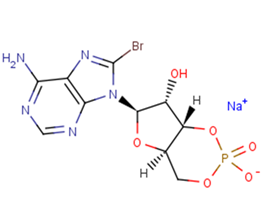
8-Bromo-cAMP sodium salt

CAS号

76939-46-3

分子式

C10H10BrN5NaO6P

主要靶点

PKA

仅限科研使用

Cat No : CM06003

Print datasheet

Synonyms

PKA|8-溴腺苷-3',5'-环单磷酸钠|8-Br-Camp sodium|8-Br-Camp sodium salt|8-Bromo-cAMP sodium|8BromocAMP sodium salt|8-Bromo-cAMP(sodium salt)|8 Bromo cAMP sodium salt


产品信息

CAS号 76939-46-3
分子式 C10H10BrN5NaO6P
主要靶点 PKA
主要通路 蛋白酪氨酸激酶
分子量 430.08
纯度 99.94%, 此纯度可做参考,具体纯度与批次有关系,可咨询客服
储存条件 Powder: -20°C for 3 years | In solvent: -80°C for 1 year | Shipping with blue ice.
别名 PKA|8-溴腺苷-3',5'-环单磷酸钠|8-Br-Camp sodium|8-Br-Camp sodium salt|8-Bromo-cAMP sodium|8BromocAMP sodium salt|8-Bromo-cAMP(sodium salt)|8 Bromo cAMP sodium salt

靶点活性

PKA:0.05 μM(Ka)

体内活性

方法:为评估 cAMP/PCA 对 CRC 细胞血管生成和 VM 的影响,将 8-Bromo-cAMP sodium salt (60 mg/kg) 腹腔注射给携带 CT26 肿瘤组织的 BALB/c 小鼠,每天一次,持续七天。 结果:8-Bromo-cAMP 治疗显著减少了肿瘤数量。8-Bromo-cAMP 治疗可抑制血管生成和 VM。8-Bromo-cAMP 在 CRC 中通过 cAMP/PKA-ERK 途径和 EMT 过程发挥作用。[3]

体外活性

方法:内皮细胞 HUVECs 用 8-Bromo-cAMP sodium salt (100 μM) 处理 3 h,使用 Boyden Chamber assay 检测细胞迁移。 结果:当用 8-Bromo-cAMP 暴露的 MC3T3-E1 细胞条件培养基补充 HUVECs 时,观察到细胞迁移增加。相反,来自对照未处理细胞的条件培养基缺乏这种活性。[1] 方法:白血病细胞系 AML193 用 8-Bromo-cAMP sodium salt (1 mM) 或 IL-3 (500 ng/mL) 处理 1-15 min,使用 Western Blot 检测靶点蛋白表达水平。 结果:在生长停滞的 AML193 细胞中,IL-3 对 Erk1,2 磷酸化的最大影响是时间依赖性的,并且发生在添加生长因子后 5-15 min 的时间窗口内。8-Bromo-cAMP 也诱导这些细胞中 Erk1,2 的磷酸化,在 1-5 min 之间可观察到最大刺激。[2]

溶解度

H2O:80 mg/mL (186.01 mM);Ethanol:< 1 mg/mL (insoluble or slightly soluble);PBS:100 mg/mL (232.51 mM);DMSO:50 mg/mL (116.26 mM);5% DMSO+40% PEG300+5% Tween-80+50% ddH2O:0.624

参考文献

1.Lo KW, et al. One-day treatment of small molecule 8-bromo-cyclic AMP analogue induces cell-based VEGF production for in vitro angiogenesis and osteoblastic differentiation. J Tissue Eng Regen Med. 2016 Oct;10(10):867-875.
2.Barge RM, et al. 8-Bromo-cAMP induces a proliferative response in an IL-3 dependent leukemic cell line and activates Erk 1,2 via a Shc-independent pathway. Biochim Biophys Acta. 1997 Feb 4;1355(2):141-6.
3.Wang S, et al. Angiogenesis and vasculogenic mimicry are inhibited by 8-Br-cAMP through activation of the cAMP/PKA pathway in colorectal cancer. Onco Targets Ther. 2018 Jul 2;11:3765-3774.

The molarity calculator equation

Mass (g) = Concentration (mol/L) × Volume (L) × Molecular Weight (g/mol)

质量   浓度   体积   分子量 *
=
×
×

The dilution calculator equation

Concentration (start) × Volume (start) = Concentration (final) × Volume (final)
This equation is commonly abbreviated as: C1V1 = C2V2

浓度 (start) × 体积 (start) = 浓度 (final) × 体积 (final)
×
=
×
C1   V1   C2   V2