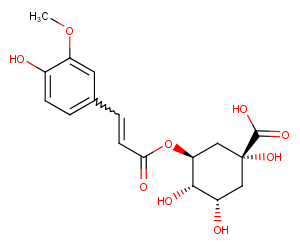
3-Feruloylquinic acid

CAS号

1899-29-2

分子式

C17H20O9

主要靶点

Antifection|Proteasome

仅限科研使用

Cat No : CM10506

Print datasheet

Synonyms

3 Feruloylquinic acid|3-O-Feruloylquinic acid|3Feruloylquinic acid|3-Feruloylquinic acid|3-O-阿魏酰奎尼酸|Antifection|Proteasome


产品信息

CAS号 1899-29-2
分子式 C17H20O9
主要靶点 Antifection|Proteasome
主要通路 微生物学|蛋白酶体|泛素化
分子量 368.34
纯度 97.83%, 此纯度可做参考,具体纯度与批次有关系,可咨询客服
储存条件 store at low temperature,keep away from direct sunlight | Powder: -20°C for 3 years | In solvent: -80°C for 1 year | Shipping with blue ice.
别名 3 Feruloylquinic acid|3-O-Feruloylquinic acid|3Feruloylquinic acid|3-Feruloylquinic acid|3-O-阿魏酰奎尼酸|Antifection|Proteasome

体外活性

Therefore, major CHAs were isolated from three major instant coffee brands, confirmed and quantified using HPLC and NMR spectroscopic methods. Then, their antioxidant activities and protective effects on H2O2-induced apoptosis in PC-12 cells were investigated using radical scavenging, mitochondrial membrane potential and caspase assays. In the coffee samples, three major CHAs (3-O-caffeoylquinic acid, 4-O-caffeoylquinic acid, 5-O-caffeoylquinic acid) and some minor CHAs (3-O-Feruloylquinic acid, 4-O-feruloylquinic acid, 5-O-feruloylquinic acid, 3,5-O-dicaffeoylquinic acid, 3,4-O-dicaffeoylquinic acid, and 4,5-O-dicaffeoylquinic acid) were detected. The three major CHAs were further isolated and their chemical structures were confirmed using NMR spectroscopic techniques. Also, the amounts of the three major CHAs were individually quantified using a HPLC method. At the concentration of 10 μM, all three major CHAs quenched DPPH and/or xanthine oxidase-generated radical species by 21-51% (P < 0.014). They also inhibited H2O2-induced mitochondrial membrane depolarization and caspase-9 activation by 27% (P < 0.034) and 50% (P < 0.05), respectively[1]

参考文献

1.Isolation and quantification of major chlorogenic acids in three major instant coffee brands and their potential effects on H2O2-induced mitochondrial membrane depolarization and apoptosis in PC-12 cells.Food Funct. 2013 Nov;4(11):1632-8.

The molarity calculator equation

Mass (g) = Concentration (mol/L) × Volume (L) × Molecular Weight (g/mol)

质量   浓度   体积   分子量 *
=
×
×

The dilution calculator equation

Concentration (start) × Volume (start) = Concentration (final) × Volume (final)
This equation is commonly abbreviated as: C1V1 = C2V2

浓度 (start) × 体积 (start) = 浓度 (final) × 体积 (final)
×
=
×
C1   V1   C2   V2