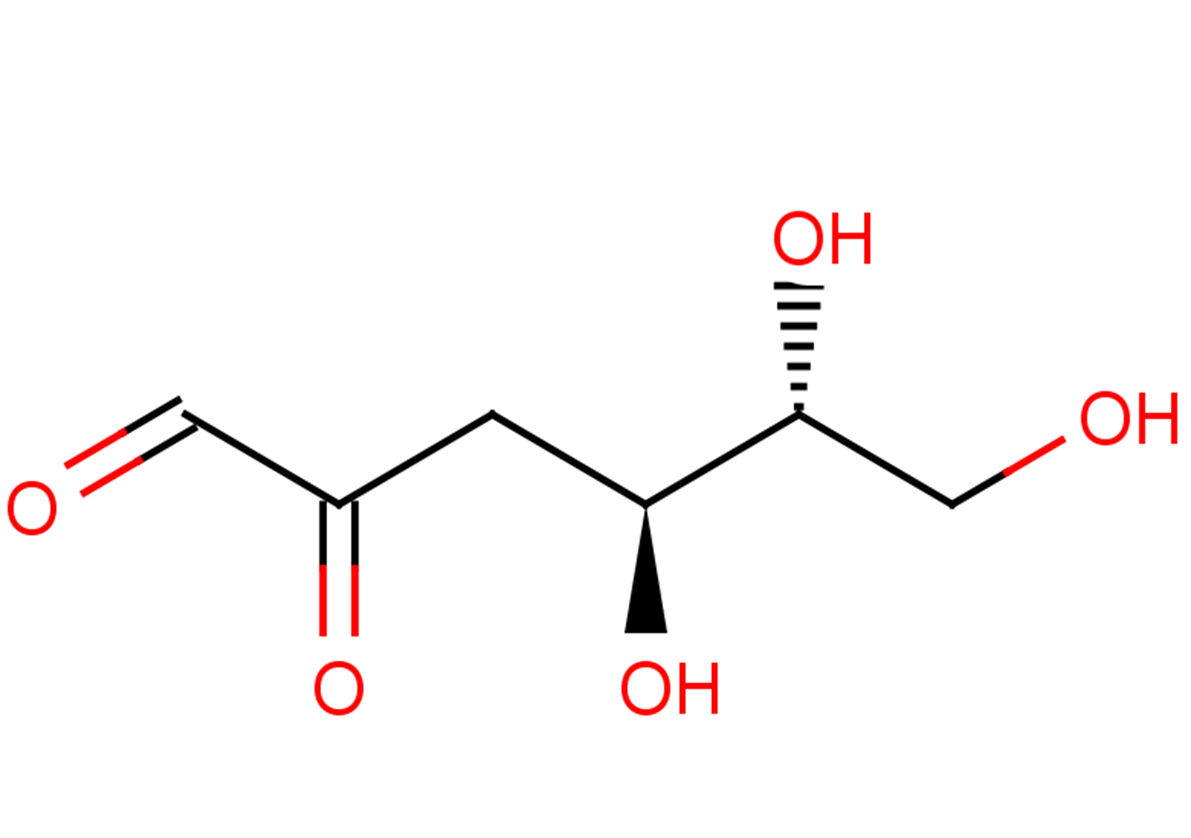
3-Deoxyglucosone

CAS号

4084-27-9

分子式

C6H10O5

主要靶点

Glucagon Receptor|GPX

仅限科研使用

Cat No : CM12608

Print datasheet

Synonyms

GlucagonReceptor|Glucagon Receptor|GLP Receptor|GPX|3-脱氧葡萄糖醛酮|3-Deoxy-D-glucosone|3-Deoxyglucosone|2-keto-3-Deoxyglucose


产品信息

CAS号 4084-27-9
分子式 C6H10O5
主要靶点 Glucagon Receptor|GPX
主要通路 氧化还原|G 蛋白偶联受体
分子量 162.14
纯度 95%, 此纯度可做参考,具体纯度与批次有关系,可咨询客服
储存条件 store at low temperature | Powder: -20°C for 3 years | In solvent: -80°C for 1 year | Shipping with blue ice.
别名 GlucagonReceptor|Glucagon Receptor|GLP Receptor|GPX|3-脱氧葡萄糖醛酮|3-Deoxy-D-glucosone|3-Deoxyglucosone|2-keto-3-Deoxyglucose

体内活性

3-Deoxyglucosone (20 mg/kg;经口投给;单剂量)会导致葡萄糖耐量变差,这一变化通过Area Under the Curve (AUC)的增加得到证实。血浆胰高血糖素水平没有显示出显著差异。3-Deoxyglucosone的投给导致了显著的糖调节受损(IGR),伴随着昆明鼠和SD大鼠胰岛细胞功能明显的失调。[2] 3-deoxyglucosone (5-50 mg/kg;经胃管灌注;每天一次;2周;SD大鼠)在上小肠(1.4倍)、下小肠(1.4倍)、回肠(1.4倍)和结肠(两倍)部位展示了与各自对照组基础水平相比的显著增加。此外,观察到十二指肠和结肠中TAS1R2、TAS1R3和TRPM5的蛋白表达显著减少。[3]

体外活性

3-Deoxyglucosone(80 ng/ml-1000 ng/ml;1小时;STC-1细胞)在300 ng/ml及1000 ng/ml的处理组中显著诱导GLP-1分泌增加1.23倍。然而,在80 ng/ml的较低浓度下,未观察到明显效应。值得注意的是,3-Deoxyglucosone在300 ng/ml的浓度显著提高了细胞内Ca2+水平,通过Fluo-3/AM(2.5 μM,30分钟)确定。相比之下,3DG不影响cAMP Elisa试验中的细胞内cAMP水平。此外,在300 ng/ml的浓度下,3-Deoxyglucosone显著增强了TAS1R2、TAS1R3和TRPM5的蛋白表达水平,无论是在无葡萄糖还是高葡萄糖条件下。

细胞实验

Cell Line: STC-1 cells. Concentration: 300?ng/ml. Incubation Time: 1 hour [1]

动物实验

Animal Model: SD rats. Dosage: 5, 20 and 50 mg/kg. Administration: oral administration; once daily; 2 weeks [3]

参考文献

1.Song X, et al. 3-Deoxyglucosone Induces Glucagon-Like Peptide-1 Secretion from STC-1 Cells via Upregulating Sweet Taste Receptor Expression under Basal Conditions.Int J Endocrinol.?2019?Oct 23;2019:4959646.
2.Wang F, et al. Acute Reduction of Incretin Effect and Glucose Intolerance in Rats by Single Intragastric Administration of 3-deoxyglucosone. Exp Clin Endocrinol Diabetes.?2017 Jan;125(1):4-11.
3.Zhang L, et al. Accumulation?of?intestinal?tissue?3-deoxyglucosone?attenuated?GLP-1?secretion?and its?insulinotropic?effect?in?rats. Diabetol Metab Syndr.?2016 Nov 29;8:78.
4.Niwa T, et al. 3-Deoxyglucosone: metabolism, analysis, biological activity, and clinical implication.J Chromatogr B Biomed Sci Appl.?1999 Aug 6;731(1):23-36.

The molarity calculator equation

Mass (g) = Concentration (mol/L) × Volume (L) × Molecular Weight (g/mol)

质量   浓度   体积   分子量 *
=
×
×

The dilution calculator equation

Concentration (start) × Volume (start) = Concentration (final) × Volume (final)
This equation is commonly abbreviated as: C1V1 = C2V2

浓度 (start) × 体积 (start) = 浓度 (final) × 体积 (final)
×
=
×
C1   V1   C2   V2